

Architecture MA (ARB/RIBA Part 2)
- Architecture and interiors
- Postgraduate
The Architecture MA at Kingston School of Art prepares you for a professional career in architecture, with a strong focus on climate-responsive, ethical and design-led practice. Accredited by the Architects Registration Board (ARB) and validated by the Royal Institute of British Architects (RIBA). Taught by award-winning practitioners from London and around the world, you’ll be part of a creative art school community, learning together in world-leading facilities.

Design innovative spaces and shape sustainable futures
Take the next step in your architecture journey and gain accreditation with Kingston School of Art.
Our Architecture MA qualification is accredited by the Architects Registration Board (ARB) and validated by the Royal Institute of British Architects (RIBA).
We are at the forefront of practice-led European architectural discourse. On the programme, you’ll engage in live design projects and explore contemporary themes such as climate literacy, ethical practice, and health and safety. Based at Kingston's vibrant Knights Park campus, you'll build upon your first degree, deepening your architectural knowledge and skills.
With hands-on opportunities and a research-driven approach, this course prepares you for a range of future careers in architectural practice, design, teaching and beyond. All contributing to the evolving landscape of architecture.
Student work

Unit 9: UltraTown
Joe Franklin, RIBA Silver Medal Winner

Unit 3: The Burren Environmental Facility
Elena Gauci

Unit 3: Enugu Art School
Finian Reece-Thomas

Unit 1: Birmingham Dance School Tectonic
Isabella Laffeaty

Unit 3: Enugu Art School
Finian Reece Thomas

Unit 5: Planometric Candle Factory Night Venue
Farah Anwar

Unit 4: Regents Canal Housing
Eliott Wells

Unit 6: Contemporary Classicism Collective Models

Unit 7: Mass and Air Tectonic Study Model
Jack Burns

Unit 3: Burren Environmental Facility
Elena Gauci

Unit 9: After London Device for Arrival
Ryan Stranger, AIA Winner

Unit 3: Wandsworth Gas Works
Will Pike, WCCA Transport Prize Winner

Unit 9: Assisted Succession
Josh Godley

Unit 9: UltraTown Striped Services
Joe Franklin, RIBA Silver Medal Winner

Unit 5: Temple Structure at KU Dorich House Museum

Unit 9: Landscape 1
Jacob Lee
Unit 9: Portrait 2
Jacob Lee

Unit 3: Embracing Tension Wandsworth Gasworks
Will Pike

Collage of Colonnade
Ana Rose Layosa

Unit 3: Manufactured Antiquities Smuggler's Wharf Follies of Waste
Sophie Hazeldine
Why choose this course
Accredited by the Architects Registration Board (ARB) and the Royal Institute of British Architects (RIBA), this course is designed to set you on a path for a successful career. Our course design employs a ground-breaking narrative structure and was commended on a series of counts by the Revalidation Panel in 2022.
You will learn from a diverse team of distinguished practitioners and academics. Design is taught through a unit system, with each unit led by prominent architects. While deeply grounded in architectural tradition, our units offer a variety of innovative and distinctive approaches. Notably, Unit 5 focuses on live community projects, involving full-scale building and making, while Unit 6 is home to Europe’s only Contemporary Classical Unit.
This course centres on the practice and theory, techniques and contexts of architectural design. It includes live making projects and engagement with practice and research. You will deepen and consolidate the knowledge, understanding and skills acquired during your first degree. Then a dissertation will give you the chance to investigate an area of interest in depth.
As part of the Architecture MA course, you’ll study themes such as anthropology, identity, memory and place. Other themes include care and repair, adaptive reuse, urban and ecological regeneration, and urgent societal concerns like housing provision and the exploration of new materials. This range of perspectives will help you to decide your chosen specialist area and pursue a career that matches your interests.
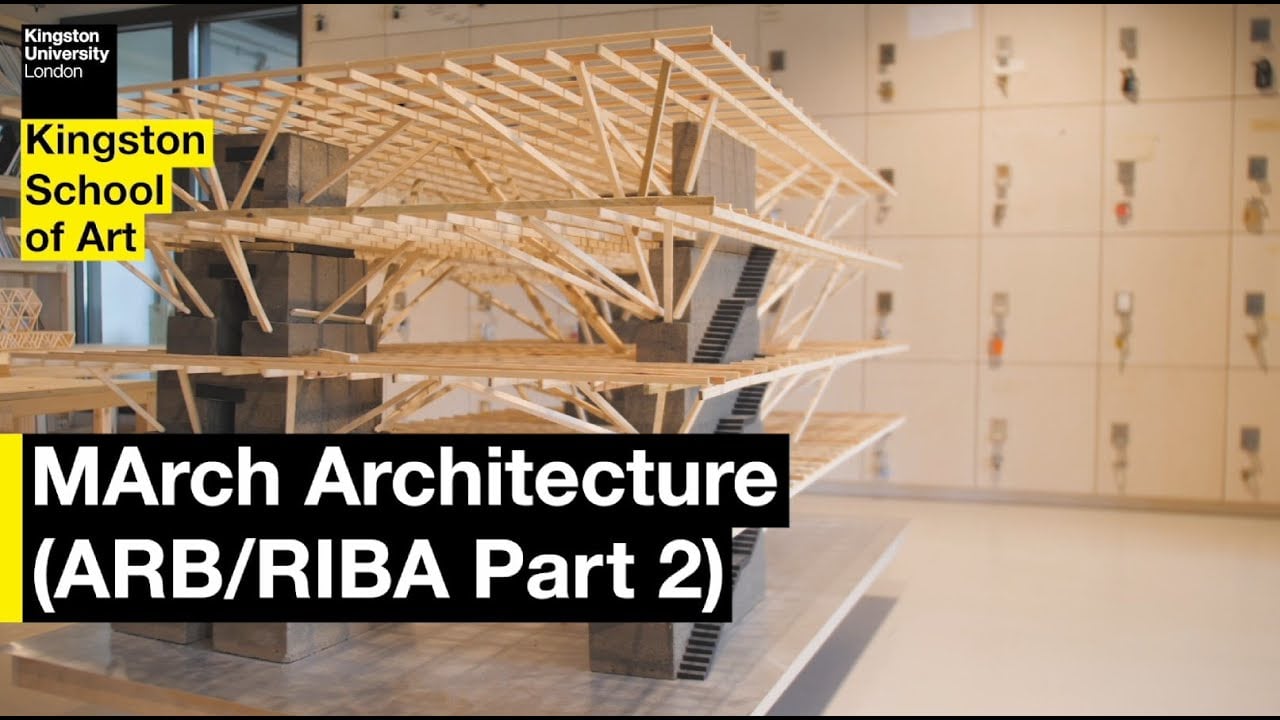
Inside architecture at Kingston University
What’s it really like to study architecture at Kingston University? Hear from our students and academics as they share their experiences and insights into the course, facilities and opportunities available to you.
Accreditations
This course is a prescribed qualification by the Architects Registration Board (ARB).
This course covers Royal Institute of British Architects (RIBA) criteria Part 2.


The Art School Experience
As part of Kingston School of Art, students benefit from joining a creative community where we encourage collaborative working and critical practice.
Our workshops and labs are open to all disciplines, enabling students and staff to work together, share ideas and explore multi-disciplinary making.

What you'll learn
During this two-year degree, you'll develop as an architectural designer and thinker and progress to engaging in architectural practice as an independent and reflective practitioner.
You'll be expected to build on the knowledge, understanding and skill acquired during your first degree and a recommended initial period of work-based learning.
The emphasis of this course is therefore to deepen and consolidate existing learning and skill from Years 1 to 3, rather than to introduce a wide range of new subject material.
The design studio aspect of the course is taught through studio units. You'll have the opportunity to enter a ballot for the unit of your choice at the beginning of each academic year. The subject focus of the units varies from year to year.
Year 4
The central focus of the course is design practice along with the theoretical, technical and contextual studies which underpin and inform design. You'll enjoy a practice-led teaching curriculum, commended by the RIBA visiting panel. Throughout the degree, you'll gain a comprehensive knowledge of the areas of study required to enter and contribute to architectural practice and architectural design.
You'll also be supported in identifying and developing your particular strengths and interests, alongside your studies in core subjects.
Core modules
Final year
Core modules
Alumni achievement
Graduate wins prestigious RIBA Silver Medal for Visionary Forest City
Graduate Joe Franklin, who completed his studies in Summer 2024, was honoured with the prestigious RIBA Silver Medal for architecture for his project that reimagined the abandoned HS2 site between Birmingham and Manchester as a forested new town.
Given for 188 years, the RIBA President's Medals recognise the world's best work by architecture students, selected by an international jury of architects, designers and artists.
Joe's project, Ultra Town, draws on his experience living in temporary, transient communities, utilising the history of woodland as a space for protest and counterculture to propose an ultra-urban condition that responds to the housing and ecological crises.
Read the full story of Joe's success

Career opportunities
Graduating from the Architecture MA at Kingston School of Art opens up a world of exciting possibilities and prepares you for ARB/RIBA Part 3. You'll not only be prepared for a range of professional opportunities, but you'll also contribute to a more sustainable, inclusive, and innovative architectural landscape.
After you graduate
Our graduates succeed in architectural practice, teaching, writing and associated construction and creative industries. They are highly sought after by prominent architectural practices in London, the UK and abroad.
Our department nurtures an active and supportive alumni network which is growing year on year.
Teaching and assessment
Fees and funding
Fees for future course years
This is a two-year full-time course.
Home students will be invoiced at the standard full-time undergraduate tuition fee rate for both years.
International students will pay the published annual fee for Years 1 and 2. If you take a break before starting your second year, or if you repeat modules from Year 1 in Year 2, the fee for your second year may increase.
Additional course costs
Some courses may require additional costs beyond tuition fees. When planning your studies, you’ll want to consider tuition fees, living costs, and any extra costs that might relate to your area of study.
Your tuition fees include costs for teaching, assessment and university facilities. So your access to libraries, shared IT resources and various student support services are all covered. Accommodation and general living expenses are not covered by these fees.
Where applicable, additional expenses for your course may include:
Funding support for postgraduate students
If you are a UK student living in England and under 60, you can apply for a loan to study for a postgraduate degree. Find out more through the government's website.

Scholarships and bursaries
Kingston School of Art offers a range of postgraduate scholarships, including:
Student work

Unit 1: Nicole Williams, 3D Reid Drawing Prize nominee

Unit 2: James Bearman, Jonathan Woolf Portfolio Prize

Unit 4: Figure/Ground
Image by Maria Kuosmanen
Unit 5: The Savage Mind
Image by Lucy Fincham

Unit 6: Modern Classicism
Image by Anthony Fitheoglou

Unit 7: Settlement
Image by Alex Wilson
Unit 9: Lydia Bagley, Construction School

Unit 2: Back to the Future
Image by Ivan Ginzberg

Unit 4: Column
Image by Sonal Bajaria

Unit 5: Civic Architecture in Tolworth
Image by Shadi Al-Beghain

Unit 6: Translation
Image by Michail Sarafidis

Unit 8: Palazzo Ridley Road
Image by Sam Punchard

Unit 2
Collage City (Rowe), Neue Staatsgallerrie (Stirling) and cupboard door (Asalache)

Unit 3: Structure and Light
Image by Hugh Strange

Unit 9: Thom Wood-Jones, RIBA Silver Medal nominee

How to apply
Before you apply
Please read the entry criteria carefully to make sure you meet all requirements before applying.
How to apply online
Use the course selector drop-down at the top of this page to choose your preferred course, start date and mode, then click 'Apply now'. You will be taken to our Online Student Information System (OSIS) where you will complete your application.
If you’re starting a new application, you’ll need to select ‘new user’ and set up a username and password. This will allow you to save and return to your application.
Application deadlines
We encourage you to apply as soon as possible. Applications will close when the course is full.
Course changes and regulations
The information on this page reflects the currently intended course structure and module details. To improve your student experience and the quality of your degree, we may review and change the material information of this course. Find out more about course changes
Programme Specifications for the course are published ahead of each academic year.
Regulations governing this course can be found on our website.


