Civil Engineering MSc
- Construction and surveying
- Postgraduate
Our Civil Engineering MSc is ideal if you are a graduate engineer starting your career in the construction industry.
Please note: this course was previously named Management in Construction (Civil Engineering) MSc. The delivery and content of the course remain the same.

Prepare for a successful career managing civil engineering contracts
Combine structural engineering with advanced construction management
At our Penrhyn Road campus, you will have access to a modern environment with the latest technology and industry-standard equipment, including:
- extensive materials and structures for concrete, masonry, steel and timber
- geotechnical and hydraulics testing facilities
- surveying equipment, such as satellite global-positioning systems
Dedicated computer-aided design facilities include:
- a range of CAD/CAM packages, such as Ideas, SolidWorks and AutoCad
- finite element analysis‚ computational fluid dynamics
- virtual instrumentation
You can use the dedicated Graduate Centre on campus. This includes:
- IT facilities
- seminar rooms
- social spaces and a canteen
- a learning resource centre with specialist libraries
Students studying this course will also benefit from the John Galsworthy Building. This is a £20 million teaching and learning facility which brings lecture theatres, flexible teaching space and information technology suites together around a landscaped courtyard.
This degree is accredited by the Joint Board of Moderators and by the Chartered Institute of Building. It also meets the requirements for Further Learning for a Chartered Engineer (CEng), if you already have an accredited CEng (Partial) BEng (Hons) or IEng (Full) BEng/BSc (Hons).
This course was originally designed to satisfy the Engineering Council's SARTOR 3 requirements. We have now developed it to appeal to students who do not require a Matching Section as well.
Why choose this course
This industry-accredited course offers a strategic overview of civil engineering and management issues. It addresses the challenges facing the construction industry and successfully combines structural engineering with advanced construction management.
This course will develop your professional, analytical and management skills, as well as improving your technical skills and knowledge. For example, you will gain communication, teamwork, IT and problem-solving skills.
Additionally, you will study subjects that are specific to civil engineering. In particular, a structural design module will broaden your technical knowledge of specialised civil engineering areas. This course also features an industrial project review and analysis module, which is designed to be taken in industry. This gives you the chance to address a real-world problem in an engineering environment.
Through a research thesis, you will be able to choose an area of specialisation. This can be an excellent selling point when looking for a job or promotion.
Throughout this, you will be supervised by a member of our research active academic staff. This ensures our staff are in touch with the latest industry thinking and bring best practice to your studies.
The research groups within the Sustainable Technology Research Centre cover a wide range of topics, including:
- land use
- building design and construction
- recycling waste materials
- efficient energy use and distribution
- water resources (hydraulics)
- monitoring using remote sensing

Further Learning Programme - MSc (non-technical)
This degree is accredited by the Joint Board of Moderators (JBM), which comprises the Institution of Civil Engineers, the Institution of Structural Engineers, Institute of Highway Engineers, the Chartered Institution of Highways and Transportation and the Permanent Way Institution on behalf of the Engineering Council, as meeting the requirements for Further Learning for a Chartered Engineer (CEng) for candidates who have already acquired a partial CEng accredited undergraduate first degree.
It should be noted that candidates completing the MSc who hold an underpinning accredited IEng degree or a non-accredited bachelor degree will need to apply for an academic assessment to determine whether they will meet the educational base for CEng registration.
See www.jbm.org.uk for further information
This course is accredited by the Chartered Institute of Building (CIOB).
Accreditation is a mark of assurance that the degree meets the standards set by the Engineering Council in the UK Standard for Professional Engineering Competence (UK-SPEC). Some employers recruit preferentially from accredited degrees, and an accredited degree is likely to be recognised by other countries that are signatories to international accords.
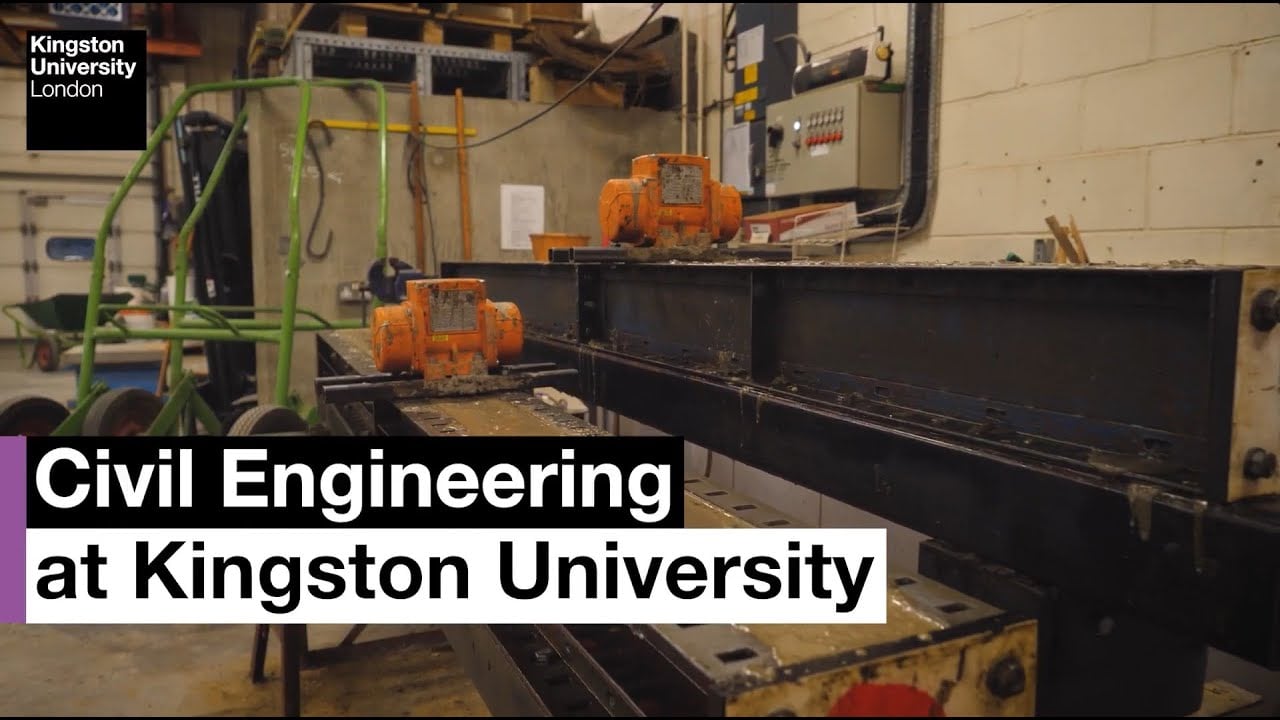
Civil engineering at Kingston University
Hear from our students and graduates as they share their experiences and insights on what it's like to study civil engineering at Kingston.
Course content
The modules on this course will give you an understanding of the core management skills needed to make a major contribution within the industry, and enable you to broaden and deepen your technical knowledge of specialised civil engineering areas. You will also cover subjects that are both specific and complementary to civil engineering. In addition, you will develop the ability to resolve the broader problems that arise in civil engineering.
For a student to go on placement they are required to pass every module first time with no reassessments. It is the responsibility of individual students to find a suitable paid placement. Students will be supported by our dedicated placement team in securing this opportunity.
Work placement scheme
Many postgraduate courses at Kingston University enable students to take the option of a 12-month work placement as part of their course. Although the University supports students in finding a placement and organises events to meet potential employers, the responsibility for finding the work placement is with the student; we cannot guarantee the placement, just the opportunity to undertake it. You may find securing a professional placement difficult as they are highly competitive and challenging, but they are also incredibly rewarding. It is very important to prepare and apply yourself if this is the route you wish to take. Employers look for great written and oral communication skills and an excellent CV/portfolio. As the work placement is an assessed part of the course, it is covered by a student's Student Route visa.
Find out more about the postgraduate work placement scheme.
Modules
Core modules
Professional placement

Career opportunities
Graduates from this course go on to roles such as construction manager, civil engineer, site engineer and sustainability consultant.
Careers and recruitment advice
The Faculty has a specialist employability team. It provides friendly and high-quality careers and recruitment guidance, including advice and sessions on job-seeking skills such as CV preparation, application forms and interview techniques. Specific advice is also available for international students about the UK job market and employers' expectations and requirements.
The team runs employer events throughout the year, including job fairs, key speakers from industry and interviews on campus. These events give you the opportunity to hear from, and network with, employers in an informal setting.
Work placement scheme
This course, like many postgraduate courses at Kingston University, enables students to integrate a 12-month work placement into their course. You are responsible for finding and securing your own professional placement, which can be highly competitive but also incredibly rewarding. It is very important to prepare yourself if this is the route you wish to take. Employers look for great written and oral communication skills and an excellent CV/portfolio. As the work placement is an assessed part of the course, it is covered by a Student Route visa.
Industrial partners
Our excellent industrial links have developed over many years and throughout many countries. Some industrial partners we have worked with in the past are:
- Matra-Marconi Space Ltd
- Ericsson
- Balfour Beatty
- The National Health Service
- British Gas
Our Industrial Advisory Committee reviews and advises industrial activities. The Committee acts as a forum for discussing teaching, research and consultancy to industry.
Teaching and assessment
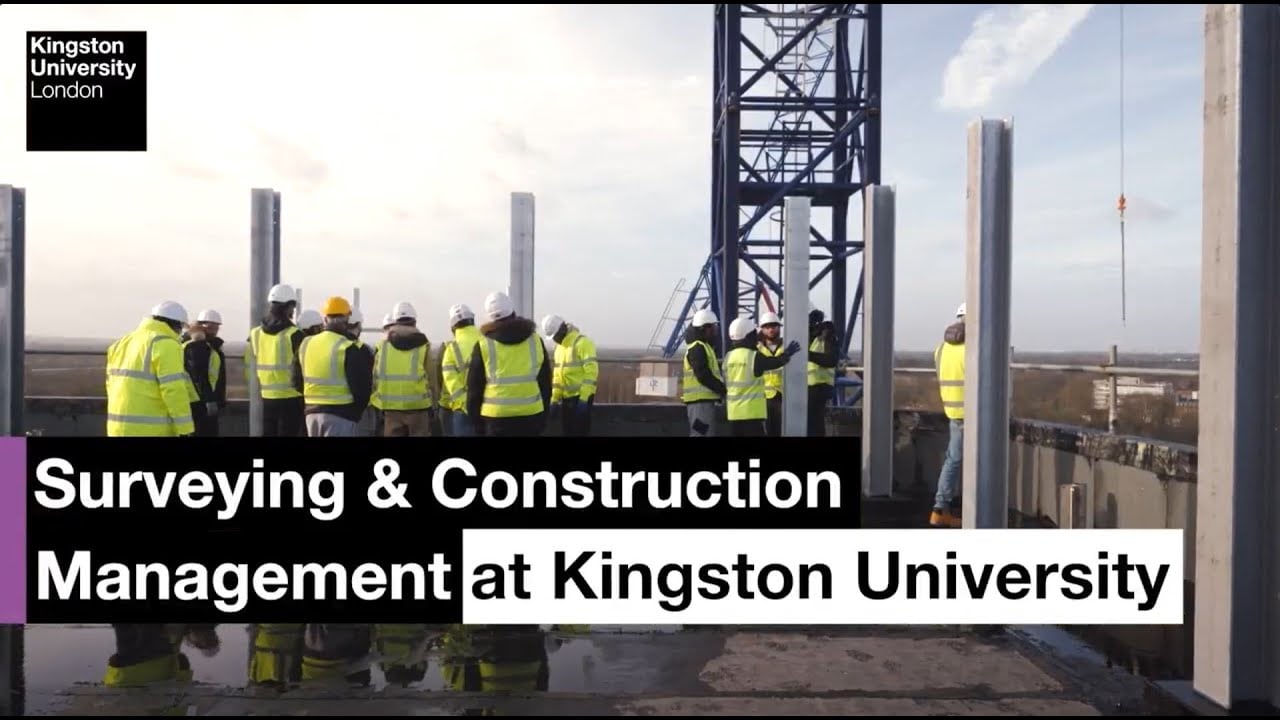
Surveying and construction management at Kingston University
Hear from current students and graduates as they share their experiences of studying surveying and construction management at Kingston University.
Fees and funding
Fees for future course years
Part time
If you start your second year straight after Year 1, you will pay the same fee for both years.
If you take a break before starting your second year, or if you repeat modules from Year 1 in Year 2, the fee for your second year may increase.
Funding support for postgraduate students
If you are a UK student living in England and under 60, you can apply for a loan to study for a postgraduate degree. Find out more through the government's website.

Scholarships and bursaries
For students interested in studying Civil Engineering MSc at Kingston, there are several opportunities to seek funding support:
Additional course costs
Some courses may require additional costs beyond tuition fees. When planning your studies, you’ll want to consider tuition fees, living costs, and any extra costs that might relate to your area of study.
Your tuition fees include costs for teaching, assessment and university facilities. So your access to libraries, shared IT resources and various student support services are all covered. Accommodation and general living expenses are not covered by these fees.
Where applicable, additional expenses for your course may include:

How to apply
Before you apply
Please read the entry criteria carefully to make sure you meet all requirements before applying.
How to apply online
Use the course selector drop-down at the top of this page to choose your preferred course, start date and mode, then click 'Apply now'. You will be taken to our Online Student Information System (OSIS) where you will complete your application.
If you’re starting a new application, you’ll need to select ‘new user’ and set up a username and password. This will allow you to save and return to your application.
Application deadlines
We encourage you to apply as soon as possible. Applications will close when the course is full.
Information required to confirm your place
If English is not your first language, we will require proof of your proficiency to allow us to confirm your place on the course. This will generally be either an IELTS or TOEFL test certificate, which can be forwarded to us after you have submitted your application. If you do not hold a formal English language qualification, please indicate how you have acquired your proficiency in written and spoken English.
After you have applied
If the postgraduate admissions tutor requires further information or wishes to invite you to interview, they will contact you directly. You will then hear whether your application has been successful.
If you do not clearly meet the standard entry requirements and the admission tutor wishes to see a portfolio from you, you will be sent an email asking you to upload your portfolio to your Kingston University OSIS account. Further details on how to do this will be provided at the time.
Course changes and regulations
The information on this page reflects the currently intended course structure and module details. To improve your student experience and the quality of your degree, we may review and change the material information of this course. Find out more about course changes
Programme Specifications for the course are published ahead of each academic year.
Regulations governing this course can be found on our website.