Environmental Management MSc
Subject and course type
- Environmental science and renewable energy
- Postgraduate
Turn your passion for the environment into a career with the Environmental Management MSc at Kingston University. This course is accredited by the Institute of Sustainability and Environmental Practitioners (ISEP).
This course benefits from our established active links with European and American universities, which ensure it is globally relevant. You will also have a wealth of field visit opportunities.

You are reading:
Find your place in the movement toward sustainable environmental management
Kingston is committed to becoming a sustainable enterprise. There are many opportunities to get involved in practical sustainability initiatives and authentic learning.
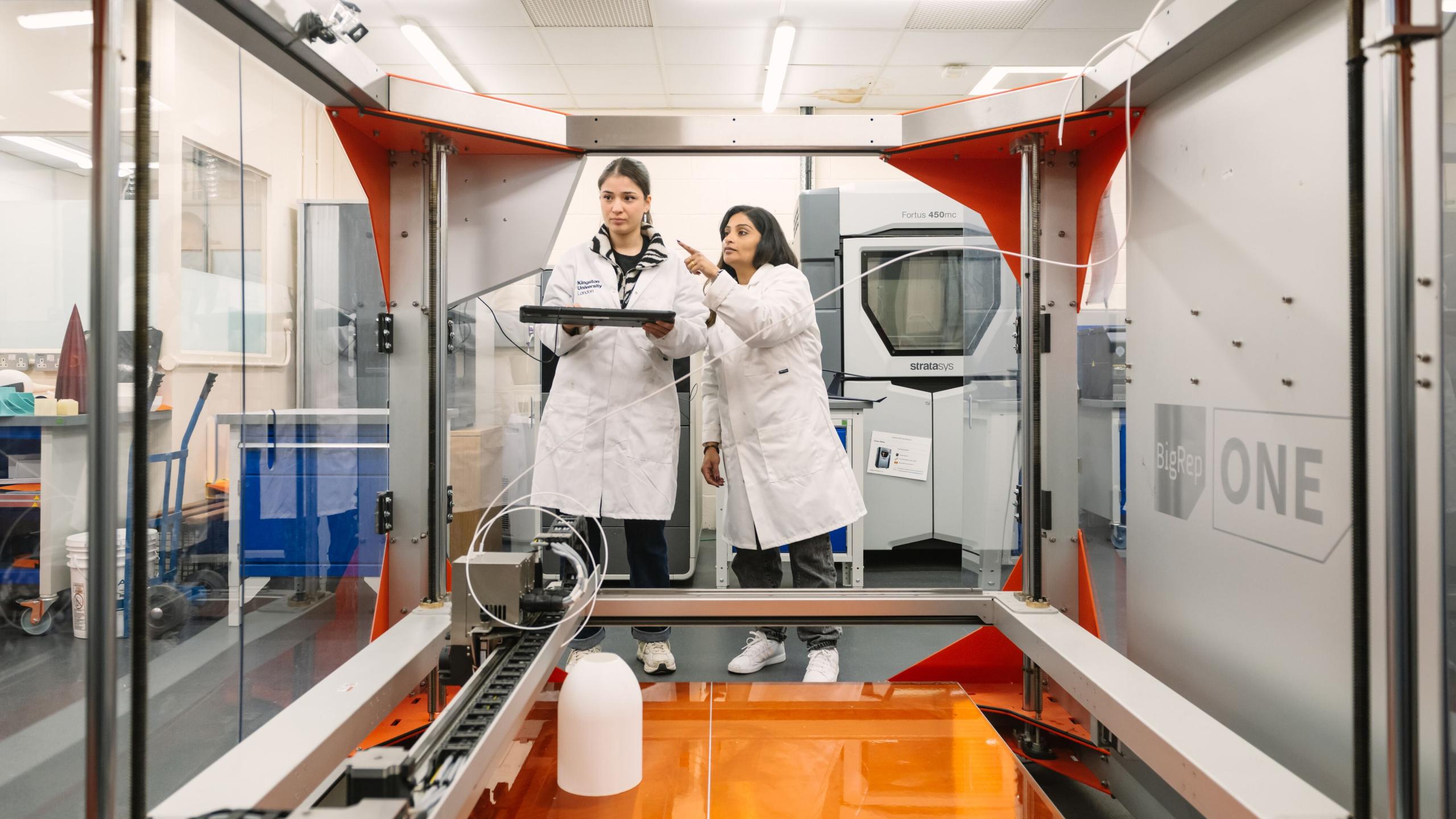
At our Penrhyn Road campus, you will have access to a modern environment with the latest equipment, including:
- laboratories dedicated to environmental science learning and research
- computing laboratories and a team of IT technicians to offer assistance
- the award-winning Town House, with a well-stocked library that boasts an impressive collection of texts, journals and online e-books/journals
- excellent social spaces, plus a large, fully equipped gym and fitness centre
- a fully integrated virtual learning environment (Canvas) so you can learn and interact with others on your course 24/7
The immersive environment and supportive faculty at Kingston University have made my experience immensely enriching, providing me with a platform to gain expertise and practical skills that extend beyond the classroom.
Inside Environmental Management MSc
Hear from our students and academics as they share insights about the course, studying at Kingston and the opportunities available to you throughout your studies.
Why choose this course
This course explores the exploitation of natural environments and the relationships between sustainable environmental management and natural ecosystems. It examines how sustainable environmental management and behaviour can be promoted and achieved.
Throughout this course, you will be exposed to the socioeconomic, ecological, and environmental challenges associated with the provision of goods and services. As well as the sustainable management of the natural and built environment, which cannot be achieved with business-as-usual practices.
You will study theoretical, practical, and legal frameworks for promoting sustainable environmental practices at individual, institutional and governmental levels. In addition, you’ll learn how to innovate, respond to new and emerging challenges, and work effectively in changing and unfamiliar situations.
Your final masters award title will be reflected by your chosen pathway:
Environmental Management MSc
This core pathway explores the rationale behind the exploitation of natural environments. It provides you with detailed knowledge and understanding of the relationships between sustainable environmental management and natural ecosystems, and the value of adopting an integrated approach to studying both.
Environmental Management (Energy) MSc
This pathway is timely, nationally and internationally relevant. For example, considering the world's energy needs, as well as the surrounding political debates regarding fossil fuels and increasingly, renewables, which form such an essential component of the world's existence.
Environmental management research at Kingston covers the following areas:
- waste resources management and circular economy
- community engagement with nature monitoring and citizen science
- the role the voluntary and community sector plays in providing resilience to hazards and how they can be effectively included in resilience planning and decision making at the local level.
- sustainable water resource management solutions in global contexts (e.g. desalination integration)
- applications of Geographical Information Systems to resource and biodiversity management
- conservation management in the UK and Madagascar
- salt marsh carbon sequestration
- virtual reality visualisation of nature-based environmental solutions
Accreditation
This course is accredited by the Institute of Sustainability and Environmental Practitioners (ISEP). ISEP is a professional body for people working in environment and sustainability. This course entitles students to FREE student membership for the duration of the course and on successful completion you qualify for GradISEP. Graduate membership is a launchpad for future leaders within environment and sustainability and offers a range of benefits to support you throughout your career. You can then "fast track" to Practitioner Membership.

Course content
You will study the theoretical, practical and legal frameworks promoting sustainable environmental management and other drivers for sustainable behaviour at individual, institutional and governmental scales. You will learn how to innovate, respond to new and emerging challenges and work effectively in changing and unfamiliar situations.
The programme is made up of six modules, two worth 30 credits, four worth 15 credits, and a research project module worth 60 credits.
For a student to go on placement they are required to pass every module. It is the responsibility of individual students to find a suitable paid placement. Students will be supported by our dedicated placement team in securing this opportunity.
Environmental Management MSc
Core modules
60 credits
This final module provides students with the opportunity to design and execute an original research ‘capstone' project related to their own discipline specific interests, which synthesises their learning. They will develop a theoretically informed body of work that integrates both theory and practice. It may take the form of a dissertation, practice project, or experiment-based project. Following submission students present their findings at a Masters Students Conference.
30 credits
The module will explore the environmental, economic, and social implications of our decisions and attempts to find sustainable solutions to environmental problems. Focusing on the 21st-century environmental and climate change challenges, you will learn, and explore the following aspects of Sustainable Environmental Management (SEM):
- Sustainable development and dependencies and interconnectivity between Sustainable Development Goals (SDGs)
- Environmental politics and policy making as underpinned by law
- Operation of Environmental Planning, and Environmental Impact Assessment (EIA)
- Importance of accountability, equality, inclusivity, transparency, cultural context, and health and well-being as part of Corporate Social Responsibility (CSR), Environmental, Social, and Governance (ESG).
These will be explored with a series of case studies that illustrate social, economic, and environmental impacts at different scales.
30 credits
This module investigates key issues relating to climate change, with a particular focus on the role of policy, governance, and social action in creating appropriate responses to this challenge. The aim is to provide students with the knowledge and skills to critically assess different options for dealing with the challenge of climate change and to identify potential ways forward, based on evidence and lessons from implementing climate change policy and programming.
Core material will be provided in lectures, supported by a range of seminars and workshops to facilitate further discussion, reflection, and analysis. Where feasible, these will draw on the experience of practitioners from a variety of settings and perspectives, or the students themselves. Field visits will be organised to complement the lecture series and to give further practical demonstration of the complexities of climate change-related policy and practice.
15 credits
Participatory approaches have become increasingly widespread in recent years, and they recognise the publics and other stakeholders' right to be involved in environmental decision making, but also expects them to take on a variety of responsibilities.
This module explores the diversity of participatory approaches, from global policy to local action. You will examine the benefits and challenges of participatory approaches involving a range of stakeholders in a number of contexts, and consider those who may be excluded and questions of social justice.
You will explore the complexities of implementing these policies and methods through case studies which focus on key issues and the challenges of balancing a range of competing needs.
15 credits
Environmental management decision-making should be evidence-based. Problems are often multifaceted and ‘wicked' in that they require the collection, synthesis, and analysis of qualitative and quantitative data on physical phenomena, human attitude and behaviour, and the regulatory and policy framework. This module is concerned with the practical aspects of data collection, analysis, and visualisation of qualitative and quantitative information and analytical results within an environmental management context.
The module covers the collection of primary data (such as through field survey, questionnaires or interviews) and the synthesis of secondary data resources that are often diverse, fragmented, partial, inconsistent, and commercially or personally sensitive. Students will learn how to explore and visualise environmental management information as graphs and maps, and to analyse textural and statistical pattern. Students will evaluate and critique the quality and fitness-for-purpose of survey designs and secondary data resources. The skills developed in this module are applicable to GG7XX7 Research Project and are transferrable skills that will enhance employability.
15 credits
The module examines global water resource challenges, the relationship between water, energy and land, and sustainable management solutions. Students will develop a critical evaluation of these challenges at a variety of scales through the systematic investigation of the component challenges, the interface between the components and their relationship to sustainable development, including resource assessment and resource use; water scarcity and security and water management decision-making.
Students will critically examine and debate natural (including climate) and socio-political drivers, mitigation, and adaptive environmental management strategies. The module will be spatially nested, examining broad global challenges, regional investigations in developed and developing world contexts, and local case studies to exemplify, compare and contrast experiences.
The module places an emphasis on professional skills development and KU Graduate Attributes and will be studied in multi-delivery and assessment modes, occupying multiple learning environments, blending lecture, seminars, debates and reflective sessions and practical skills acquisition. Practical skills will include field-based learning will include the opportunity for regional study in the UK and overseas.
15 credits
This module is concerned with the theoretical, practical, and ethical aspects of good academic, research and professional practice. The module begins by developing students' knowledge and skills of academic practice: finding, assessing, and collating information; academic writing, citation and referencing; and academic integrity.
With a firm academic base established, the module moves to implementing this practice to produce a team-based research project proposal of a designated environmental challenge. Research will be placed in the context of theoretical/conceptual frameworks such as Saunder's 'research onion', 'design thinking', and dissertation forms (traditional, systematic review, systematic map, and meta-analysis). The purpose and praxis of undertaking a literature review and developing a research proposal will be explained, as will their structure. Research and project management, ethics, and health and safety are considered.
The module will be delivered through a short series of lectures that explain concepts and good practice. Practical skills will be developed through workshop and computer-based classes and independent learning though on-line resources. The module develops crucial academic and professional practice a companion to Evidence-based Environmental Management and feeds into Research Project.
Environmental Management (Energy) MSc
Core modules
60 credits
This final module provides students with the opportunity to design and execute an original research ‘capstone' project related to their own discipline specific interests, which synthesises their learning. They will develop a theoretically informed body of work that integrates both theory and practice. It may take the form of a dissertation, practice project, or experiment-based project. Following submission students present their findings at a Masters Students Conference.
30 credits
The module will explore the environmental, economic, and social implications of our decisions and attempts to find sustainable solutions to environmental problems. Focusing on the 21st-century environmental and climate change challenges, you will learn, and explore the following aspects of Sustainable Environmental Management (SEM):
- Sustainable development and dependencies and interconnectivity between Sustainable Development Goals (SDGs)
- Environmental politics and policy making as underpinned by law
- Operation of Environmental Planning, and Environmental Impact Assessment (EIA)
- Importance of accountability, equality, inclusivity, transparency, cultural context, and health and well-being as part of Corporate Social Responsibility (CSR), Environmental, Social, and Governance (ESG).
These will be explored with a series of case studies that illustrate social, economic, and environmental impacts at different scales.
30 credits
This is the key module for the Energy pathway in the MSc Environmental Management. Against the background of international commitments on atmospheric emissions, diminishing fossil fuel resources and the liberalisation of energy markets, this module examines sustainable options for energy production, supply, and consumption. Specifically, the module will equip the students with a set of skills and abilities to identify classify and critically describe energy sources, and energy usage using analytical methods.
It is certainly true to say that today, few would perceive a future without renewables making a notable contribution to energy supplies in the longer term. However, it is also true to say that many envisage an ongoing role for both conventional fossil fuels and nuclear power. The primary aim of the module is to give students a good understanding of current trends, and to enable a critical evaluation of emerging ideas, technologies and policies.
15 credits
Participatory approaches have become increasingly widespread in recent years, and they recognise the publics and other stakeholders' right to be involved in environmental decision making, but also expects them to take on a variety of responsibilities.
This module explores the diversity of participatory approaches, from global policy to local action. You will examine the benefits and challenges of participatory approaches involving a range of stakeholders in a number of contexts, and consider those who may be excluded and questions of social justice.
You will explore the complexities of implementing these policies and methods through case studies which focus on key issues and the challenges of balancing a range of competing needs.
15 credits
Environmental management decision-making should be evidence-based. Problems are often multifaceted and ‘wicked' in that they require the collection, synthesis, and analysis of qualitative and quantitative data on physical phenomena, human attitude and behaviour, and the regulatory and policy framework. This module is concerned with the practical aspects of data collection, analysis, and visualisation of qualitative and quantitative information and analytical results within an environmental management context.
The module covers the collection of primary data (such as through field survey, questionnaires or interviews) and the synthesis of secondary data resources that are often diverse, fragmented, partial, inconsistent, and commercially or personally sensitive. Students will learn how to explore and visualise environmental management information as graphs and maps, and to analyse textural and statistical pattern. Students will evaluate and critique the quality and fitness-for-purpose of survey designs and secondary data resources. The skills developed in this module are applicable to GG7XX7 Research Project and are transferrable skills that will enhance employability.
15 credits
The module examines global water resource challenges, the relationship between water, energy and land, and sustainable management solutions. Students will develop a critical evaluation of these challenges at a variety of scales through the systematic investigation of the component challenges, the interface between the components and their relationship to sustainable development, including resource assessment and resource use; water scarcity and security and water management decision-making.
Students will critically examine and debate natural (including climate) and socio-political drivers, mitigation, and adaptive environmental management strategies. The module will be spatially nested, examining broad global challenges, regional investigations in developed and developing world contexts, and local case studies to exemplify, compare and contrast experiences.
The module places an emphasis on professional skills development and KU Graduate Attributes and will be studied in multi-delivery and assessment modes, occupying multiple learning environments, blending lecture, seminars, debates and reflective sessions and practical skills acquisition. Practical skills will include field-based learning will include the opportunity for regional study in the UK and overseas.
15 credits
This module is concerned with the theoretical, practical, and ethical aspects of good academic, research and professional practice. The module begins by developing students' knowledge and skills of academic practice: finding, assessing, and collating information; academic writing, citation and referencing; and academic integrity.
With a firm academic base established, the module moves to implementing this practice to produce a team-based research project proposal of a designated environmental challenge. Research will be placed in the context of theoretical/conceptual frameworks such as Saunder's 'research onion', 'design thinking', and dissertation forms (traditional, systematic review, systematic map, and meta-analysis). The purpose and praxis of undertaking a literature review and developing a research proposal will be explained, as will their structure. Research and project management, ethics, and health and safety are considered.
The module will be delivered through a short series of lectures that explain concepts and good practice. Practical skills will be developed through workshop and computer-based classes and independent learning though on-line resources. The module develops crucial academic and professional practice a companion to Evidence-based Environmental Management and feeds into Research Project.
Professional placement
Professional placement
120 credits
The Professional Placement module is a core module if you're following a masters programme that incorporates an extended professional placement. It provides you with the opportunity to apply your knowledge and skills in an appropriate working environment, and develops and enhances key employability and subject specific skills in your chosen discipline. You may wish to use the placement experience as a platform for a major project or your future career.
It is your responsibility to find and secure a suitable placement opportunity; this should not normally involve more than two placements which must be completed over a minimum period of 10 months and within a maximum of 12 months. The placement must be approved by your Course Leader prior to commencement to ensure its suitability. You will have access to the standard placement preparation activities offered by the Student Engagement and Enhancement (SEE) group.
Read more about the postgraduate work placement scheme.

Career opportunities
Graduates from this course go on to career opportunities with NGOs, governmental organisations, businesses, industry and education or as independent consultants and advisers. Recent graduates are employed by local councils as environmental sustainability officers or waste management officers.
Careers and recruitment advice
The Faculty has a specialist employability team. It provides friendly and high-quality careers and recruitment guidance, including advice and sessions on job-seeking skills such as CV preparation, application forms and interview techniques. Specific advice is also available for international students about the UK job market and employers' expectations and requirements.
The team runs employer events throughout the year, including job fairs, key speakers from industry and interviews on campus. These events give you the opportunity to hear from, and network with, employers in an informal setting.
Work placement scheme
This course, like many postgraduate courses at Kingston University, enables students to integrate a 12-month work placement into their course. You are responsible for finding and securing your own professional placement, which can be highly competitive but also incredibly rewarding. It is very important to prepare yourself if this is the route you wish to take. Employers look for great written and oral communication skills and an excellent CV/portfolio. As the work placement is an assessed part of the course, it is covered by a Student Route visa.
This course is accredited by the Institute of Sustainability and Environmental Practitioners (ISEP). ISEP is a professional body for people working in environment and sustainability.
This course entitles students to FREE student membership for the duration of the course and on successful completion you qualify for GradISEP. Graduate membership is a launchpad for future leaders within environment and sustainability and offers a range of benefits to support you throughout your career. You can then "fast track" to Practitioner Membership.
Teaching and assessment
When not attending timetabled sessions, you will be expected to continue learning independently through self-study. Typically this will involve reading journal articles and books, working on individual and group projects, coursework assignments and presentations, and preparing for exams. Your independent learning is supported by a range of excellent facilities including online resources, the library and CANVAS, the online virtual learning platform.
As a student at Kingston University, we will make sure you have access to appropriate advice regarding your academic development. You will also be able to use the University's support services.
A course is made up of modules, and each module is worth a number of credits. You must pass a given number of credits in order to achieve the award you registered on, for example 360 credits for a typical undergraduate course or 180 credits for a typical postgraduate course. The number of credits you need for your award is detailed in the programme specification which you can access from the link at the bottom of this page.
One credit equates to 10 hours of study. Therefore 180 credits across a year (typical for a postgraduate course) would equate to 1,800 notional hours. These hours are split into scheduled and guided. On this course, the percentage of that time that will be scheduled learning and teaching activities is shown below. The remainder is made up of guided independent study.
- 15% scheduled learning and teaching
The exact balance between scheduled learning and teaching and guided independent study will be informed by the modules you take.
Your course will primarily be delivered in person. It may include delivery of some activities online, either in real time or recorded.
Assessment typically comprises exams (e.g. test or exam), practical (e.g. presentations, performance) and coursework (e.g. essays, reports, self-assessment, portfolios, dissertation). The approximate percentage for how you will be assessed on this course is as follows, though depends to some extent on the optional modules you choose:
Type of assessment
Year 1:
- Coursework 92%;
- Exams 8%
Please note: the above breakdowns are a guide calculated on core modules only. If your course includes optional modules, this breakdown may change to reflect the modules chosen.
We aim to provide feedback on assessments within 20 working days.
Fees and funding
| Fee category | Annual Fee |
|---|---|
| Home (UK students) | |
| Full Time | £12,300 |
| Part Time | £6,765 |
| International | |
| Full Time | £23,300 |
| Part Time | £12,815 |
| Fee category | Annual Fee |
|---|---|
| Home (UK students) | |
| Full Time | £11,900 |
| Part Time | £6,545 |
| International | |
| Full Time | £20,000 |
| Part Time | £11,000 |
Fees for future course years
Part time
If you start your second year straight after Year 1, you will pay the same fee for both years.
If you take a break before starting your second year, or if you repeat modules from Year 1 in Year 2, the fee for your second year may increase.
Funding support for postgraduate students
If you are a UK student living in England and under 60, you can apply for a loan to study for a postgraduate degree. Find out more through the government's website.

Scholarships and bursaries
For students interested in studying Environmental Management MSc at Kingston, there are several opportunities to seek funding support:
The Inspire the Future Scholarship offers a 40% reduction in fees for taught masters or postgraduate diploma courses with September start dates. 20 scholarships are available for progressing Kingston University graduates.
For more information on how to apply for this scholarship, visit the Inspire the Future Scholarship page.
International postgraduate students could receive up to £5,000 towards tuition in their first year of study.
For more information on how to apply for these scholarships, visit the International Scholarship page.
If you are a Kingston University undergraduate student progressing to a postgraduate degree (taught or research), you could get a 15% reduction in tuition fees.
For more information on how to apply for this scholarship, visit the Postgraduate Progression Scholarship page.
Kingston University offers a 10% discount on full and part-time postgraduate degree course tuition fees to our alumni.
For more information on how to apply for this discount, visit our alumni discount page.

Additional course costs
Some courses may require additional costs beyond tuition fees. When planning your studies, you’ll want to consider tuition fees, living costs, and any extra costs that might relate to your area of study.
Your tuition fees include costs for teaching, assessment and university facilities. So your access to libraries, shared IT resources and various student support services are all covered. Accommodation and general living expenses are not covered by these fees.
Where applicable, additional expenses for your course may include:
Our libraries have an extensive collection of books and journals, as well as open-access computers and laptops available to rent. However, you may want to buy your own computer or personal copies of key textbooks. Textbooks may range from £50 to £250 per year. And a personal computer can range from £100 to £3,000 depending on your course requirements.
While most coursework is submitted online, some modules may require printed copies. You may want to allocate up to £100 per year for hard-copies of your coursework. It’s worth noting that 3D printing is never compulsory. So if you choose to use our 3D printers, you’ll need to pay for the material. This ranges from 3p per gram to 40p per gram.
Kingston University will pay for all compulsory field trips. Fees for optional trips can range from £30 to £350 per trip.
Your tuition fees don’t cover travel costs. To save on travel costs, you can use our intersite bus service. This route links the campuses and halls of residence with local train stations - Surbiton, Kingston upon Thames, and Norbiton.
If you choose to do a placement year, travel costs will vary depending on your location. These costs could be up to £2,000.

How to apply
Before you apply
Please read the entry criteria carefully to make sure you meet all requirements before applying.
How to apply online
Use the course selector drop-down at the top of this page to choose your preferred course, start date and mode, then click 'Apply now'. You will be taken to our Online Student Information System (OSIS) where you will complete your application.
If you’re starting a new application, you’ll need to select ‘new user’ and set up a username and password. This will allow you to save and return to your application.
Application deadlines
We encourage you to apply as soon as possible. Applications will close when the course is full.
Information required to confirm your place
If English is not your first language, we will require proof of your proficiency to allow us to confirm your place on the course. This will generally be either an IELTS or TOEFL test certificate, which can be forwarded to us after you have submitted your application. If you do not hold a formal English language qualification, please indicate how you have acquired your proficiency in written and spoken English.
After you have applied
If the postgraduate admissions tutor requires further information or wishes to invite you to interview, they will contact you directly. You will then hear whether your application has been successful.
If you do not clearly meet the standard entry requirements and the admission tutor wishes to see a portfolio from you, you will be sent an email asking you to upload your portfolio to your Kingston University OSIS account. Further details on how to do this will be provided at the time.
Course changes and regulations
The information on this page reflects the currently intended course structure and module details. To improve your student experience and the quality of your degree, we may review and change the material information of this course. Find out more about course changes
Programme Specifications for the course are published ahead of each academic year.
Regulations governing this course can be found on our website.
What our students and graduates say
Currently, I am finishing my masters degree in Environmental Management at Kingston University. I am delighted to share that my academic journey has been complemented by a partnered dissertation with SUEZ, a valuable opportunity that has provided real-world insights into environmental management practices. Concurrently, I have secured a position as a sustainability consultant, aligning seamlessly with the knowledge and skills I've cultivated during my time at Kingston.
Since I received my masters degree in Environmental Management at Kingston University, I have been working as a Sustainability Coordinator at Marble – a creative production, delivery and marketing agency that organises events globally. I am responsible for driving environmental action throughout the business to meet our wider sustainability objectives and net zero goals.
At Kingston University I researched business growth and innovation opportunities created for businesses through the net zero commitments in partnership with the Royal Borough of Kingston upon Thames. This research helped me develop a thorough understanding of net zero policies in the UK as well as the environmental initiatives local businesses implement in their operations, how they benefit from them and what challenges they face. Thanks to the knowledge I gained when writing my dissertation I was able to create a robust net zero plan as part of Marble's sustainability strategy that we will start implementing in early 2024.
I am both an alumni and guest lecturer at Kingston University. I am so very proud of the MSc Environmental Management course; the course is aligned to IEMA, which gives students a professional advantage once they graduate. The content also covers key industry relevant themes, which ensures graduates can walk into industry equipped with the right background to succeed in sustainability.
I am in contact with many ex-students from the MSc course over the years, and it brings me much joy to see how their careers are progressing by delivering leading sustainability expertise and solutions to a range of industries.