Fine Art & Art History BA (Hons)
Teaching Excellence Framework (TEF) Gold award
Our commitment to high quality teaching has been recognised with a TEF Gold rating. The University has received an overall rating of Gold, as well as securing a Gold award in the framework's two new student experience and student outcomes categories.
Why choose this course?
This course helps you realise your creative potential in fine art and develops skills to understand contemporary art. You will explore traditional forms of painting and sculpture with new forms such as film and digital printmaking. You will also develop visual analysis skills and historical knowledge by exploring a range of images, texts and objects.
Kingston University is an associate of the Institute of Contemporary Arts (ICA), so you'll receive free membership and access to seminars and events. Our links to industry also include the Tate, Stanley Picker Gallery, Drawing Room, Five Years and Traffic.
The course focus is on personal and professional development and you'll have the opportunity to participate in external projects and competitions. You'll also have the chance to exhibit your work at our on-site gallery, and other London locations.
| Attendance | UCAS code | Year of entry |
|---|---|---|
| 3 years full time | WV1H | 20242025 |
| Main location | Kingston School of Art, Knights Park |
Reasons to choose Kingston
- Kingston is ranked No.1 in London for Art and Design (The Times Good University Guide 2023).
- The University is an associate of the Institute of Contemporary Arts (ICA), so you'll receive free membership and access to seminars and events.
- You'll gain the expertise to develop independent thought and confidence in your practice, as well as transferable skills suitable for employment in the creative industries.
- 100% of students thought staff were good at explaining things and made the subject engaging (NSS 2023).
The Art School Experience
As part of Kingston School of Art, students on this course benefit from joining a creative community where collaborative working and critical practice are encouraged.
Our workshops and studios are open to all disciplines, enabling students and staff to work together, share ideas and explore multi-disciplinary making.

What you will study
Working primarily in a dedicated studio space, you will examine practices that have shaped the cultures of contemporary art. You can discuss your development with tutors, visiting artists, technical staff and fellow students. Your study will be supported by seminars, workshops, critiques and study trips.
Modules
Fine Art and Art History is made up of two 30-credit modules in each level. Typically a half-field student must complete 60 Fine Art credits and 60 Art History credits at each level.
Year 1
Year 2
Year 3
Year 1 introduces research skills and visual art practice in traditional and new media. You will undertake independent studio practice, and build confidence through technical and studio-based workshops. Lectures, seminars, workshops, visits, projects, and modules in art history offer historical knowledge, creative research methods, and an understanding of concepts for interpreting contemporary art.
Core modules
Introducing Studio Practice
30 credits
This module is designed to promote effective use of the studio to stimulate the establishment of a fine art practice and to introduce a broad subject context alongside that delivered through critical historical studies.
Through independent, peer and group learning, you are encouraged to identify and develop new practical / thinking skills and interests and to nurture existing ones.
With consideration to their established methods, you will be asked to consider new and alternative modes of practice in and beyond the studio and to begin to invest in collaborative approaches to making and reviewing your work. You will be invited to be curious and reflective in your approach to materials, processes and ideas as well as to establish strategies for self-management and enrichment.
Professional Skills I
30 credits
This module supports you to disseminate the work you make to critically reflect on what you have done and to gain awareness of a broad professional context for Fine Art practice.
You will be encouraged to acquire strategic skills for planning, showing, recording and communicating work in a variety of formats, including publication and exhibition via analogue, digital and online media. By rendering and displaying practical work for peers, teaching staff and external audiences, you will gain an awareness of the importance of editing and evaluating the work you have made.
Contextualising Contemporary Practice: Fine Art
30 credits
This module introduces the various contexts in which the contemporary practices of fine art, are defined, debated and displayed. The module is designed to support your first steps as practitioners within the wider field of the visual arts in the 21st century. Through lectures, discussions, screenings and exhibition visits you will be introduced to the historical framework of modernity and post-modernity in order to understand the development and contemporary situation of your discipline.
The module is organised as discrete but related teaching blocks that progress from broader questions of cultural practice to the more specific debates that have framed the historical development fine art and its associated fields - for example experimental filmmaking, video making and photography. In the first block, the emphasis is broad and focused on developing in you, an understanding of the notion of practice in the visual arts, by addressing the historical, theoretical, social and political factors that have affected our understanding of its function. In the second block, you will be encouraged to consider the key debates, theoretical questions and changing contexts that inform your discipline. Throughout, there is an emphasis on the introduction of key analytical, critical and research skills, and through close engagement with visual sources, historical texts and contemporary critical writing, you will begin to develop the tools necessary to discuss, conceptualise and reflect on your own emerging practice.
Key Concepts: Research, Interpretation & Communication
30 credits
This module focuses on key methods in the processes of research and its interpretation and communication. Through a series of thematically structured, contemporary focused encounters with key artefacts, texts, events and sites from the late 19th century to the present, it aims to develop your knowledge and skills in a range of methods related to the history and theory of the production, consumption and mediation of art and design. The module interrogates core concepts in the disciplines of art and design history and theory and introduces key methods for the identification and interpretation of research material, including: conducting oral history, using archives, and employing material culture and gendered approaches to objects. The module also introduces you to key methods in communicative and interpretative activities such as different curation and critical writing modes. This combination of methods will connect your research-based practice to contemporary audiences interested in art and design past and present, providing be key skills for professional careers. Finally, the module will develop critically informed awareness of your own research-based practice.
Year 2 develops your individual research interests, creative expression, collaborative skills and technical competence. You will explore source material critically and analytically. You will engage with contemporary critical debates and develop your theoretical understanding.
Core modules
Developing Studio Practice
60 credits
This module promotes effective use of the studio to develop your fine art practice. Through a process of continuous practice-based research, you are supported to expand on ideas with further experimentation, to develop and extend your own formal language within the context of contemporary Fine Art.
Through independent, peer and group learning, you are encouraged to enhance your practical / thinking skills and interests and to nurture existing ones.
Throughout this module, you are encouraged to pursue increasingly self-led enquiry, in and beyond the studio, and to continue to invest in collaborative approaches to making and reviewing your work. You are supported to be increasingly analytical in your approach to materials, processes and ideas, and to hone strategies for self-management and enrichment.
Professional Skills II
30 credits
Designed to help develop the skills that will equip you for a professional life in work, this module supports you to enlarge upon your knowledge of a broad professional context for Fine Art practice.
You will develop upon and enhance relevant strategies for planning, curating, exhibiting, and documenting work in a variety of ways, including publication and exhibition via analogue, digital and online media. By testing and determining increasingly relevant strategies for rendering and displaying practical work to peers, teaching staff and external audiences, you will develop further awareness of the importance of editing, evaluating and adapting the work you have made in plural contexts.
Assisting Level 6 students with the mounting of a final show further develops your exhibition and project planning skills.
Critical Issues in Fine Art: Research and Practice
30 credits
This module engages you with the critical issues driving contemporary art practice within the expanded field in which it operates. Emphasising practical, experiential research-led enquiry and reflection as an integral mode of learning common to both art practice and the study of art's histories and theories, you will identify, explore and analyse current trends by investigating the contexts in which those issues emerge - in critical literature, art writing, exhibitions and curatorial agenda. Looking outwards to address the contemporary manifestations of the relationships between, for example, art and politics, the operation of global capital, activism and community, changing sites and spaces of the production of meaning, the politics of identity, and contemporary turns in philosophy and critical theory, the module also encourages you to reflect and begin to situate yourselves. Making links and interpreting the themes emerging in their own practice, the module provides you with the building blocks with which to construct an informed critical and conceptual framework within which operate while forging connections to wider artistic networks and contexts beyond the studio.
Researching the Contemporary
30 credits
This module builds on the introduction to key concepts in methods for research and its interpretation and communication at level 4. It updates the knowledge and skills acquired at level 4 and offers opportunities to apply these by focusing on the contemporary and interrogating studio-based practice. The module will focus on critical themes and issues in contemporary research practice in art and design history, as performed by researchers including academics, curators and art and design practitioners. The module will interrogate the shifting relationship between art and design history, theory and studio-based research practice. You will correspondingly explore a range of creative interpretative and communicative research-based activities such as exhibition making, curation, policy writing, and academic publishing. This will develop skills in producing research for a variety of media, aims and audiences.
The module is designed to support your learning across your Level 5 modules, enabling you to create the critical framework within which to explore current issues in art and design practice, interpret the production, consumption and display of historical and contemporary artefacts, and develop your own informed practical approaches to the communication of art and design history and theory using these as disciplines with which to interrogate contemporary art and design culture. Throughout, you will establish a clear position for yourselves, and present (in spoken and written form) your interests and perspectives.
Year 3 focuses on independent study. Your work will articulate increasingly subtle and complex visual arguments, reflecting current critical, conceptual, theoretical and aesthetic issues. You will produce work for a final portfolio, exhibition and review. You will also examine an art history theme through a guided independent research project, and complete a dissertation. This will enable you to explore a topic in detail and reflect on the links between theory and practice.
Core modules
Sustaining Studio Practice
60 credits
This module is designed to be the culmination of previous studio practice modules in which you are required to synthesise the contingent parts of your prior academic experience and consolidate your learning through a comprehensive body of work, enabling you to progress to professional practice or further study.
At previous levels of study, you will have progressed your learning incrementally and as such you will have acquired the tools to engage with this module and demonstrate your achievements in an appropriate final presentation. You are encouraged to reflect on the knowledge and skills that you have acquired during your degree and, through independent, peer and group learning you will be encouraged to learn how to present them to an audience external to your immediate peer group.
Additionally, you are encouraged to continue to develop an authoritative understanding of contemporary fine art and the critical evaluation skills essential to fine art practice.
Professional Skills III
30 credits
Building on previous achievements in the professional presentation of your work to an audience, in this module you will fine-tune your exhibition skills and extend your ability to document and communicate your work in a way that is fitting to your individual professional.
You are required to develop your understanding of how to pursue a professional fine art practice, and an awareness of the possibilities for success in both continuing as an artist and / or moving into other related areas. A combination of final exhibition and portfolio enable students to highlight and synthesise your achievements in the final year of undergraduate study and produce documentation that can be applied to a range of career choices.
Dissertation: Research and Reflection
30 credits
Building on the links between research and practice embedded at Level 5, the Critical and Historical Studies (CHS) Dissertation: Research and Reflection module focuses on in-depth research, critical enquiry and reflection on questions and critical issues emerging in students' own practice, and pertinent to the practice of their own discipline.
Over the module, students will initiate and develop an individual research topic; identify and evaluate appropriate archives, bodies of critical literature, visual/material sources and research methods; manage their study time; engage with and respond to tutorial dialogue and peer feedback, and apply critical and analytical skills to produce a 7-8000 word written Dissertation, supported by a series of lectures, seminars and tutorials.
Special Topics in Art and Design II
30 credits
The special topic is an opportunity for a responsive, research-led module. The specific subject can be defined in relation to a particular staff member's research or may have a more thematic drive drawing on convergent aspects in interests across the staff team.
Future Skills
Knowledge to give you the edge
Embedded within every course curriculum and throughout the whole Kingston experience, Future Skills will play a role in shaping you to become a future-proof graduate, providing you with the skills most valued by employers such as problem-solving, digital competency, and adaptability.
As you progress through your degree, you'll learn to navigate, explore and apply these graduate skills, learning to demonstrate and articulate to employers how future skills give you the edge.
At Kingston University, we're not just keeping up with change, we're creating it.

Entry requirements
Teaching and assessment
Who teaches this course?
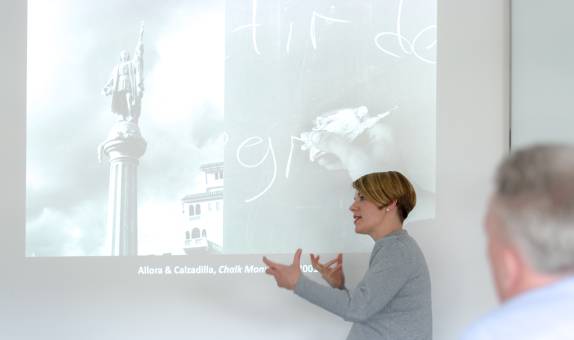
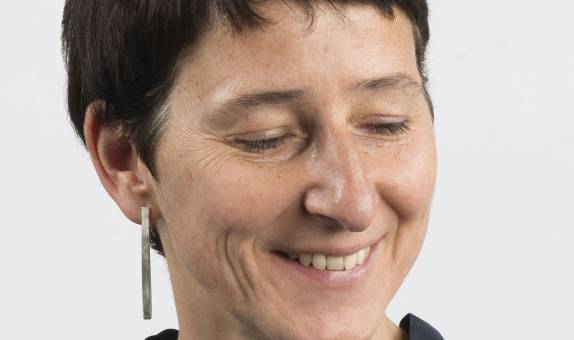
This course is taught at Knights Park, where staff are current practitioners and have extensive experience and professional links, helping you to develop your skills, networks and gain access to industry contacts.



Course fees and funding
Additional costs
Depending on the programme of study, there may be extra costs that are not covered by tuition fees which students will need to consider when planning their studies. Tuition fees cover the cost of your teaching, assessment and operating University facilities such as the library, access to shared IT equipment and other support services. Accommodation and living costs are not included in our fees.
Where a course has additional expenses, we make every effort to highlight them. These may include optional field trips, materials (e.g. art, design, engineering), security checks such as DBS, uniforms, specialist clothing or professional memberships.
Facilities
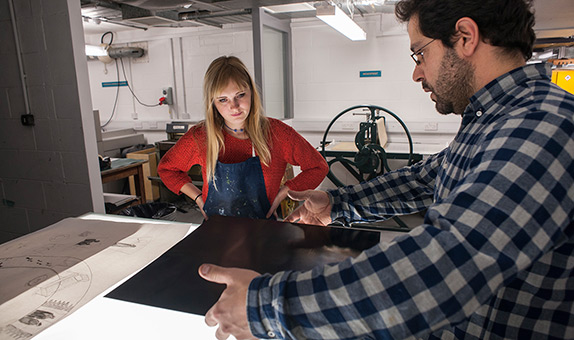
You'll use our studio spaces and facilities to experiment and explore new ways to push the boundaries of projects and open discourse across disciplines.
Collaborative and multi-disciplinary teamwork is actively encouraged between students, across faculty courses, international institutions and with industry.
Skills and techniques such as typography, photography, moving image, printmaking, rapid proto-typing, analysis and research, human factors, presentation, interactive and graphic software all support project work by helping realise solution-led ideas.
After you graduate
Our graduates have gone on to work in museums, galleries, auction houses, arts administration, curating, teaching, advertising, picture research and the media. The course is also an excellent foundation for postgraduate study.
I had always had an interest in Art History and found Kingston to have very understanding lecturers which drew me to the University. I like the variety of subjects on offer here and have enjoyed the campus atmosphere immensely; it always feels alive, moving, thinking and, above all, creative.
As a dyslexic student at Kingston I have been impressed with the dedication my tutors have shown. The staff on the course are very understanding and happy to help with any problems or queries. I have found my lecturers enthusiastic, knowledgeable and accommodating.
During my time at Kingston, I have become involved with the Students' Union. I am the campus representative and also the second year representative for my course and its parallel course of Visual and Material Culture. In addition to this, I work at the Students' Union bar. So far I have really enjoyed all this, particularly the bar's atmosphere and just how much fun it can be.
I haven't yet totally decided what my long-term ambitions are, but this course is definitely helping me decide what direction I would like to go in.

Kendra Bucknell - History of Art, Design and Film BA(Hons)
Links with business and industry
We aim to give you real experience of professional working life so you are prepared for the highly-competitive, fast-changing art world.
Our students have worked on commissions from clients such as:
- BP Amoco;
- Johnson Controls;
- Lever Brothers;
- Merrill Lynch; and
- Sapcote Developments.
Key information set
The scrolling banner(s) below display some key factual data about this course (including different course combinations or delivery modes of this course where relevant).
Course changes and regulations
The information on this page reflects the currently intended course structure and module details. To improve your student experience and the quality of your degree, we may review and change the material information of this course. Course changes explained.
Programme Specifications for the course are published ahead of each academic year.
Regulations governing this course can be found on our website.