

Kingston University launches latest Future Skills report at House of Commons
- Future Skills

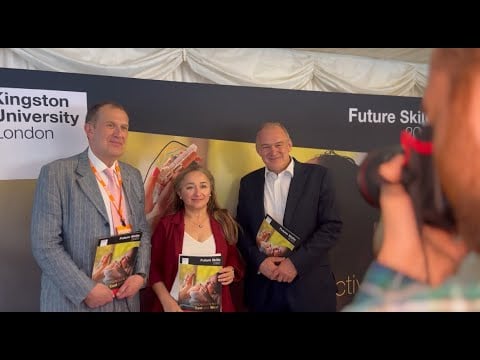
Senior politicians, business leaders, educators and students joined supporters and guests from the Republic of Korea at the House of Commons for the launch of Kingston University’s latest Future Skills report, Perspectives from East and West.
The report – part of the University’s campaign highlighting what Kingston University is doing to deliver skills for innovation and economic growth – was launched at Westminster on Wednesday 18 June. It includes new polling in partnership with YouGov and contributions from Nanyang Technological University (NTU) Singapore, offering a comparative analysis of skills requirements between the UK and four economies in East Asia.
The findings highlight a growing global emphasis on human-centric skills, such as problem solving and critical thinking, as well as the vital need for education around emerging technologies. The report also underscores the role universities must play in equipping graduates for rapidly changing workplaces.
Attendees heard from Minister for AI and Digital Government Feryal Clark MP – who is an alumna of Kingston University – Kingston and Surbiton MP and Leader of the Liberal Democrats Sir Ed Davey and Adobe Vice President Go To Market Claire Darley, who all highlighted the vital importance of Future Skills in defining the next generation of leaders, creators and changemakers. Professor Nam-Joon Cho, Director of the Centre for Cross Economy at NTU and Dr Yuhyun Park, Founder of the DQ Institute, also spoke at the event.
Introducing the report, Vice-Chancellor Professor Steven Spier emphasised how the rapid growth of artificial intelligence (AI) reinforced the value of uniquely human skills – skills the University’s students are now explicitly developing through its Future Skills programme – as well as the importance of a global outlook around core skills needs.
“Businesses have told us the skills they need and at Kingston University we are leading the way in defining Future Skills and how we deliver them,” he said. “As AI continues to advance rapidly and digitalisation accelerates, businesses are now actively seeking candidates with these essential life skills in their recruitment and hiring practices.
“This, our fourth report, adds an international perspective by comparing skill demands across major East Asian economies.”
The University is embedding Future Skills across its undergraduate curriculum. From this September, it will be a core taught and assessed part in every year of every degree, alongside subject-specific learning.
Sir Ed Davey MP, who earlier this year led a Westminster Hall debate championing the University’s Future Skills programme, praised its leadership on this agenda. “The enthusiasm shown by the students I’ve met this evening is palpable,” he said. “Future Skills has enabled them to specialise in their subject while developing a broad skillset. The learning provided by Future Skills is equipping students for the workplace and for life, my call to government is to learn more about what the University is doing.”

Among the leading businesses working with the University on Future Skills is Adobe, who also contributed to this year’s report.
Adobe’s Claire Darley called for greater collaboration between sectors in her address. “Our partnership is anchored in the University’s flagship Future Skills programme.
Ambitiously embedded into every undergraduate degree, it focuses on nine graduate attributes including digital competency, creativity, and critical thinking – the very skills that will define the next generation of leaders, creators, and changemakers.
“In an era increasingly shaped by generative AI and digital innovation, preparing students and learners with future-ready skills is essential.”
NTU research, included in the report, reveals distinct regional approaches to skills development. East Asian nations tend to prioritise leadership, ethics and global perspective, alongside a strong emphasis on digital skills and AI readiness. In contrast, the UK tends to focus more on individual capabilities such as creativity and critical thinking. Governance strategies also differ markedly.
At the launch event, students had the opportunity to speak to business leaders and policymakers about how Future Skills was preparing them for career success.
Second-year environmental science student Ophelia Bevilacqua reflected on how much she had gained from working with the John Lewis Partnership on a large-scale Future Skills project. “It’s given me the confidence to communicate with professionals and a deeper insight into the career I want. It’s great to see how the University has become a driving force for Future Skills, and how it’s developing international links,” she said.
Read the latest Future Skills report here.


