Study Abroad programme
Want to experience life at Kingston University for a semester or full academic year? Everything you need to know about our established Study Abroad programme is right here.
You are reading:
The Kingston University Study Abroad programme
Why study abroad at Kingston University London?
Kingston University welcomes more than 250 students to our high-quality Study Abroad programme every year. Here’s why you should be one of them:
- Choose from more than 700 modules in over 30 subject areas
- Get a guaranteed spot in our University accommodation (fee-paying students on Study Abroad Programme only)
- Experience the best of London from our vibrant riverside location
- Enjoy competitive tuition fees
- Take our unique British Life and Culture module
If you are a potential Erasmus/EU Exchange student, please visit our dedicated Erasmus page for more information.
Studying abroad at Kingston is undoubtedly the best experience of my life. I recommend it to anyone!
Understanding the Study Abroad programme
You can join us for one of three study options, with teaching taking place over two semesters:
| Study option | Length | Study period |
|---|---|---|
| 1 | Whole academic year | September – June |
| 2 | Autumn/Fall semester | September – December |
| 3 | Spring semester | January – April |
Our Study Abroad programme is made up of modules. Each module has defined content, contact hours, learning outcomes and assessments. They are measured in credits.
Most modules are whole year in length but many are also suitable for single-semester study (study options 2 or 3) and their suitability for this is indicated in our module directory. In this case, you will either complete the standard assessment for that part of the module or sometimes be given a specific alternative assessment appropriate for your study period.
How many credits and modules should I study?
If you’re studying for a full year, you’ll need to enrol for 120 Kingston credits. This is the same as 32 US semester credit hours or 60 European Credit Transfer System (ECTS) credits.
If you’re studying for a single semester, you’ll need to enrol for 60 Kingston credits. This is the same as 16 US semester credit hours or 30 ECTS credits.
We recommend applying for a total of eight modules, with four as your first choice and four as your second choice.
What if I change my mind about modules?
Our add and drop period gives students the chance to make minor module changes at the start of each semester.
How are modules assessed?
Each module may be assessed differently. Usually, assessment includes a mix of written papers, exams, special tests, presentations, performance or practical assignments.
Please note that there is one formal exam period, running from late April until mid-May for students here for study option 1, though not all modules will have this type of assessment anyway.
Our modules are designed for different stages of the undergraduate programme. Each one has a level (4, 5 or 6) to help you choose the right one for you.
In the UK, students generally specialise in secondary (high) school. This is much earlier than in North America, for example. Therefore, UK students will normally have chosen their major when starting university. They then just focus upon that subject over three years and there are no general education requirements. This is very different from a liberal arts curriculum and should be borne in mind when making your module selection.
Check out the table below to see how our module codes line up with the level you’re at:
UK education | UK FHEQ | US education | Kingston module code | Suitability |
|---|---|---|---|---|
Final year of high school |
| Freshman | N/A | N/A |
First year of university | Level 4 | Sophomore | AB4000 | No prior knowledge or only basic introductory study |
Second year of university | Level 5 | Junior | AB5000 | Intermediate level knowledge, with some background or a completed introductory module |
Final of university | Level 6 | Senior | AB6000 | Advanced level knowledge – a strong academic background |
UK university grades usually range between 40% (pass) and 70%. A grade of 60–69% is considered very good.
After the end of your study period, the Study Abroad International Learning Office will produce a transcript showing the US credit value (or ECTS if preferred) and a letter grade designed to be compatible with the US system, as shown below:
| US letter grade | Kingston (percentage) | Qualitative grade |
|---|---|---|
| A+ | 80+ | Equivalent to UK First Class degree |
| A | 70 – 79 | Equivalent to UK First Class |
| A- | 65 – 69 | Equivalent to UK Upper Second Class |
| B+ | 60 – 64 | Equivalent to UK Upper Second Class |
| B | 55 – 59 | Equivalent to UK Lower Second Class |
| B- | 50 – 54 | Equivalent to UK Lower Second Class |
| C+ | 47 – 49 | Equivalent to UK Third Class |
| C | 43 – 46 | Equivalent to UK Third Class |
| C- | 40 – 42 | Equivalent to UK Third Class |
| D | 35 – 39 | Unclassified Pass |
| F | Below 35 | Fail |
When your studies finish, you’ll get a transcript to show how your results translate to your home countries’ credit system.
At Kingston University, most of your learning and teaching will be a mix of formal lectures, smaller seminars and independent study.
Other methods may include:
- Online references and teaching
- Language suite work
- Laboratory work
- Engineering workshops
- Computer workshops
- Art and design studio work
Module directory
Here you can view the modules available within each faculty.
There is also a module specifically for Study Abroad and Exchange students, British Life and Culture (PDF).
- Architecture (PDF)
- Art & Design: Critical and Historical Studies (PDF)
- Creative and Cultural Industries: Events and Experiences Design (PDF)
- Creative Writing and English Literature (PDF)
- Dance (PDF) (not open to Erasmus students)
- Drama (PDF)
- Fashion (PDF)
- Fashion Promotion and Communication (PDF)
- Film (PDF)
- Filmmaking (PDF)
- Fine Art (PDF)
- Graphic Design (PDF)
- Illustration Animation (PDF)
- Interior Design (PDF)
- Media, Communication and Journalism (PDF)
- Music Technology (PDF)
- Product & Furniture Design (PDF)
- Business (PDF)
- Criminology (PDF)
- Economics (PDF)
- Law (PDF)
- Psychology (PDF)
- Civil Engineering and Infrastructure (PDF)
- Computer Science (PDF)
- Electrical and Electronic Engineering (PDF)
- Geography and Environmental Science (PDF)
- Mathematics (PDF)
- Mechanical Engineering (PDF)
- Robotic Engineering (PDF)
- Biological Sciences (PDF)
- Chemistry (PDF)
- Forensic Science (PDF)
- Sport and Exercise Sciences (PDF)
Accommodation at Kingston University
Studying for a semester?
Students on the Study Abroad Programme (i.e. fee paying) are eligible for a hall room and the accommodation team will contact you directly how about to apply for it.
International (non-EU) exchange students are not eligible for a hall room, but there are plenty of private accommodation options nearby.
Learn more about private accommodation.
Studying for a full academic year?
After you’ve accepted your offer, our accommodation team will contact you directly to tell you how to apply for a room in our halls of residence.
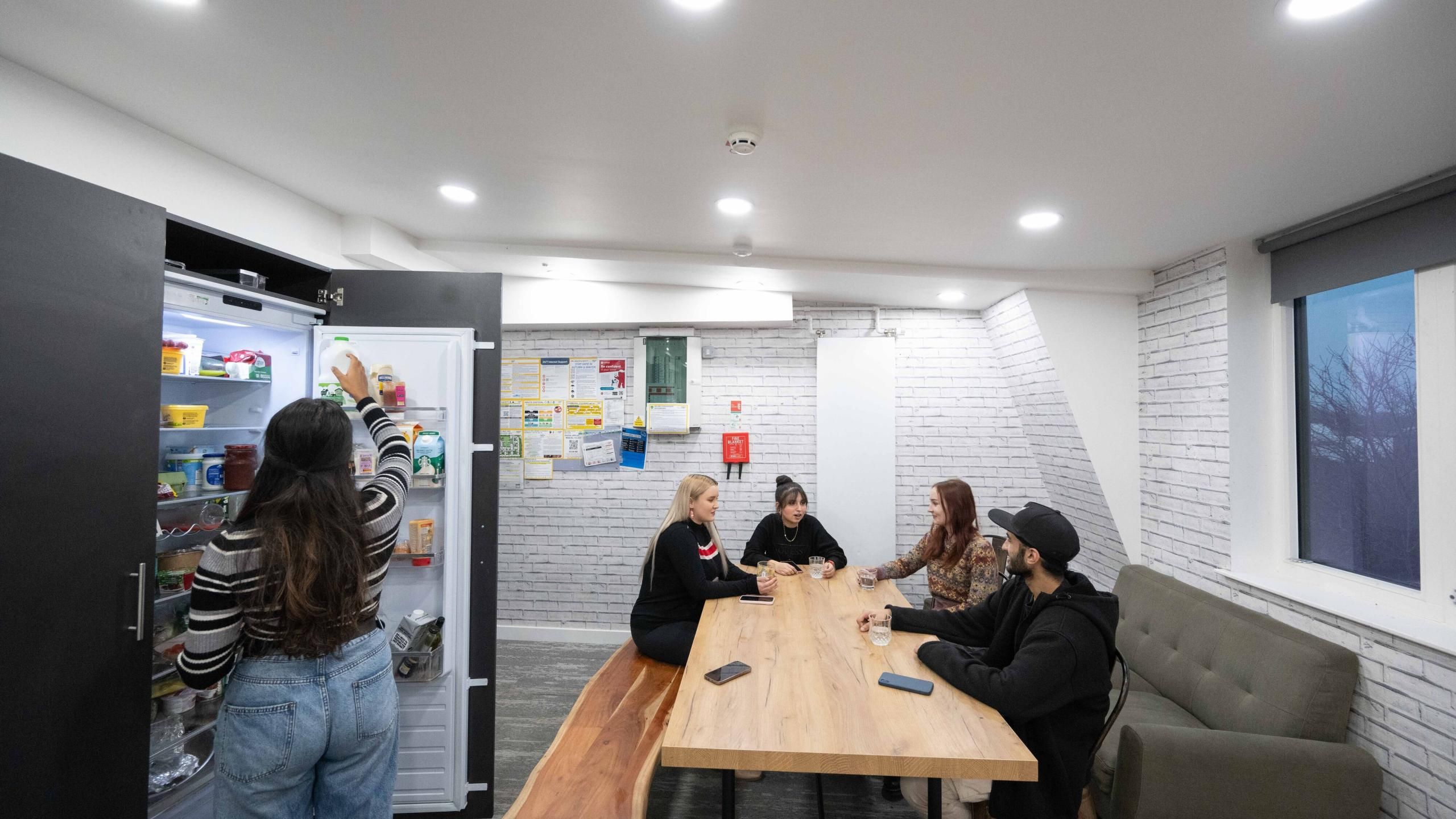
Our halls are self-catering, mixed gender and have WiFi access. You’ll share a flat with other students from different backgrounds and courses.
Want to know more about our halls?
Discover our section about the types of accommodation available to Kingston University students.
Am I eligible to apply for the Study Abroad programme?
Academic requirements
To apply for our Study Abroad programme, you must:
- Be a current undergraduate university or college student
- Have successfully completed at least one year of university study
- Have a cumulative GPA of at least 2.75 on a 1–4 scale (or equivalent)
Higher-level modules might have other prerequisites. If your GPA is below 2.75 or you’re not sure how your grading system translates, please get in touch with us at [email protected].
Language requirements
If English is not your first language, you’ll need to meet the following UKVI minimum requirements:
- IELTS (academic): 6 (with 5.5 minimum in each element)
- TOEFL iBT: 4 (Overall score of 4, with a minimum of 2 elements at 4.5 and 2 elements at 4)
We are happy to consider other internationally recognised tests too, please visit our English language entry requirements page for more information.
Need to improve your English language skills?
Over the summer, we run pre-sessional English courses for international students looking to advance their English language skills.
How to apply to study abroad at Kingston
There are four ways to apply to Kingston University. Your home institution will be able to tell you which is best for you.
You can apply:
- Through an institution we have a direct enrolment agreement with
- Through a Study Abroad provider like Academic Programs International (API) or Worldstrides
- As an independent student
- Through one of our official international exchange partners

You must submit the following information as part of your application, all of which should be submitted in the online application.
- An official college or university transcript showing which classes you’re enrolled in
- A 250–300 word personal statement explaining why you chose Kingston, which modules you’ve selected and your main goal here
- A good quality flat scan of your passport’s photo page
- An academic reference from an academic member of staff who has taught you in at least one class and can comment on your performance
- A head-and-shoulders photo
- Official confirmation of your English language proficiency, if it’s not your first language
Please make sure everything is in English.
If you’re applying for a studio-based module at Kingston School of Art in one of the following subjects, you’ll need to send us a portfolio of your work too.
- Architecture
- Creative and Cultural Industries: Art Direction
- Creative and Cultural Industries: Events and Experiences Design
- Fashion
- Fashion Promotion and Communication (specific agreements only)
- Fine Art
- Graphic Design
- Illustration Animation
- Interior Design
- Photography
- Product and Furniture Design
Creating and sharing your portfolio
We accept web portfolios and PowerPoint or JPEG documents under 10MB. Email the link or attachment to [email protected]k.
You must include:
- Your name, current university and the course you wish to apply for on all correspondence headers and web links
- A mix of developmental work and finished projects
- Anything personal or interesting to you that supports your application and shows us how you think
Apply by 5 June for the autumn semester (study option 2) or the full year (study option 1).
Apply by 6 November for the spring semester (study option 3).
- You’ll get an email to confirm we’ve received your completed application
- Your application will be reviewed and we will send you an admissions decision by email.
- You can accept the offer by following the link and replying to the email
- We’ll send all the arrival information you need before you start
View the institutions we have a direct enrolment agreement with
- Academic Programs International (API)
- Central Michigan University
- Georgian Court University
- Lebanon Valley College
- Lucerne University of Applied Sciences and Arts
- Nürtingen-Geislingen University
- Robert Morris University
- Slippery Rock University
- State University of New York, New Paltz
- University of Rochester
- University of Southern Maine
- University of Tulsa
- Winthrop University
- Worldstrides
View our official international exchange partners
- Hiroshima University (Faculty of Engineering, Computing & the Environment)
- Kyoto Institute of Technology (Design School/Architecture only)
- Kyoto Seika University (Illustration Animation only)
- Academy of Art University (School of Fashion only)
- Adelphi University
- Baldwin-Wallace University
- California State University
- Grand Valley State University
- Jacksonville University - Davis College of Business
- James Madison University
- Pratt Institute
- State University of New York New Paltz
- The Catholic University of America (School of Architecture only)
- University of North Carolina Charlotte
- Wentworth Institute of Technology
Ready to start your Study Abroad journey?
Applications to the Study Abroad programme for Study Options 1 (academic year) and 2 (autumn/fall semester) are now open.
How much does it cost to Study Abroad at Kingston?
Kingston University’s competitive Study Abroad fees cover:
- All tuition
- A discounted airport pick-up service
- Special welcome and departure events
- Use of the library and computing services
- Student counselling, wellbeing and health centre services
- Students' Union membership
- A transcript at the end of your studies
If you’re applying and paying independently, you need to pay your fees in British pounds on your first day at Kingston.
Learn more about how to pay.
| Study option | Period of study | Tuition fees 2026/27 |
|---|---|---|
| 1 | Academic year | £14,000 |
| 2 | Autumn (Fall) semester | £7,000 |
| 3 | Spring semester | £7,000 |
Check out our refund policy below. Remember, weeks start on Saturdays and end on Fridays.
Date of withdrawal | Study option | Fees |
|---|---|---|
Before 15 August | 1 or 2 | No administration fee |
Before 1 December | 3 | No administration fee |
After 15 August | 1 or 2 | £200 administration fee |
After 1 December | 3 | £200 administration fee |
After arrival at Kingston University, but before first day of teaching | 1, 2, 3 | Either switch to the next semester/year at no additional cost; or
£200 administration fee plus 90% refund of tuition fees |
After the first day of teaching, but before end of second teaching week | 1, 2, 3 | £200 administration fee plus 75% refund of tuition fees |
After second week of teaching | 1, 2, 3 | No refund |
Make sure you budget for living expenses as well as tuition fees.
Around £180 per week should cover meals, some local travel, study-related costs, entertainment and other personal items.
Standard university accommodation is usually between £150 and £200 per week.
All undergraduates registered at an institution in the USA or Canada can apply for the $500 British Universities Transatlantic Exchange Association (BUTEX) scholarship. Find out more about BUTEX.
Arriving at Kingston University
Arriving in a new country can be overwhelming, so we’ve got lots going on to help you feel welcome.
You’ll receive all the details in your pre-arrival information emails. But here’s some useful information about what to expect:
- A tailored orientation session to meet key teams and discuss your studies
- An informal welcome reception to socialise with fellow students
- A Welcome Week programme full of fun events and information
- An enrolment event to confirm your student status
Looking for more arrival information?
We tell you what you can expect when you arrive at Kingston University.
Programme dates 2026/27
Please note, there is just one exam period during the academic year. See our module directory for information about fall (Study Option 2) and spring (Study Option 3) assessments for single-semester students.
The timetable for the exam period for full-year (i.e. Study Option 1) students is normally published in March. You will not be able to confirm your departure date until the timetable is published and exam dates are not able to be changed.
The dates below may occasionally be subject to change for operational reasons.
- Application deadline for January 2026 entry: Friday 7 November
- Halls of residence contract start date (for students on Study Option 3): Thursday 8 January
- Orientation (for new students here for Study Option 3): Friday 9 January
- Welcome events: Friday 9 and Saturday 10 January
- Teaching begins: Monday 12 January
- Enrichment/Reading Week: Monday 16 February to Friday 20 February
- Teaching finishes: Thursday 2 April
- Halls of residence contract end date (for students on Study Option 3): Saturday 25 April
- Summer Period (including exams) starts: Monday 27 April
- Exam period (for students here for Study Option 1): Monday 27 April to Friday 22 May
- Halls of residence contract end date (for students on Study Option 1): Saturday 27 June
- Application deadline for September 2026 entry (Study Options 1 and 2): Friday 5 June
- Student Arrival: Thursday 17 September
- Orientation: Friday 18 September
- Halls of residence contract start date: Saturday 19 September
- Welcome Week: Monday 21 September to Friday 25 September
- Teaching begins: Monday 28 September
- Enrichment/Reading Week: Monday 2 November to Friday 6 November
- Teaching finishes: Friday 18 December
- Halls of residence contract end date (for students here for Study Option 2): Saturday 19 December
- Application deadline for January 2027 entry (Study Option 3): Friday 6 November
- Halls of residence contract start date (for students on Study Option 3): Saturday 9 January
- Orientation (for new students here for Study Option 3): Friday 8 January
- Welcome events: Friday 8 and Saturday 9 January
- Teaching begins: Monday 11 January
- Enrichment/Reading Week: Monday 15 February to Friday 19 February
- Easter vacation period: Friday 26 March to Friday 9 April
- Final teaching week: Monday 12 to Friday 16 April
- Halls of residence contract end date (for students on Study Option 3): Saturday 24 April
- Summer Period (including exams) begins: Monday 26 April
- Exam period (for students here for Study Option 1): Monday 26 April to Friday 21 May
- Halls of residence contract end date (for students on Study Option 1): Saturday 26 June
Useful information
Check out our pre-arrival information page for practical tips to support you as you settle in the UK.
Learn your rights when it comes to finding paid work here.
Discover more about Kingston’s unique location.
Read about our multi-faith community and how you can practise your religion here.
Find out what’s going on in our vibrant student community.
We’re here to help
Our Study Abroad International Learning (SAIL) team is here to answer your questions and offer guidance whenever you need it. You can get in touch by:
- Visiting their office on the first floor of Yorkon Building on the Kingston Hill campus (see the Kingston Hill campus plan)
- Emailing [email protected]