

Improving the design of multi-sensory environments for people living with dementia

Dementia is a serious condition that affects the daily life, independent function, behaviour, feelings and relationships of individuals. There are over 850,000 people living with dementia in the UK, according to the Alzheimer's Society.
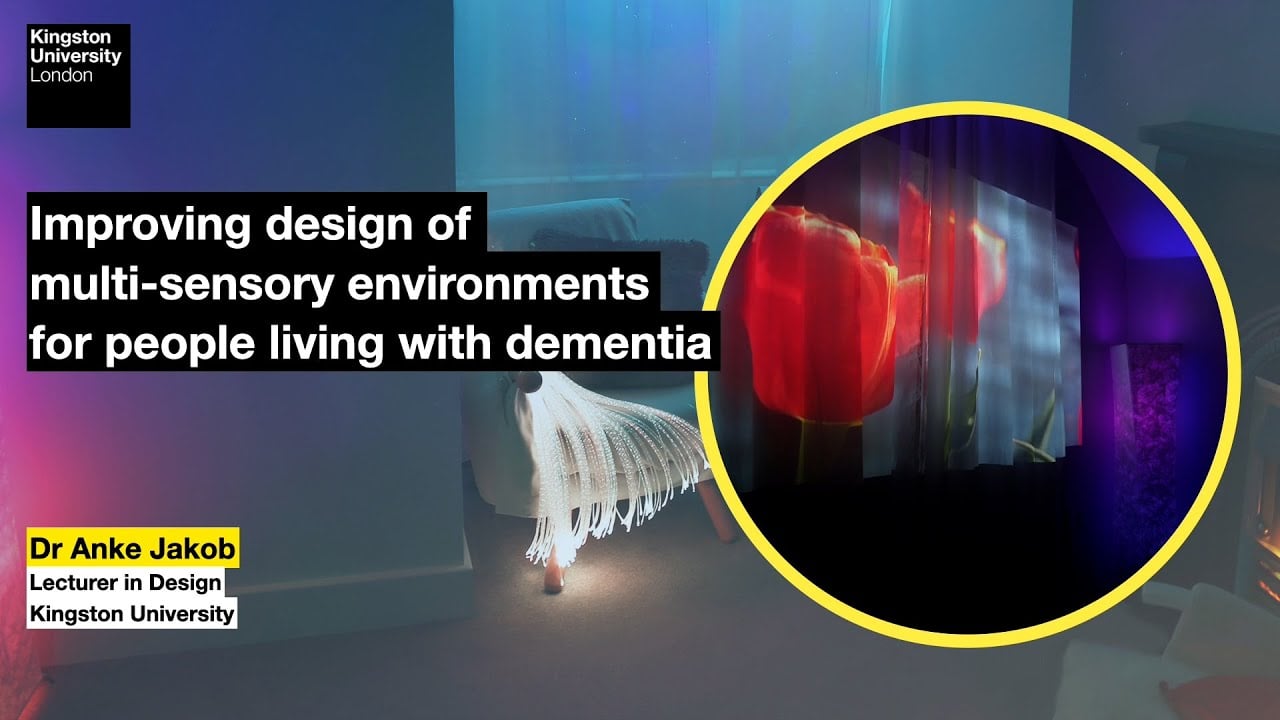
For those affected by dementia to receive the best support, it is necessary to understand how to design environments and activities that benefit them. Dr Anke Jakob of Kingston University's Design School has researched the provision and design of spaces used for multi-sensory stimulation, known as Multi-Sensory Environments (MSEs) or Sensory Rooms, for people with dementia living in care homes. Watch the video below to find out more.
As part of an AHRC-funded research project, Dr Jakob conducted an ethnographic study in 16 care homes.
The study revealed that in most cases, MSEs did not produce the expected benefits. This was due to inadequate design, installation and functionalities as well as aesthetic appearances not suitable for people living with dementia. Moreover, care practitioners lacked guidance and knowledge of facilitating appropriate sensory activities and environments for their residents.
Based on these findings, and in collaboration with Professor Lesley Collier (Winchester University), Dr Jakob developed the guidebook How to Make Sensory Room for People Living with Dementia. Published in 2014, the book offers design recommendations for installing sensory-enhanced spaces tailored to the needs of people living with dementia. The guide is freely available online. It has attracted coverage by media outlets and organisations supporting people with dementia, including Science Daily, Alzheimers Weekly and Alzheimers.net.
The guide had regional, national and international reach. This included care homes overseas and local, Coombe Hill Manor (CHM) in Kingston being one of them. With Dr Jakob's help and guidance, CHM staff transformed an underused lounge into a new facility used daily by residents for sensory activities. Ronald Gibson House (South London) and Rose Blumkin Jewish Home (Omaha, US) are other care homes that took inspiration and insights from the guidebook and created sensory-enhanced spaces to the benefit of their residents. Rose Blumkin's occupational therapist stated: "The guide educated us in important design features and practical considerations for this kind of environment that we had not found in other resources". According to RGH staff, the stimulating, yet calm Sensory Room "helps to reduce challenging behaviour and stress. This applies not only to residents with dementia but also to residents with other mental health issues".
Dr Jakob collaborated with Chinese care provider Tai Kang Healthcare who translated the guidebook into Chinese, making it freely available and potentially benefiting a large number of people living with dementia in China.
Dr Jakob's research inspired Relish, a company that develops and produces activity products for people living with dementia.
Relish introduced a new sensory product range, particularly beneficial for people with late-stage dementia. This range includes products such as Scentscapes, Sensory Scenes and Sensory Snaps. Rompa, a company producing multi-sensory products for a range of users, reviewed their product catalogue ‘Meaningful Activities for Older Adults' based on insights from Dr Jakob's research, and adapted the design of their products to make them more age- and dementia-appropriate.
Dr Jakob's research also proved useful to Historic Royal Palaces (HRP) for the development of their health and well-being 'Sensory Palaces' community programme.
HRP senior staff reported that Dr Jakob's research informed them about the manifold issues surrounding sensory stimulation and made them consider the balance between sensory stimulation versus sensory overload.
Dr Jakob's research has created international impact on care providers and developers of activity products, and on community projects in the UK. It has transformed the caring environment as well as the dialogue regarding how to best engage people living with dementia.
Contact us
For non-student research enquiries, email the Research Office.
For research impact and REF enquiries, email the REF and Impact Team.