Highlights of 2025 – a year of innovation and ambition for Kingston University
- Research
- Awards
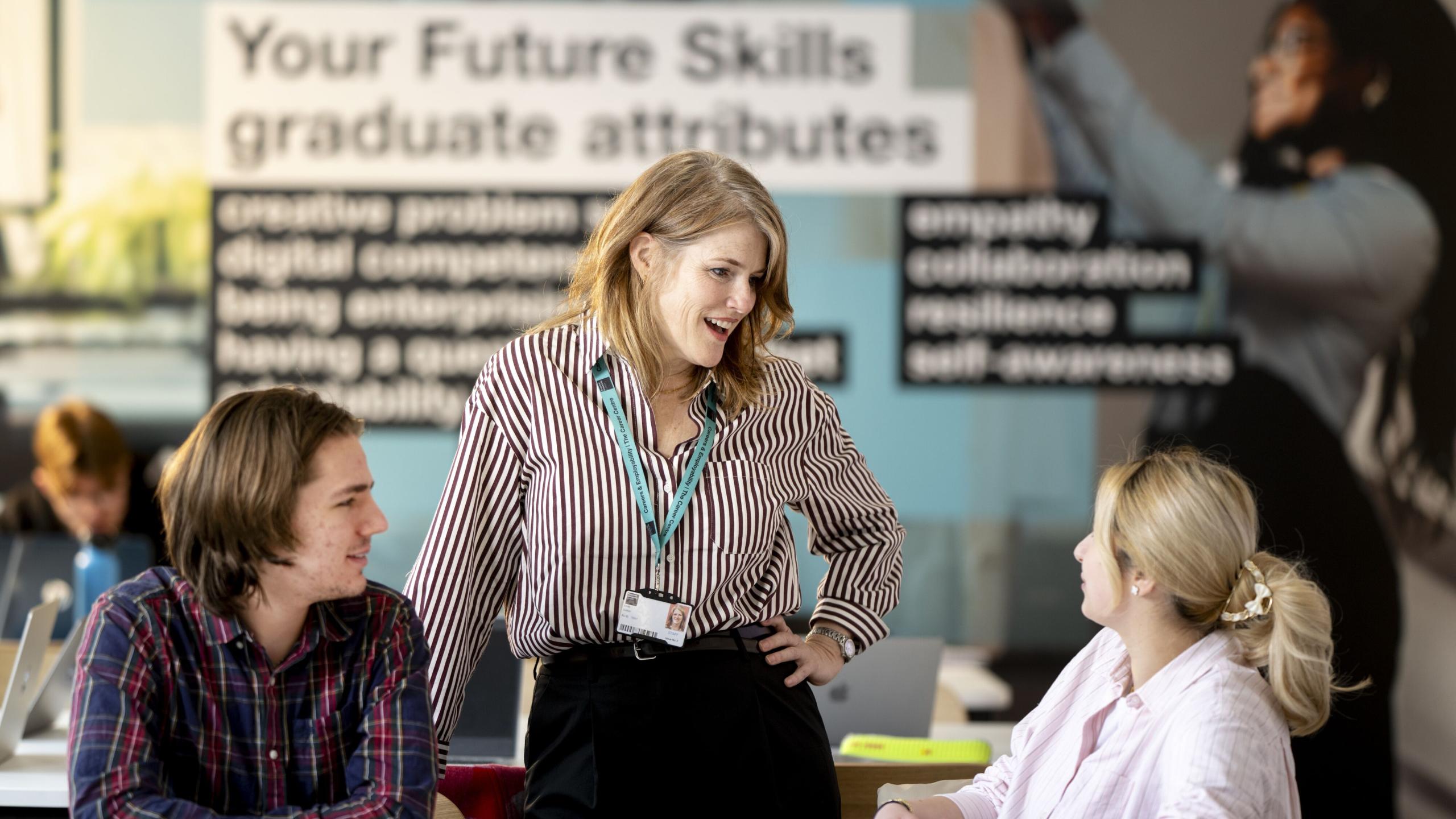
- Future Skills
- Knowledge exchange

Kingston University students, staff and alumni have celebrated a wide range of achievements and successes throughout 2025. As the year draws to a close, we reflect on the highlights of the past 12 months, from milestones in our sector-leading Future Skills approach to advances in teaching, learning, research and knowledge exchange, student celebrations and showcases and investments in our campuses.
In January, the achievements of some 3,000 graduates were applauded as they crossed the stage across 17 graduation ceremonies at the Rose Theatre in Kingston. Four influential figures received honorary degrees. The University marked the launch of our largest ever live brief in conjunction with the John Lewis Partnership, with 600 students involved as part of the Explore phase of our Future Skills programme.

February saw Kingston Business School at the forefront of two groundbreaking EU-funded research projects on 6G and edge computing technologies, while the funding of 16 Seedcorn Innovation projects was announced. Elsewhere, the 20th final of Kingston University's Bright Ideas competition saw £9,500 worth of prize money won by entrepreneurial students. A Kingston School of Art filmmaker won multiple international awards for her ground-breaking short animation. To round off the month, brand-new immersive healthcare simulation suites equipped with the latest technology were opened at our Kingston Hill campus.
March was a notable month for Future Skills. Kingston and Surbiton MP and Lib Dem leader Sir Ed Davey opened a Westminster Hall debate championing the value of Future Skills. In the Faculty of Engineering, Computing and the Environment, a new PhD programme was launched to develop the rocket engineers of the future. Kingston Business School’s Master of Business Administration (MBA) was included among the top global business schools in the latest CEO Magazine ranking. At the Penrhyn Road campus, a new sensory space for neurodivergent students opened.
In April, FIFA funding for research into ACL injuries in women's football, led by University academics was announced. Another new research study explored how roaming AI-powered sensors can help improve the accuracy of air quality monitoring. Engineering students and staff celebrated five years of Kingston Racing by preparing to compete in two international Formula Student competitions for the first time.
The University’s research and knowledge exchange ambitions were highlighted during an all-staff event in May at Town House. Students taking part in the Future Skills live brief with the John Lewis Partnership took their learning into the fields of Leckford Estate in a Waitrose & Partners farm visit. A criminology and sociology expert was awarded a British Academy ODA Global Innovation Fellowship to further pioneering research to develop solutions for young refugees facing social exclusion.

The creations of final year Kingston School of Art students took centre stage in June at the annual Kingston School of Art Degree show. Staff and teams from across the University were shortlisted for five University Alliance Awards. Our fourth Future Skills report, Perspectives from East and West was launched at the House of Commons. The latest report, which builds on three previous reports, found that UK businesses are placing increasing emphasis on human-centric skills for graduate recruitment.
In July, graduations returned as thousands donned their gown and mortar boards for our summer ceremonies. BBC journalist and broadcaster Clive Myrie emphasised the importance of hard work to graduates when awarded his Honorary Doctorate by the University. There was award success for our Future Skills approach at the Institute of Student Employers (ISE) Awards and the University was recognised for actions to improve outcomes for staff with disabilities.
August saw an influx of retro computer game fans flocking to an Archive of Retro Computing exhibition at Town House. Artificial intelligence and virtual reality were used in combination by academics from the University’s Knowledge Exchange and Research Institutes to create an engaging new interpretation of a statue of King Athelstan, who is widely regarded by historians as the first King of England. This was part of Kingston Council’s cultural celebrations to mark the 1100th anniversary of Athelstan's crowning.
As the new academic year began in September, the University reached a significant milestone with the much-anticipated roll-out of Apply – the final phase of its sector-leading undergraduate Future Skills programme. The University maintained its position in the top half of UK universities the 2026 Guardian University Guide and was recognised as one of the top institutions for graduate start-ups in the Knowledge Exchange Framework. In addition, its KU Cares programme was recognised with a new Quality Mark from the National Network for the Education of Care Leavers (NNECL).
Two innovative research projects were shortlisted in the prestigious Times Higher Education Awards while teams and individuals earned top honours at this year’s University Alliance Awards.

October saw more investments in our campuses. A range of new computing and engineering facilities were opened at Roehampton Vale and Penrhyn Road. In the same month, the University hosted a landmark international conference aimed at equipping teachers from Kingston and the Republic of Korea with the skills to integrate AI into their classrooms.
University researchers were selected for a prestigious Innovate UK programme to help commercialise their research. At Kingston School of Art, four fashion graduates were shortlisted for a prestigious award that celebrates emerging creative talent on the world stage.
The University also submitted a planning application for a state-of-the-art education building at the Middle Mill site, designed to elevate creative learning and innovation at Kingston School of Art on its Knights Park campus. Closing the month, the transformative impact of our knowledge exchange expertise was celebrated at the Innovate UK Knowledge Transfer Partnership (KTP) Awards.

The official opening of the transformation of the main building at the Penrhyn Road campus and Adobe’s education leader championing creativity and enterprise at our annual People Awards were highlights in November. Additionally, a study involving Kingston University developed a world-first platform to evaluate AI disease detection systems demonstrates safety for NHS use.
Rounding off the year, December saw an Amazon Science-funded research initiative in the spotlight, which aims to revolutionise genetic science by harnessing artificial intelligence. There was award recognition for an architecture student who received a commendation in the prestigious Royal Institute of British Architects (RIBA) awards for a ground-breaking dissertation inspired by Hebron’s Old City in the West Bank, Palestine.
Watch Kingston University's highlights of 2025