

Landscape Architecture MLA (LI accredited)
- Architecture and interiors
- Postgraduate
The Landscape Architecture MLA course from Kingston University is accredited by the Landscape Institute (LI). As such, it can form part of your Professional Pathway to Chartership, a development programme that provides the knowledge required for a chartered practice.

Explore and refine your vision for the world around you
Throughout this course, you will work closely with architecture students in an art school environment.
You will use purpose-designed architecture studios, designed by Stirling Prize-winning architects Haworth Tompkins.
As part of Kingston School of Art, students on this course benefit from joining a creative community where collaborative working and critical practice are encouraged. Our workshops and studios are open to all disciplines, enabling students and staff to work together, share ideas and explore multi-disciplinary making.
Kingston School of Art at Knights Park is situated on the Hogsmill River, with its restaurant and bar opening on to the waterside. It has a friendly, creative feel and benefits from recently-refurbished workshops and studios, a reception area with a gallery, art shop and space, and the light and airy open-plan learning resources centre. There are also well-equipped lecture theatres, seminar rooms and computer resources.
For most courses, learning takes place in fully-equipped specialist studios. You will take part in classes, tutorials and critical reviews with fellow students. This strong studio culture ensures regular interaction between students and tutors.
For non-studio-based courses, learning takes place in classroom-based seminars, tutorials and lectures, alongside site visits to museums, galleries, auction houses and other creative professional environments.
I enjoyed the variety of projects and the opportunities and experiences that were presented to us by working on real sites with real issues, and communicating with real people who had an interest in the future of the site.
Student work

Canopy Design
Sophia Porter and Edward Buckton, 2022-2023

An ecological Future for Seething Wells
Jiahao Li, 2024

Softscapes - Permeable Surfaces for Flood Risk Mitigation
Rongfang Wu, 2024

Softscapes - Permeable Surfaces for Flood Risk Mitigation
Rongfang Wu, 2024

Canopy Design
Jiachen Chu and Chen Chen, 2022-2023

Canopy Design
Jiachen Chu and Chen Chen, 2022-2023

Canopy Design
Jiachen Chu and Chen Chen, 2022-2023

Soil Operations
Jiahao Li, 2022-2023

Canopy Design
Zhuohan Zhang and Bin Yang, 2022-2023

Thesis Project
Sophia Porter, 2022-2023

Revitalisation of Seething Wells
Allan Ingles, 2024
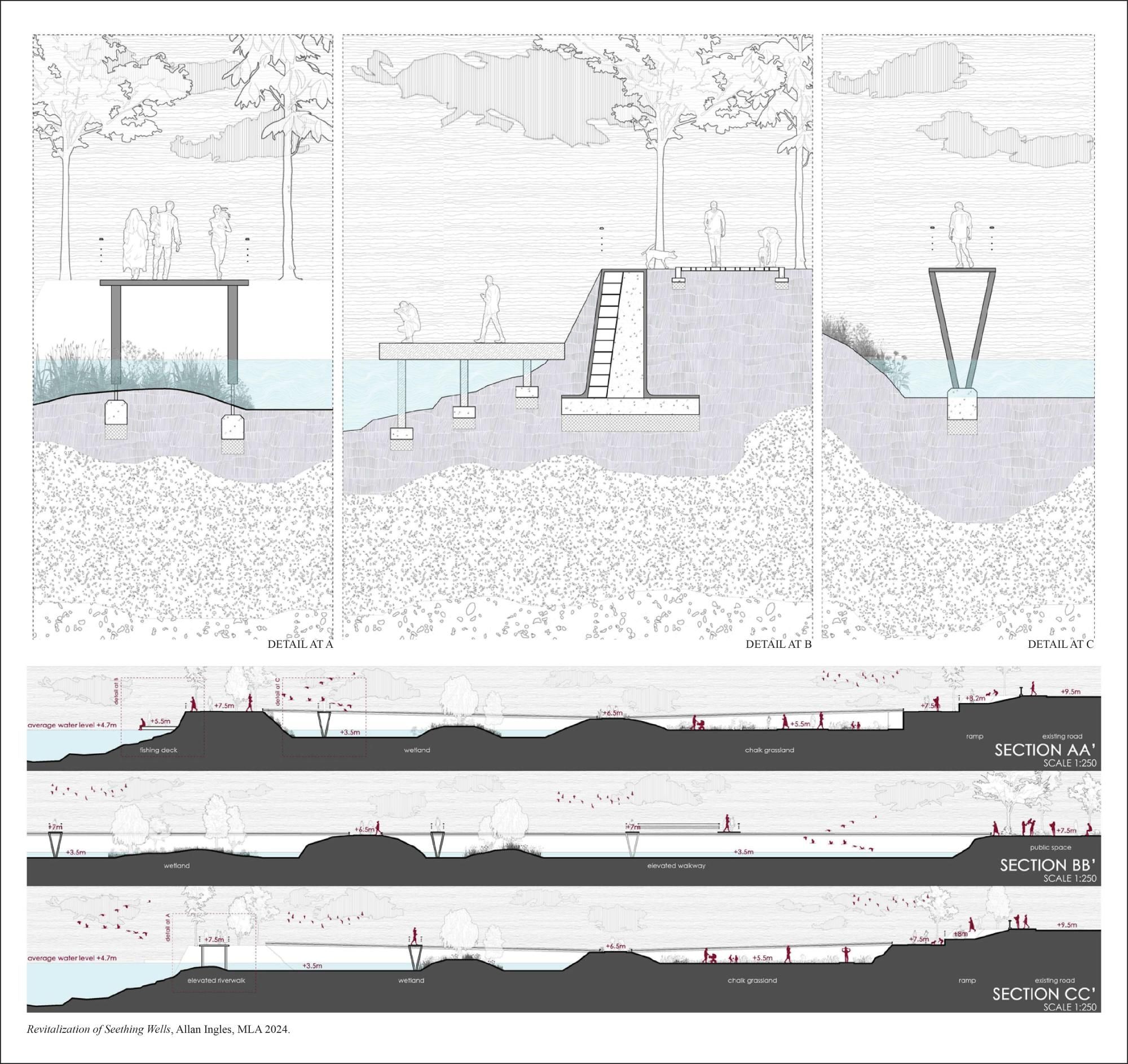
Revitalisation of Seething Wells
Allan Ingles, 2024

Ecological Sound Sanctuary
Trupti Kale, 2024

Urban Garden - A Proposal for Seething Wells
Nan Qiao, 2024

Softscapes - Permeable Surfaces for Flood Risk Mitigation
Rongfang Wu, 2024
Inside Landscape Architecture MLA & Urban Design MA
Hear from our academics, current students and graduates as they share their insights about what it's like to study Landscape Architecture and Urban Design at Kingston University.

Why choose this course
This course comprises a conversion year followed by a masters year.
With design at the heart of this course, you will work with advanced practitioners on site, including leading landscape architects who will critique your live design projects. Kingston's excellent reputation means that industry leaders regularly visit student shows to see the best of new talent.
Projects will reflect potential future opportunities for a landscape architect and form part of your personal portfolio. As a result, you will graduate with the tools you need to demonstrate your style and enter the workplace.
Throughout the course, you will take part in study visits and have opportunities to collaborate on live projects with clients and community engagement. The University has established local, European and international networks.
Many of the staff in the Kingston School of Art are research active. Their research ensures they are in touch with the latest thinking and bring best practice to your studies. Below are examples of projects undertaken by the Landscape Interface Studio.
Limehouse Cut: linking place and creativity
We collaborated with Shared Assets to develop the methodology and tools for a project engaging local people and creative industries in imagining a future for Limehouse Cut, London's oldest canal. This project was funded by CreativeWorks London. Students took part in the recording of a floating workshop and presentation at AHRC Creative Economy Showcase 2014 in London, targeting policy-makers and business leaders.
Milan Design Week Festival 2014
The 'Culture_Water_Landscapes' workshop explored links between local agriculture and the Naviglio Grande canal.
Water City Territory – international design workshop
A workshop for the design and research collaboration – 'Liverpool New York' – was hosted by the Van Alen Institute in New York City, with colleagues and students from Kingston and New York.
Follow our Architecture & Landscape Instagram to see some of the great work we are doing.
Accreditation
Our course is accredited by the Landscape Institute (LI). Accreditation requires education providers to meet important criteria which ensure high standards are maintained, meaning you can be sure your course meets the standards needed for you to enter the landscape profession.

The Art School Experience
As part of Kingston School of Art, students benefit from joining a creative community where we encourage collaborative working and critical practice.
Our workshops and labs are open to all disciplines, enabling students and staff to work together, share ideas and explore multi-disciplinary making.

Course content
All design projects are developed as part of a personal portfolio that can be immediately used to target employment. Projects reflect critical challenges and opportunities of contemporary landscape practice including green and blue infrastructures, resilient and adaptive strategies, detailed design of places for people, planting, biodiversity, transformation and change through time. Workshops include: model making (in the Faculty's 3D workshop), mapping, drawing, digital media, materials and construction.
Our London location, established local, European and international networks, and Landscape Interface Studio provide the focus for contemporary landscape design projects that address immediate and long-term landscape solutions for cities and their regions.
Modules
The course begins with a series of intensive workshops with expert practitioners for rapid assimilation and application of key landscape architecture skills, techniques and knowledge.
The course includes study visits and opportunities to collaborate on live projects with client and community engagement.
Summer work experience and a critical case study engage students with an immediate context of practice and the opportunity for dialogue with practitioners in relation to projects on site.
Core modules
I have now developed specialisms in river restoration and habitat creation, which have been realised through projects at Arup, for the Environment Agency.
Career opportunities
Examples of recent graduate destinations for this and similar courses include:
- senior landscape architect, ARUP Environmental
- landscape architect, Churchman Landscape Architects London
- landscape architect, Gustafson Porter London and Seattle
- landscape architect, Grant Associates Bath
- associate director/landscape architect, AECOM
- landscape architect, HTA Design London
- director, Spacehub London
Links with business and industry
You will be encouraged to engage closely with the diverse businesses that make London one of the most important centres for the creative industries. Students on this course have had the opportunity to work on collaborations with industry partners on both a national and international scale.
Future Skills
Our Future Skills programme is embedded within all our undergraduate courses and throughout the whole Kingston experience. These skills will help you to become a future-proof graduate by equipping you with the skills most valued by employers, such as problem-solving, digital competency and adaptability.
As you progress through your degree, you'll learn to navigate, explore and apply these graduate skills. You’ll also understand how to demonstrate and articulate to employers how these future skills give you the edge.

Teaching and assessment
You will be taught by an experienced teaching team whose expertise and knowledge are closely matched to the content of the modules on this course. The team includes senior academics and professionals, many of whom have their own architectural practices and are involved in the delivery of different elements of this course.
I champion the Kingston course and in particular the tutors whose encouragement and enthusiasm all helped shape me as the landscape architect I am today.
Fees and funding
Fees for future course years
Full time
If you start your second year straight after Year 1, you will pay the same fee for both years.
If you take a break before starting your second year, or if you repeat modules from Year 1 in Year 2, the fee for your second year may increase.
Part time
If you study for four consecutive academic years, you will pay the same fee every year.
If you take a break, or if you repeat modules, your future fees may increase in line with the course's annual increase.
Additional course costs
Some courses may require additional costs beyond tuition fees. When planning your studies, you’ll want to consider tuition fees, living costs, and any extra costs that might relate to your area of study.
Your tuition fees include costs for teaching, assessment and university facilities. So your access to libraries, shared IT resources and various student support services are all covered. Accommodation and general living expenses are not covered by these fees.
Where applicable, additional expenses for your course may include:
Funding support for postgraduate students
If you are a UK student living in England and under 60, you can apply for a loan to study for a postgraduate degree. Find out more through the government's website.

Scholarships and bursaries
For students interested in studying Landscape Architecture MLA at Kingston, there are several opportunities to seek funding support:

Student work

Projective Landscapes
Jiachen Chu, 2022-2023

Reimagining the Shores of Brighton and Hove
Anagha Rajendra Koli, 2022

Reimagining the Shores of Brighton and Hove
Anagha Rajendra Koli, 2022

Reimagining the Shores of Brighton and Hove
Anagha Rajendra Koli, 2022

Reimagining the Shores of Brighton and Hove
Anagha Rajendra Koli, 2022

A Kelp Forest for the Shores of Brighton and Hove
Qingcen Zhang, 2022

A Kelp Forest for the Shores of Brighton and Hove
Qingcen Zhang, 2022

A Kelp Forest for the Shores of Brighton and Hove
Qingcen Zhang, 2022

A Kelp Forest for the Shores of Brighton and Hove
Qingcen Zhang, 2022

Reclaiming Land - Strategies for an Ecological Urbanism for Brighton’s Coast
Ritvika Singh, 2022

Reclaiming Land - Strategies for an Ecological Urbanism for Brighton’s Coast
Ritvika Singh, 2022

Reclaiming Land - Strategies for an Ecological Urbanism for Brighton’s Coast
Ritvika Singh, 2022

Soil Operations
Rongfang Wu, 2022-2023

Canopy Design
Sophia Porter and Edward Buckton, 2022-2023

Canopy Design
Zhuohan Zhang and Bin Yang, 2022-2023

Canopy Design
Zhuohan Zhang and Bin Yang, 2022-2023
How to apply
Before you apply
Please read the entry criteria carefully to make sure you meet all requirements before applying.
How to apply online
Use the course selector drop-down at the top of this page to choose your preferred course, start date and mode, then click 'Apply now'. You will be taken to our Online Student Information System (OSIS) where you will complete your application.
If you’re starting a new application, you’ll need to select ‘new user’ and set up a username and password. This will allow you to save and return to your application.
Application deadlines
We encourage you to apply as soon as possible. Applications will close when the course is full.
Information required to confirm your place
If English is not your first language, we will require proof of your proficiency to allow us to confirm your place on the course. This will generally be either an IELTS or TOEFL test certificate, which can be forwarded to us after you have submitted your application. If you do not hold a formal English language qualification, please indicate how you have acquired your proficiency in written and spoken English.
After you have applied
If the admission tutor wishes to see a portfolio from you, you will be sent an email asking you to upload your zipped portfolio to the OSIS portal within three weeks of the date of the email request.
If the admissions tutor requires further information or wishes to invite you to an interview, they will contact you directly. You will then hear whether your application has been successful.

Course changes and regulations
The information on this page reflects the currently intended course structure and module details. To improve your student experience and the quality of your degree, we may review and change the material information of this course. Find out more about course changes
Programme Specifications for the course are published ahead of each academic year.
Regulations governing this course can be found on our website.
What our students and graduates say
My enthusiasm for the profession of landscape architecture is entirely based upon my experience at Kingston University where I feel students are encouraged to explore diversity within the wider subject, pursuing their individual interests. This led to two key developments which have maintained my interest in landscape architecture.


