Master of Business Administration (MBA)
Subject and course type
- Business and management
- Postgraduate
Our AMBA-accredited Master of Business Administration (MBA) is a transformative experience focused on business innovation and leadership. Through real-world challenges you'll develop practical skills and the confidence to make effective, strategic decisions. If you strive for business innovation and leadership transformation, this is the right path for you.
You are reading:
Reasons to choose Kingston University’s MBA
Our MBA will accelerate your professional growth, giving you strategic, analytical and leadership skills to succeed in a fast-changing global business environment.
- Global classroom, global impact. Learn alongside professionals from diverse industries and cultures. Gain cross-industry insights and global perspectives.
- International study exchange. Take elective modules at partner institutions in Germany or France, broadening your international outlook.
- Hands-on, active learning. Apply theory to practice through industry-led sessions, live business challenges and company visits.
- Globally-recognised accreditation. Kingston Business School is accredited by AMBA and AACSB, placing it among the top 2% and 6% of business schools worldwide respectively.
- Diversity and experience. Collaborate with professionals from a wide range of industries, bringing real-world insight into every discussion.
- Tier One global ranking. The Kingston MBA is ranked Tier One in CEO Magazine's Global MBA Rankings 2026 – the highest possible rating, and one of only 16 UK programmes to achieve this status.
Through the MBA, our students actively analyse, question, interpret and innovate. This course will prepare you to identify and embrace potential opportunities whilst developing your creative capacities and collaborative approach for success in different environments.
Invest in your future with up to £10,000 in scholarships towards your tuition fees, while building a global network of peers and alumni. With automatic consideration for our MBA Scholarship and the opportunity to apply for the Kingston Impact Scholarship, this financial support will help you thrive at Kingston University and beyond.
Before joining the MBA at Kingston, I had never considered opening my own business. But now I have adopted an entrepreneurial mindset, which has led me to launching my own consultancy company. One of the most useful elements of the course was being able to base the assignments through the lens of your own business. This has helped me develop key skills within risk analysis, time management, marketing, leadership and strategic planning.
Who this MBA is for
- Senior professionals seeking executive roles: Develop the strategic thinking and global perspective needed for C-suite positions. Learn alongside peers from diverse industries, bringing fresh insights to complex business challenges.
- Entrepreneurs and innovators: Transform ideas into viable businesses through our innovation-focused curriculum. Access incubation facilities, mentorship, and a network of fellow entrepreneurs while developing critical skills in risk analysis and strategic planning.
- Professionals ready for industry transformation: Pivot confidently with our comprehensive, multi-disciplinary approach. Build expertise across all business functions while expanding your international network through our exclusive study exchanges in Germany and France.
Globally-recognised excellence
The Kingston MBA has been accredited by the Association of MBAs (AMBA) since 1984. It was one of the first UK MBAs to receive this prestigious endorsement. Kingston Business School also holds AACSB accreditation, placing it in the top 6% of business schools globally.
Our MBA has also been included among the top global business schools, receiving the prestigious Tier One in the CEO Magazine ranking.
AMBA member benefits
- Network with students and alumni from more than 80 countries.
- Find mentors, business partners and career opportunities.
- Join one-to-one conversations and group discussions.
- Access MBA book club and industry forums.
- CV360: AI-optimised CV writing for maximum impact.
- Interview360: AI-powered interview practice with instant feedback.
- Global job board with worldwide opportunities.
- Career assessments to identify your strengths.
- Skills training through interactive e-learning modules.
- Verified digital badges and certificates.
- Professional mentorship programme.
- Exclusive member resources and discounts.
Shape your MBA around your goals
Choose the elective modules that suit you
All MBA students complete the same core modules (please see the list below). However, you can tailor your learning through a choice of two elective modules to support different career ambitions - whether you're progressing to senior leadership, expanding your impact across sectors, or building your own venture.
Do you aspire to be a cross-sector leader, with a foundation of business knowledge to successfully transition into a new industry? If so, we suggest two elective modules from:
- High Performance Leadership
- Supply Chain & Logistics Management
- Change and Creativity
Do you seek to accelerate your leadership and move into senior management roles? If so, we suggest two elective modules from:
- High Performance Leadership
- Change and Creativity
- Project Management
Do you aim to launch your own successful venture? If so, we suggest two elective modules from:
- Venture Capital and Start-up Fundraising
- Development & Growth of SMEs
- Project Management
Course content
Year 1
Elective modules (choose 2)
15 credits
Why do organisations need to change; to become more creative and innovate? How can management help people to achieve their new ideas and practices in a creative and imaginative way?
Change is a defining feature in contemporary organisations, posing key challenges and questions for all sorts of businesses, communities and societies. Implicit in change is the ability and capacity to act creatively in order to maintain healthy organisations. Therefore, to learn more about how organisations change, how to manage it, how people understand it; and, the complexities involved in acting and enacting change through creative processes becomes an essential feature of organisations in order to succeed in the 21st century. All of these exciting issues are explored in this module focusing on both, the epistemological and ontological aspects of creativity and change.
15 credits
The potential for growth is a defining feature of the entrepreneurial small and medium enterprises (SMEs). This module is concerned with the issues and decisions that the entrepreneur must consider in successfully managing the growth and development of new SMEs. The module is designed to cover four broad and interrelated issues: a) the process of business growth of SMEs, b) barriers to business growth of SMEs; c) internal strategies for the growth of SMEs, and d) external strategies for the growth of SMEs. The course will draw on materials from the literature on entrepreneurship to provide a basis for a critical understanding of the concepts and strategies for entrepreneurial venture growth and development.
15 credits
This module introduces you to the nature and scope of high performance leadership within private and public organisations, and explores how organisations can create and sustain success.
15 credits
In this module we look at how to use project management to deliver strategic change in organisations and thereby achieve performance improvement. We consider how strategic change can deliver performance improvement and identify the change required to deliver it. We then describe how to plan and manage a project to deliver the change. We consider how to define, plan and organise the project, and how to engage the stakeholders. We then describe how to manage time, cost, quality and risk. Projects usually take place as part of a portfolio or program of projects, so we describe how to manage them. We also cover the development of the business case and benefits realisation management. Portfolios and programs are a key governance mechanism in the project-oriented organisation, and so we place them in the context of governance. They are also key for translating corporate strategy into project strategy, and for ensuring project objectives are linked to corporate objectives.
15 credits
This module will develop your ability to understand how to plan, implement and control the most effective and efficient flow of products and services. You will develop decision making skills in the structuring of strategic and tactical options for organisations engaged in various supply chain and logistics activities. Class will be delivered by the combination of lecture, discussion of case studies, and students' presentations. This module considers how the theoretical aspects and methodologies of logistics and supply chain management can be applied into the real life practices. This module will be assessed through group presentation and individual assignment. Formative feedback on how well they do this will be provided in class.
15 credits
Venture capital and Business Angel finance has been the driving force behind some of the most vibrant sectors of the economy. Companies famous for receiving venture capital or business angel funding early in their development include Apple, Microsoft, Google and Amazon. US and Western Europe no longer dominate the industry and emerging countries such as China, India and Russia are fast catching up. Recently, the explosion of Crowdfunding platforms has signalled a new era for the innovation finance industry. This module analyses all stages of the funding ladder for innovative companies, from Crowdfunding, Business Angels, Venture Capital, Private Equity to IPO or M&A. It examines the main forms of innovation finance and the investment process; how private equity and venture capital funds, business angels and crowdfunding platforms work; how firms become investment ready, raise external finance and how to they finally exit. Students also learn about wider framework conditions that have a bearing on business innovation, including availability of finance for innovation, public policies and agencies promoting innovation.
Core modules
15 credits
The module aims to provide aspiring senior managers with an appreciation of the likely multidisciplinary impact of digital transformation on the overall customer experience and the need to develop future marketing executives possessing the necessary skills and capabilities, namely IT skills, to comfortably communicate across the different business functions ensuring that all digital platforms achieve optimal customer centricity.
15 credits
Students learn the necessary skills to build and scale a successful business. This includes how to develop ideas, build prototypes, and understand what customers truly want. The focus of the teaching and student experience is around hands-on learning and entrepreneurial activity. Students are given the opportunity to attend guest lectures with practising entrepreneurs and intrepreneurs to gain practical understanding towards making innovation happen. Support will be given through the Kingston University flexible office space for entrepreneurial start-ups, drop in advice, training and challenges.
Assessment is through coursework, presentations, business prototypes and completion of the entrepreneurial process.
15 credits
Financial analysis forms the bedrock of effective management decisions. The future truly is written in the numbers. This module equips you to interpret these numerical signals by developing your critical analytical skills through financial statements and market indicators, with AI significantly enhancing your interpretive capabilities.
Generative AI will expand your decision-making horizon when confronting financial challenges, revealing options that might otherwise remain hidden. It will also deliver an unbiased critique of your analytical reasoning and proposed solutions, refining your ability to extract actionable insights from financial data.
From reporting and management accounting to crucial budgeting and investment decisions, you'll explore financial domains where numbers reveal the path forward. This comprehensive approach will help you recognise how financial metrics uncover both opportunities and threats that determine organisational trajectories.
By mastering this powerful combination of traditional financial analysis and AI-enhanced techniques, you'll develop the essential skill of reading tomorrow's possibilities in today's numbers.
15 credits
This module is designed to introduce business students to the exciting world of business intelligence and big data science with a particular focus on its use to inform strategic decision-making policies. Today's managers need to understand where and how to use business intelligence and big data analytics, to allow them to utilise new sources of customer, product, and operational data, which coupled with data science will allow them to optimise key business processes and KPIs.
30 credits
This module consists of taught sessions on theory and practice of management consulting, as well as business research methods and a set of activities to support MBA candidates in the development of their client consultancy project. As such it looks at the relevant business research and analysis instruments and processes of sourcing and delivering consulting work. Perspectives of both consultant and client in a typical engagement are considered. The material provides solid theoretical and practical background to those wishing to pursue management advisory work on a professional basis.
15 credits
This module introduces you to the nature and scope of operations management within private and public sector operations in both service and manufacturing environments. The module explores operations strategy, process and capacity issues, supply chain management and improving operations.
15 credits
The module provides a critical understanding of the concepts of business ethics, corporate social responsibility (CSR), and stakeholder management and enables you to analyse, evaluate, and formulate business decisions in the light of ethical and societal considerations. It will enable you to manage organisations and your activities in a socially responsible way through the ability to evaluate CSR practices as applied to various business issues.
15 credits
This module introduces you to a systemic approach to identifying, understanding and analysing macro, meso and micro issues, set within the global context, which have significant implications for the successful management of organisations and the people within them to produce appropriate detailed recommendations for organisational implementation.
15 credits
This module explores how an organisation could develop widely supported and high quality decisions in a manner that would ensure its ability to succeed and remain sustainable. The module also helps you to learn how to translate a strategy into action in organisations and engage with the challenges that the implementation of strategy brings about in order to ensure sustainable success in a rapidly changing environment.
To achieve this we will be examining a number of conceptual and analytical approaches and models to help us understand the assets and capabilities of the organisation, and its relationships with suppliers, customers, regulatory bodies and other firms. Following on from this analysis we will consider the issues involved in understanding and designing strategic options and introduce a number of ideas as how the execution of strategy should be understood and related to different activities of the organisation that relate to the implementation of its different strategic options in terms of people, processes and technology.
Placement Year (optional)
This professional placement year is optional. It takes place after the full time MBA year. It enables you to do a 12-month work placement as part of your course. The work placement is an assessed part of the course and is therefore covered by a Student Route visa.
Find out more about the postgraduate work placement scheme.
Core modules
120 credits
The Professional Placement module is a core module for those students following a masters programme that incorporates an extended professional placement that follows completion of the first 180 credits of taught modules and project or dissertation. It provides students with the opportunity to apply their knowledge and skills in an appropriate working environment, and to develop and enhance key employability skills and subject specific skills in their chosen subject.
It is the responsibility of individual students to locate and secure a suitable placement opportunity; this will normally involve one placement which must be completed over a minimum period of 10 months and within a maximum of 12 months. The placement must be approved by the module leader prior to commencement to ensure its suitability.
Complete your MBA in 12 months
With our immersive block-learning format, most students are able to complete the Kingston MBA in 12 months. The format allows you to fully immerse yourself in each module, balancing focused study with practical application and networking opportunities.
Download the indicative MBA timetable to see how the course content is structured and when you will focus on each learning topic during the course.
Career opportunities
An MBA from Kingston opens doors to senior roles in diverse industries, from finance to tech. Graduates have secured roles such as Chief Operating Officer, Marketing Director and Management Consultant.
Many graduates use the knowledge gained from the Kingston MBA to help them operate more effectively at a higher level of senior management. Others use these skills to successfully set up their own business, expand into a consultancy role within an existing firm, or set up their own consultancies.
Examples of well-known organisations our alumni have worked for include GSK, AstraZeneca PLC, RBS, Tata Consultancy Services and Deloitte Digital.
We are proud of our collaborations with a range of organisations from various industries. This approach ensures that we can provide invaluable opportunities for MBA students. We plan live project briefs and guest lectures, as well as experiential visits and networking events.
International business networking
All Kingston MBA students come together for our annual International Fortnight event. Taking place on campus, you will study and socialise with other MBA students to grow your professional network.
Building on the knowledge you've gained during your course, you will immerse yourself in your choice of specialist modules and hear from inspiring guest speakers. Previous attendees have also had the opportunity to take part in exciting company visits, to give them a head start on their career path.
Courtesy of our AMBA accreditation, Kingston's MBA programme opens the door to lifetime membership of the Association of MBAs (AMBA) and a global alumni network.
Our MBA Talent Book
Find out what our class of 2024-2025 achieved during their studies and how they hope to transform their futures in business.
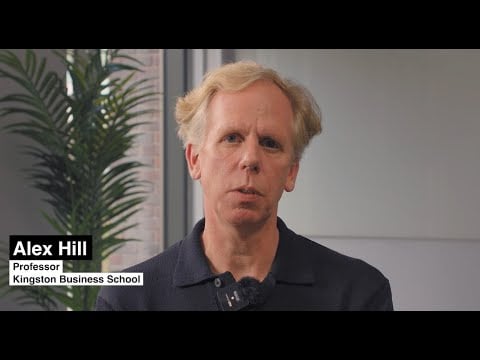
Meet the Kingston MBA academics
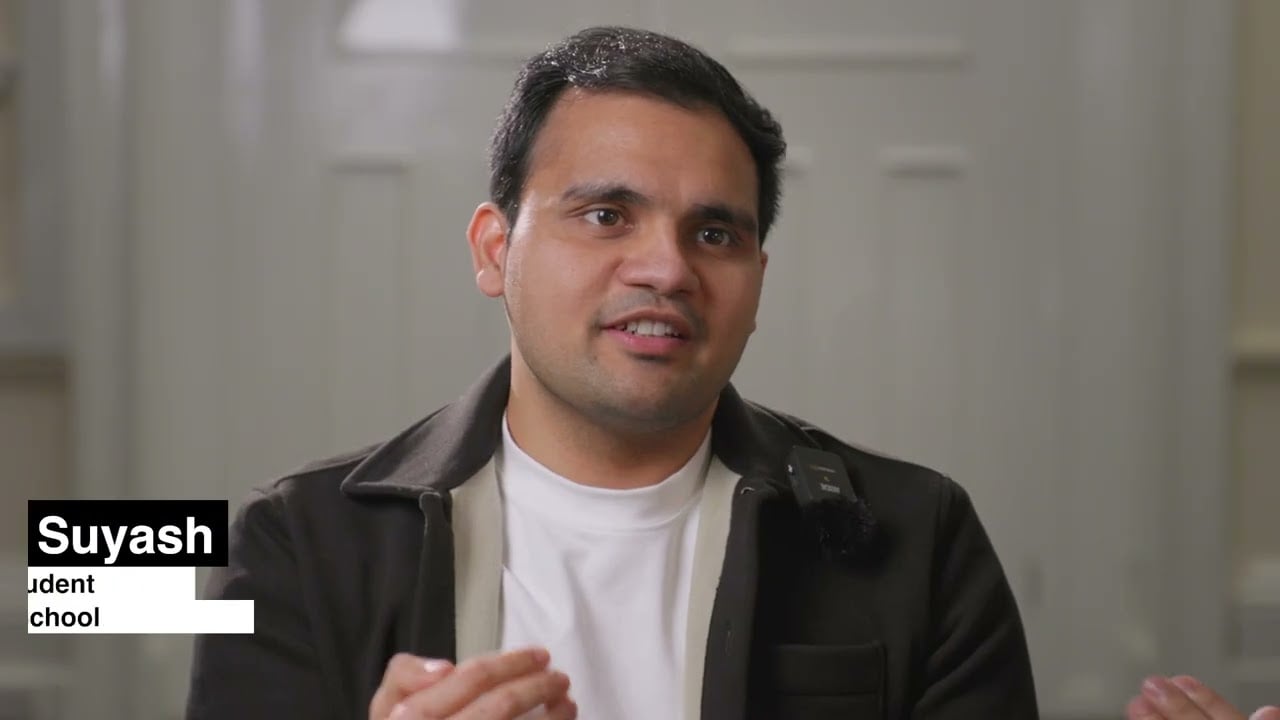
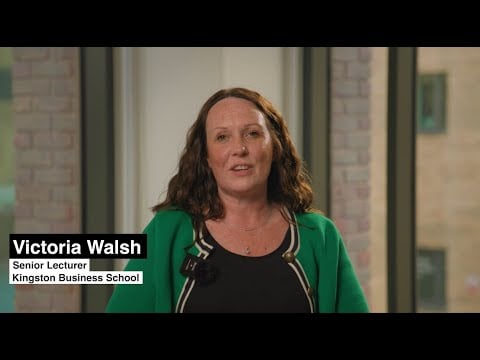
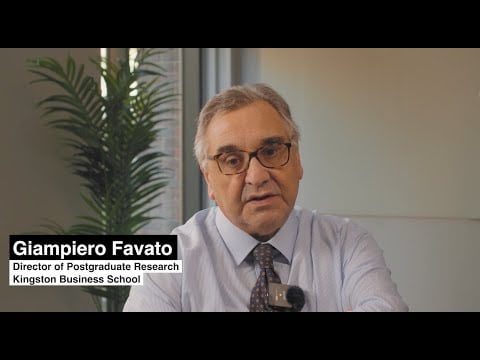
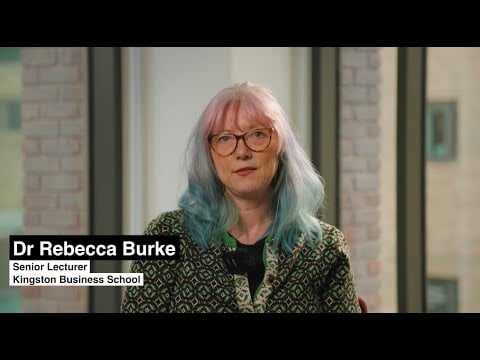
Get to know the experts who shape the MBA experience at Kingston Business School. In these videos, our academics share their backgrounds, academic interests, industry experiences, and what they bring to the MBA classroom.
Teaching and assessment
When not attending timetabled sessions, you will be expected to continue learning independently through self-study. This typically will involve reading journal articles and books, working on individual and group projects, preparing coursework assignments and presentations, and preparing for exams. Your independent learning is supported by a range of excellent facilities including online resources, the library and CANVAS, the online virtual learning platform.
As a student at Kingston University, we will make sure you have access to appropriate advice regarding your academic development. You will also be able to use the University's support services.
A course is made up of modules, and each module is worth a number of credits. You must pass a given number of credits in order to achieve the award you registered on, for example 360 credits for a typical undergraduate course or 180 credits for a typical postgraduate course. The number of credits you need for your award is detailed in the programme specification which you can access from the link at the bottom of this page.
One credit equates to 10 hours of study. Therefore 180 credits across a year (typical for a postgraduate course) would equate to 1,800 notional hours. These hours are split into scheduled and guided. On this course, the percentage of that time that will be scheduled learning and teaching activities is shown below. The remainder is made up of guided independent study.
- 25% scheduled learning and teaching
The exact balance between scheduled learning and teaching and guided independent study will be informed by the modules you take.
Your course will primarily be delivered in person. It may include delivery of some activities online, either in real time or recorded.
Type of assessment
- Year 1: Coursework: 85%, Practical 15%
- Professional placement: Coursework 100%
Assessment typically comprises exams (e.g. test or exam), practical (e.g. presentations, performance) and coursework (e.g. essays, reports, self-assessment, portfolios, dissertation).
Please note: the above breakdowns are a guide calculated on core modules only. If your course includes optional modules, this breakdown may change to reflect the modules chosen.
We aim to provide feedback on assessments within 20 working days.
Each student receives a personalised timetable. This is usually available after you have completed your online enrolment, which is typically accessible one month before the start of your course.
Partner institutions
We have close partnerships with esteemed institutions in Germany and France. MBA students can take on an elective module in a different cultural setting and experience different approaches to learning, whilst broadening their personal and professional network.
Fees and funding
| Fee Category | Annual Fee |
|---|---|
| Home (UK students) | Full Time £25,000 |
| International | Full Time £25,000 |
| Fee Category | Annual Fee |
|---|---|
| Home (UK students) | Full Time £25,000 |
| International | Full Time £25,000 |
Additional course costs
Please note, the MBA programme at Kingston so far has been a fully-financed programme for its students. All core text books and company visits are included. If you decide to do a study exchange at one of our partner institutions, you will need to pay for your own travel and accommodation.
Students who choose to take opportunities for supplementary certificates may incur costs for the exam. For example, we offer project management through ILX. Kingston University funds the teaching but not the exam.
Your tuition fees include costs for teaching, assessment and University facilities. So your access to libraries, shared IT resources and various student support services are all covered. Accommodation and general living expenses are not covered by these fees.
Where applicable, additional expenses for your course may include:
Our libraries have an extensive collection of books and journals, as well as open-access computers and laptops available to rent. However, you may want to buy your own computer or personal copies of key textbooks. Textbooks may range from £50 to £250 per year. And a personal computer can range from £100 to £3,000 depending on your course requirements.
While most coursework is submitted online, some modules may require printed copies. You may want to allocate up to £100 per year for hard-copies of your coursework. It’s worth noting that 3D printing is never compulsory. So if you choose to use our 3D printers, you’ll need to pay for the material. This ranges from 3p per gram to 40p per gram.
Kingston University will pay for all compulsory field trips. Fees for optional trips can range from £30 to £350 per trip.
Your tuition fees don’t cover travel costs. To save on travel costs, you can use our intersite bus service. This route links the campuses and halls of residence with local train stations - Surbiton, Kingston upon Thames, and Norbiton.
Courses involving placements or direct work with vulnerable groups may require a DBS check or other security checks.
If you choose to do a placement year, travel costs will vary depending on your location. These costs could be up to £2,000.
Some courses may require professional memberships.
Funding support for postgraduate students
If you are a UK student living in England and under 60, you can apply for a loan to study for a postgraduate degree. Find out more through the government's website.

Scholarships and bursaries
For students interested in studying Master of Business Administration (MBA) at Kingston, there are several opportunities to seek funding support:
We are proud to offer a scholarship of £5,000 towards tuition fees for self-funded candidates, who will be considered automatically following a formal offer of a place on the programme. This scholarship is designed to empower self-funded students to succeed at Kingston University.
The Kingston Impact Scholarship offers a £5,000 contribution towards tuition fees for two MBA students who are making a significant career transition or bringing entrepreneurial experience to the programme.
It is designed for candidates with non-traditional backgrounds who demonstrate leadership potential, a clear vision for their future, and the ambition to create meaningful change in their career, organisation or industry.
If you are an international student, find out more about scholarships and bursaries.
We offer discounts for Kingston University alumni. Please visit our postgraduate finance page to read more.
Progression Scholarships are available for certain postgraduate courses. Review our range of funding opportunities for masters-level study.
I have found communicating and networking with fellow students a highlight of the course. Our teamwork has allowed us to overcome the challenges in solving business cases, developing product ideas, and creating marketing, financial and operational strategies. As well as developing my knowledge and skills, I also expanded my professional network and built friendships with like-minded people.
Industry partners
We are proud of our collaborations with a range of organisations from various industries. This ensures that we can provide invaluable opportunities for students, from live project briefs and guest lectures, to experiential visits and networking events.
The business case to the Board was very well received. The presentation was a success, and we are extremely grateful for the support and work contributed by the MBA Director and the MBA students throughout the process.
The Centre for Political and Diplomatic Studies (CPDS) partnered with a team of four final-year MBA students on a project as part of their Management Consultancy module. The detailed 75-page consultancy report was presented to CPDS by the student team at a Client Presentations event. For CPDS as a small enterprise, the report is a simply invaluable resource. The immediate impact for CPDS has been realistic solutions for us to improve our business processes and grow our business.
How to apply
Before you apply
Please read the entry criteria carefully to make sure you meet all requirements before applying.
How to apply online
Use the course selector drop-down at the top of this page to choose your preferred course, start date and mode, then click 'Apply now'. You will be taken to our Online Student Information System (OSIS) where you will complete your application.
If you’re starting a new application, you’ll need to select ‘new user’ and set up a username and password. This will allow you to save and return to your application.
Application deadlines
We advise that candidates apply for the Kingston MBA as soon as possible – it can take longer than you think to get organised to start your MBA. We accept admissions throughout the year, so you can join the next available group of students when you are ready.
Information required to confirm your place
If English is not your first language, we will require proof of your proficiency to allow us to confirm your place on the course. This will generally be either an IELTS or TOEFL test certificate, which can be forwarded to us after you have submitted your application. If you do not hold a formal English language qualification, please indicate how you have acquired your proficiency in written and spoken English.
After you have applied
For courses that select on application alone, applicants should normally receive an initial decision or a request for more information within four to six weeks of receipt of their application. Our admissions team will notify you of the decision by email.
Learn more about the postgraduate application process in detail.
Coming in September 2026: The Kingston MBA (Online)
From September 2026, the Kingston MBA will be available in a fully online format. This option allows you to study our AMBA-accredited MBA from anywhere in the world, providing the flexibility to balance your studies with personal and professional commitments.
Whether you're balancing a demanding job, family commitments, or global travel, the Kingston MBA (Online) ensures you don’t have to compromise on quality or connection.
You'll benefit from:
- Access to the same academic expertise and high teaching standards as our on-campus course.
- A rich virtual learning environment, with interactive sessions, group work and real-time support.
- Opportunities to connect with your cohort, to network globally and to engage in live projects.
You're always welcome on campus. Online students can visit and make the most of Kingston University's facilities. From networking events to summer school sessions, there are plenty of opportunities to experience the best of both online and on-campus learning.
Please note: as this course is still subject to validation, some information may not be available at this time. The course is undergoing a rigorous approval process to ensure the content is relevant, meets industry standards and fulfils student needs.
Course changes and regulations
The information on this page reflects the currently intended course structure and module details. To improve your student experience and the quality of your degree, we may review and change the material information of this course. Find out more about course changes
Programme Specifications for the course are published ahead of each academic year.
Regulations governing this course can be found on our website.
What our MBA students and graduates say
The Kingston MBA helped me transition from an engineer to a senior management position. The course goes beyond the carefully designed modules - students are also given practical opportunities to apply theory to real business cases.
The way the MBA is taught is closely aligned with current corporate standards. As such, it has allowed me to implement what I have learnt into my business strategy, with a clear vision about how I can progress in my career. I joined the MBA as a doctor with plans to set up a tertiary health care hospital in my hometown in India. I am now equipped with the necessary skills and knowledge to achieve my goals.
My MBA cohort allowed me to work closely with an extremely talented group of people from a broad range of industry sectors, geographies and backgrounds. When writing my MBA dissertation on ‘IT integration in mergers and acquisitions' I established a number of unique and interesting relationships. This strengthened my professional network and was presented with opportunities to attend and speak at a number of industry events.