Intelligent Networks and Cloud Computing / with Management Studies MSc
- Computing and information systems
- Postgraduate
Gain the skills to develop a career in modern networking and cloud-based systems with the Intelligent Networks and Cloud Computing MSc. You can also tailor your studies through the Management Studies option, depending on your career goals. Throughout the programme, you will benefit from hands-on experience in our state-of-the-art laboratories, working with up-to-date systems and networked environments that reflect current industry practices.
Please note: this course was previously known as Networking and Data Communications MSc.

Explore modern networking and cloud communication technologies that underpin today’s AI-driven digital infrastructure
Develop specialist knowledge in intelligent networks, AI-enabled systems, cloud computing, wireless communications and network security
Our Intelligent Networks and Cloud Computing MSc equips you with the knowledge and practical skills to design, develop and manage modern networked systems that are cloud-integrated, software-defined and increasingly AI-enabled. You will develop expertise in areas such as cloud computing, network automation, and intelligent network management, alongside core principles of secure IP-based networking.
The programme combines theoretical understanding with hands-on application, enabling you to work on the specification, design, modelling and implementation of software and hardware-based systems. You will also explore key enabling technologies including 5G and beyond, the Internet of Things (IoT), and distributed cloud environments, reflecting current and emerging industry practices.
The curriculum is also designed to align with industry-relevant skill domains, including networking knowledge associated with CCNA-level concepts and cloud practices aligned with platforms such as AWS. While the programme is academic in nature and does not provide certification training, it offers a strong foundation that can support students who wish to progress towards relevant professional certifications.
At our Penrhyn Road campus, you will have access to a modern environment supported by industry-relevant tools and facilities, including:
- Dedicated postgraduate computing laboratories with high-spec systems and networked environments.
- Access to development platforms and tools such as Linux, Java, .NET and other industry-standard software environments.
- Networking and embedded systems equipment supporting practical experimentation.
- Facilities supporting work in areas such as wireless networking, IoT and digital systems.
The MSc has played a vital role in developing my career. I was given numerous opportunities to attend course-related workshops and conferences. I also published papers and participated in research activities of the Wireless Multimedia and Networking research group.
The student experience
Hear from current student, Kiyadokh as she shares insights into the course, why she chose Kingston and why she recommends the course to future applicants.

Why choose this course
The Intelligent Networks and Cloud Computing MSc provides a strong combination of theoretical understanding and practical skills aligned with modern industry needs. You will develop a critical understanding of networking, cloud computing and AI-enabled systems, and learn how to analyse complex requirements and design appropriate, scalable solutions.
The programme reflects current industry practice, incorporating areas such as cloud-native networking, automation and intelligent network management, alongside core communication principles. It is also aligned with industry-relevant skill domains, including networking knowledge associated with CCNA-level concepts and cloud practices aligned with platforms such as AWS. While the course does not deliver certification training, it supports progression towards relevant professional certifications.
You can also choose to combine the course with Management Studies, enabling you to develop key business, leadership and strategic skills alongside your technical expertise.
A major project/dissertation allows you to explore a specialist area in depth, often aligned with your career goals, providing a strong portfolio piece for employment or progression. For international students, projects can be tailored to contexts relevant to your home country or future career plans.
You will benefit from exposure to industry practices and emerging technologies through guest sessions, demonstrations and vendor-led seminars. Teaching is informed by research-active staff, ensuring that your learning is shaped by current developments in areas such as AI, wireless communications, and intelligent systems.
Accreditation
This degree has been accredited by British Computer Society (BCS), The Chartered Institute for IT. Accreditation is a mark of assurance that the degree meets the standards set by BCS. An accredited degree entitles you to professional membership of BCS, which is an important part of the criteria for achieving Chartered IT Professional (CITP) status through the Institute.
Following recent enhancements to the course module diet and a change to the course title, this course is pending re-accreditation in autumn 2026.

More about this course's accreditation
Some employers recruit preferentially from accredited degrees, and an accredited degree is likely to be recognised by other countries that are signatories to international accords.
British Computer Society (BSC)
This degree is accredited by BCS for the purposes of partially meeting the academic requirement for registration as a Chartered IT Professional.
This degree has been accredited by BCS, on behalf of the Engineering Council for the purposes of partially meeting the academic requirement for a Chartered Engineer (CEng). Accreditation is a mark of assurance that the degree meets the standards set by the Engineering Council in the UK Standard for Professional Engineering Competence (UK-SPEC). An accredited degree will provide you with some or all of the underpinning knowledge, understanding and skills for eventual registration as an Incorporated (IEng) or Chartered Engineer (CEng).
For full details of exemption and accreditation levels, please check the BCS course search.
The Faculty is a long-time member of BCS. For many years we have hosted meetings of the local BCS Kingston and Croydon Branch, contributing to members' continuing professional development programmes.
Please note: The programme delivered at our partner institution overseas is not currently accredited by the BCS.

Course content
The full MSc course consists of an induction programme, four taught modules and a project dissertation. Please note this is an indicative list of modules and is not intended as a definitive list.
For a student to go on placement they are required to pass every module first time with no reassessments. It is the responsibility of individual students to find a suitable paid placement. Students will be supported by our dedicated placement team in securing this opportunity.
Intelligent Networks and Cloud Computing MSc
Core modules
Intelligent Networks and Cloud Computing with Management Studies MSc
Core modules
Professional placement
Professional placement

Completing the Master of Science degree in Networking and Data Communication at Kingston University was a pivotal step in my professional journey. The program was not just a gateway to a doctoral program, it also laid the foundation for the academic career I had envisioned.
Career opportunities
Boost your employability
Graduates from this course go on to work in management, engineering and computing roles, as IT managers or consultants, and have become academics. Our alumni have worked for companies such as British Telecom (BT), IBM, Spotify, Meta, Inify Labs, and public organisations such as the NHS, Digital Catapult, and Rail delivery group.
Academic Centre of Excellence in Cyber Security Education
Kingston University is committed to promoting excellent cyber security education. As such the Faculty of Engineering, Computing and the Environment has established the Academic Centre of Excellence in Cyber Security Education and Culture.
Careers and recruitment advice
The Faculty of Science, Engineering and Computing has a specialist employability team. It provides friendly and high-quality careers and recruitment guidance. This includes advice and sessions on job-seeking skills such as CV preparation, application forms and interview techniques. Specific advice is also available for international students about the UK job market and employers' expectations and requirements.
The team runs employer events throughout the year, including job fairs, key speakers from industry and interviews on campus. These events give you the opportunity to hear from, and network with, employers in an informal setting.
Links with business and industry
To ensure your studies are kept up to date and answer the needs of business, our courses are created and reviewed in consultation with an advisory board of key industry experts and senior academics. The Board also provides input and advice on our research portfolio.
Members of the board are from organisations, such as Google, Microsoft, easyJet, games developer Colossal. The board also includes Chief Information Officers from local government. Our Advisory Board therefore represents the diverse spectrum of industries and public sector organisations that make up the jobs market for our graduates.
This course also has links with the Institute of Electrical and Electronics Engineers (IEEE), Institution of Engineering and Technology (IET), and Association for Computing Machinery (ACM).
Academics and industry researchers are often invited to deliver talks to MSc students via the IEEE distinguished lecturer scheme. Invited speakers in the course are also often selected IET members. Students are encouraged to get involved in ACM activities.
Teaching and assessment
Fees and funding
Fees for future course years
Part time
If you start your second year straight after Year 1, you will pay the same fee for both years.
If you take a break before starting your second year, or if you repeat modules from Year 1 in Year 2, the fee for your second year may increase.
Funding support for postgraduate students
If you are a UK student living in England and under 60, you can apply for a loan to study for a postgraduate degree. Find out more through the government's website.

Scholarships and bursaries
For students interested in studying this course at Kingston, there are several opportunities to seek funding support:

Additional course costs
Some courses may require additional costs beyond tuition fees. When planning your studies, you’ll want to consider tuition fees, living costs, and any extra costs that might relate to your area of study.
Your tuition fees include costs for teaching, assessment and university facilities. So your access to libraries, shared IT resources and various student support services are all covered. Accommodation and general living expenses are not covered by these fees.
Where applicable, additional expenses for your course may include:
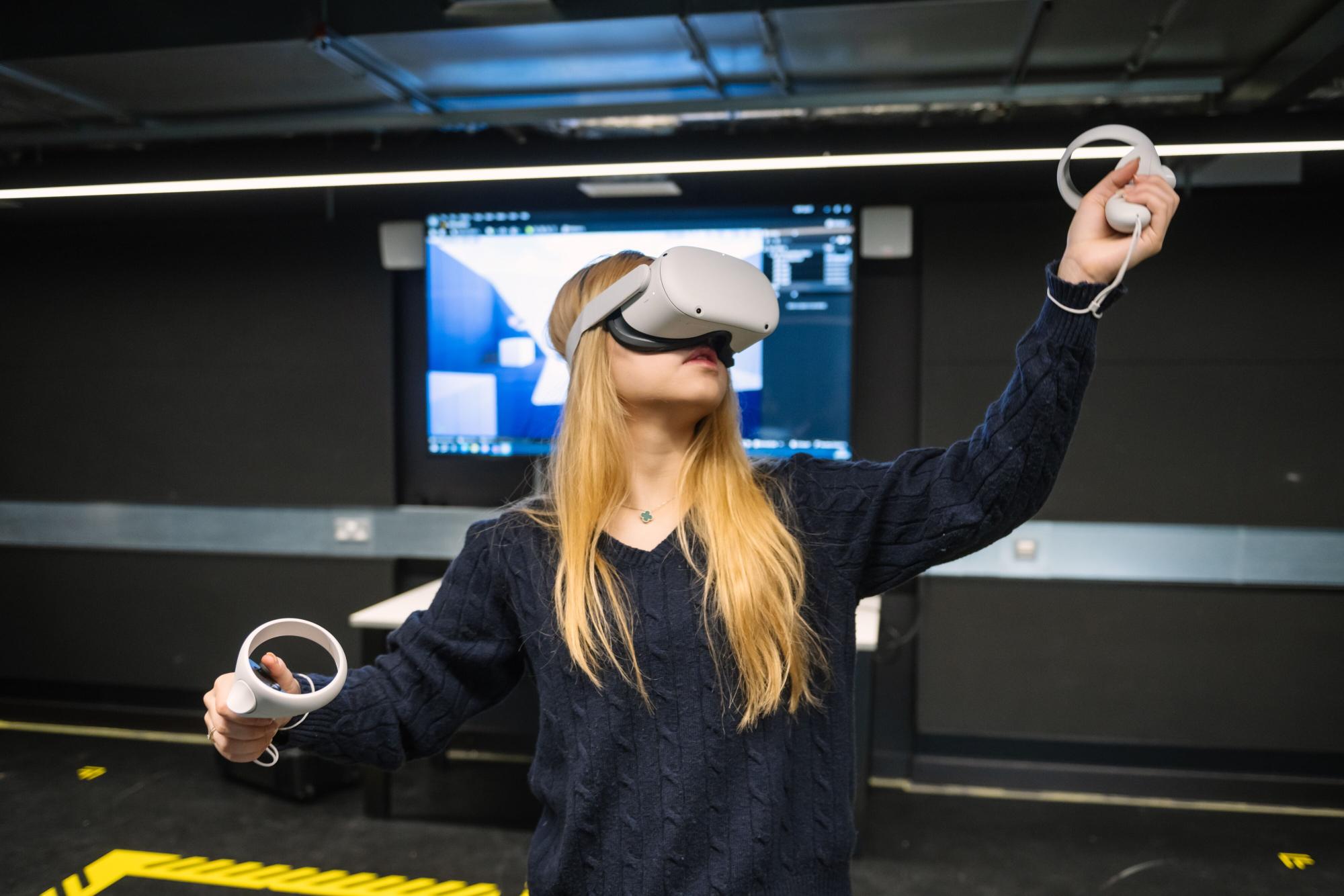
CAVE (Centre for Augmented and Virtual reality Environments)
Students have full access to the University's CAVE, a treasure trove of specialist equipment, including:
- virtual reality headsets and specialist equipment that tracks eye movements and brain activity
- state-of-the-art technology allowing students to monitor a user's levels of experience and enjoyment
- professional high-dynamic range (HDR), UHD, and light field (plenoptic/holographic) cameras and displays to capture and represent (even remotely) immersive environments
- event-driven (a.k.a. neuromorphic) visual sensors, which capture scenes mimicking the human eye
This lab has also allowed computing students to work closely and collaborate with design students. These collaborations promote interdisciplinary work and allow students to establish successful partnerships based on creating innovative products at the forefront of technology.
Due to this collaborative learning environment, Kingston University has become one of only 12 universities to have obtained an educational partnership with Sony (2017).
As a result, students have the possibility to experiment with several types of wireless networks and enterprise scale networking technologies. These include Internet of Things communications and 5G with a mobile edge computing testbed.
Extensive computer resources for experimenting with deep learning and blockchain technology are also available. As well as a fully equipped "cyber-lab" for students who wish to focus on security aspects.

How to apply
Before you apply
Please read the entry criteria carefully to make sure you meet all requirements before applying.
How to apply online
Use the course selector drop-down at the top of this page to choose your preferred course, start date and mode, then click 'Apply now'. You will be taken to our Online Student Information System (OSIS) where you will complete your application.
If you’re starting a new application, you’ll need to select ‘new user’ and set up a username and password. This will allow you to save and return to your application.
Application deadlines
We encourage you to apply as soon as possible. Applications will close when the course is full.
Information required to confirm your place
If English is not your first language, we will require proof of your proficiency to allow us to confirm your place on the course. This will generally be either an IELTS or TOEFL test certificate, which can be forwarded to us after you have submitted your application. If you do not hold a formal English language qualification, please indicate how you have acquired your proficiency in written and spoken English.
After you have applied
If the postgraduate admissions tutor requires further information or wishes to invite you to further assessment by interview they will contact you directly. You will then hear whether your application has been successful.
If you do not clearly meet the standard entry requirements and the admission tutor wishes to see a portfolio from you, you will be sent an email asking you to upload your portfolio to your Kingston University OSIS account. Further details on how to do this will be provided at the time.
Course changes and regulations
The information on this page reflects the currently intended course structure and module details. To improve your student experience and the quality of your degree, we may review and change the material information of this course. Find out more about course changes
Specifications for this course are published ahead of each academic year.
Regulations governing this course can be found on our website.