Criminology with Forensic Psychology MSc
- Criminology and law
- Psychology
- Postgraduate
Gain in-depth insight into crime, justice, and the role of psychology in investigations and the courtroom. This course combines criminology and forensic psychology, equipping you with research skills and critical knowledge relevant to policing, victimisation, offender behaviour, and the wider justice system.

Help make society a safer place
Studying this MSc in Criminology with Forensic Psychology at Kingston University will give you the skills to progress to careers in a wide range of private and public sector organisations.
Previous graduates have gone on to work in policy making, offender management, crime reduction and more.
During the course, you’ll consider the formal responses to offending behaviour. You’ll unpack policing, punishment, rehabilitation and wider social control strategies, as well as studying the criminalisation process and engaging critically with crime reduction methods.
Through a blend of practical and theoretical learning, you’ll critically evaluate a range of historical and contemporary investigative methods. You’ll study investigative and legal processes, exploring how psychological methods can improve interviewing techniques and police inquiry decision-making.
Alongside the forensic component, you’ll also examine social, economic and political contexts that lead to crime and victimisation.
Please note: If you’re interested in becoming a practising psychologist, you should complete an MSc in Forensic Psychology, which is BPS-accredited. To find out more visit our Forensic Psychology MSc course page.
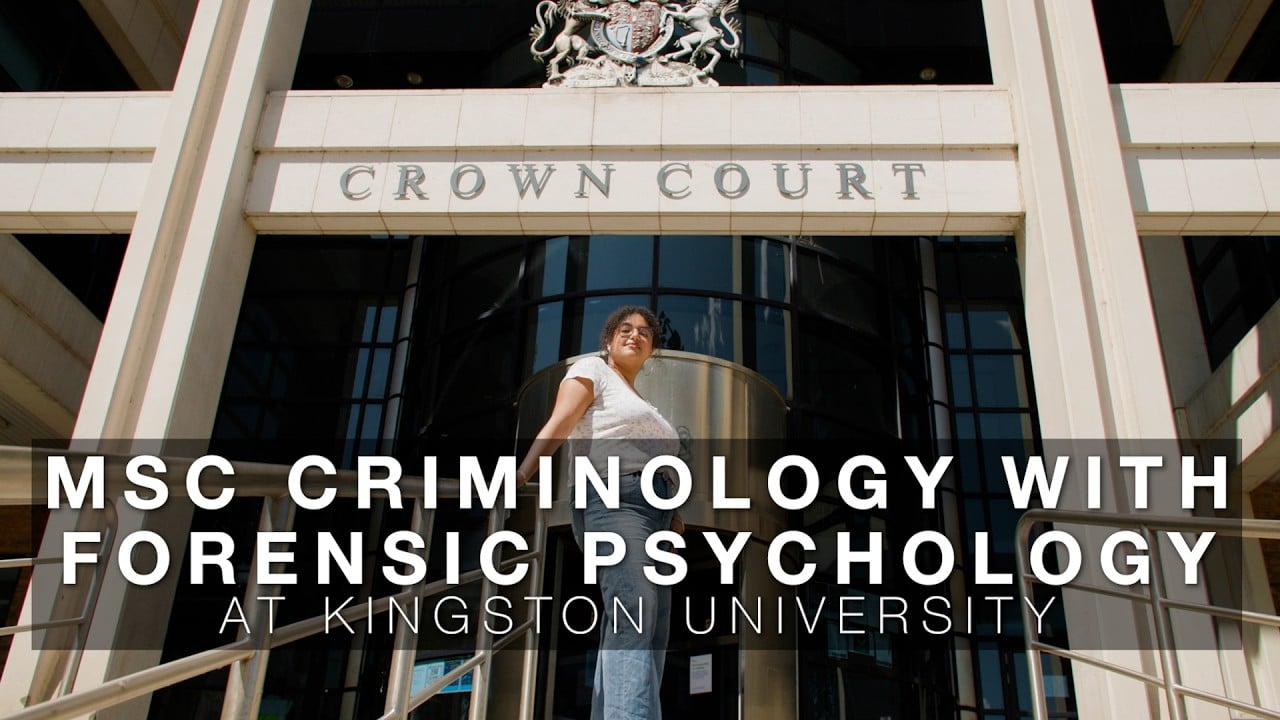
Criminology with Forensic Psychology MSc at Kingston University
Hear from our students about their experience studying Criminology with Forensic Psychology MSc. Explore how the course brings together criminology and forensic psychology to examine crime, offending behaviour and the criminal justice system, while developing the knowledge and skills to pursue a career in this fascinating field.
Why choose this course
Learn from experts. Study in context. Make an impact.
At Kingston University, our MSc in Criminology with Forensic Psychology offers a unique opportunity to explore the intersection of crime, justice, and psychology – guided by experts and grounded in real-world experience.
Kingston University is proud to be Gold-rated in the Teaching Excellence Framework (TEF), reflecting our commitment to high-quality teaching and student success. You’ll be taught by experienced academics and expert criminal justice professionals, bringing both academic rigour and practical insight to your lectures and seminars.
As part of the Kingston School of Law, Social and Behavioural Sciences, you’ll join a vibrant academic community with access to cutting-edge research and hands-on learning opportunities. Our course is designed to enhance your employability, equipping you with the skills and experience needed to thrive in a range of criminal justice careers.
Our location offers unparalleled access to the criminal justice system. With Kingston Crown Court just minutes away, you’ll have the chance to observe live court proceedings and see how the theories you study are applied in real life.
Throughout the course, you’ll benefit from guest lectures by practitioners working in the criminal justice sector applying legal and forensic psychology perspectives. These sessions bring contemporary issues to life and connect your learning to current practice.
You’ll explore key theories, research methods, and real-world practices, while also examining social harms and marginalised perspectives traditionally overlooked by criminologists and the legal system.
Whether you're aiming to work in criminal justice policy, or research, this course provides the knowledge, experience, and critical thinking skills to make a meaningful difference.
Prepare for global impact
Kingston School of Law, Social and Behavioural Sciences offers courses in economics, law, psychology and criminology. Our degrees are underpinned by a vibrant research culture and delivered by a blend of practitioners and academics who are dedicated to equipping you with the employability skills to thrive in your career.

Course content
Criminology is a dynamic and multi-disciplinary subject that draws upon a range of theoretical frameworks and social research techniques to explore criminological phenomena. You will engage with the theoretical ideas that govern the discipline and apply them to better understand the substantive issues in the study of crime, harm and justice. In the forensic psychology component, you will study the psychological processes underpinning investigative techniques and judicial processes. The programme will involve a critical appreciation of how psychology can be used to improve: police decision making when interviewing witnesses and courtroom procedures.
Full time: You will study four core modules plus a Criminology Dissertation worth 60 credits.
Part time: Typically, as a part-time student you will study three core modules in Year 1. In Year 2 you will take one core module and a dissertation.
Modules
Core modules
Inside the School of Law, Social and Behavioural Sciences
Hear from current students, graduates and our academics as they talk about what it's like to study in the School of Law, Social and Behavioural Sciences.
Career opportunities
You’ll complete this course well-prepared for careers in a range of public and private sector organisations. Previous graduates have progressed to roles in policy making, offender management, crime reduction, multi-agency partnerships, security, counter-terrorism and policing.
Others have gone on to work in criminological research, local and national government and related advocacy and policy-based organisations. You could also secure work in policing, victim and witness services, prisons, prison offender management, the military, security and counter-terrorism. So, whether you're advancing in your current profession or preparing for new opportunities, this programme provides the foundation for a rewarding career in the criminal justice sector and related agencies.
Teaching and assessment
Fees and funding
Fees for future course years
Part time
If you start your second year straight after Year 1, you will pay the same fee for both years.
If you take a break before starting your second year, or if you repeat modules from Year 1 in Year 2, the fee for your second year may increase.
Funding support for postgraduate students
If you are a UK student living in England and under 60, you can apply for a loan to study for a postgraduate degree. Find out more through the government's website.

Scholarships and bursaries
Interested in studying Criminology with Forensic Psychology MSc at Kingston? The following funding support is available:
Additional course costs
Some courses may require additional costs beyond tuition fees. When planning your studies, you’ll want to consider tuition fees, living costs, and any extra costs that might relate to your area of study.
Your tuition fees include costs for teaching, assessment and university facilities. So your access to libraries, shared IT resources and various student support services are all covered. Accommodation and general living expenses are not covered by these fees.
Where applicable, additional expenses for your course may include:

How to apply
Before you apply
Please read the entry criteria carefully to make sure you meet all requirements before applying.
How to apply online
Use the course selector drop-down at the top of this page to choose your preferred course, start date and mode, then click 'Apply now'. You will be taken to our Online Student Information System (OSIS) where you will complete your application.
If you’re starting a new application, you’ll need to select ‘new user’ and set up a username and password. This will allow you to save and return to your application.
Please note: If you’re from a country outside the EU or EEA that’s classified as overseas fee-paying, you won’t be eligible to apply for a part-time course because of visa regulations in the UK. For information about exceptions, please visit the UKCISA website or email our CAS and Visa Compliance team.
Application deadlines
We encourage you to apply as soon as possible. Applications will close when the course is full.
Course changes and regulations
The information on this page reflects the currently intended course structure and module details. To improve your student experience and the quality of your degree, we may review and change the material information of this course. Find out more about course changes
Specifications for this course are published ahead of each academic year.
Regulations governing this course can be found on our website.