Analytical Chemistry MSc
- Chemistry and pharmaceutical sciences
- Postgraduate
Boost your employability with the Analytical Chemistry MSc from Kingston University. Using our modern laboratories, you will gain the knowledge and key skills required for a career in analytical chemistry. Our links with industry provide a practical base for this course and help ensure your studies are up to date and relevant to the working environment.

Deepen your knowledge of chemistry by diving into the study of all matter
Immerse yourself in good measurement and scientific practice, and the evaluation and interpretation of data.
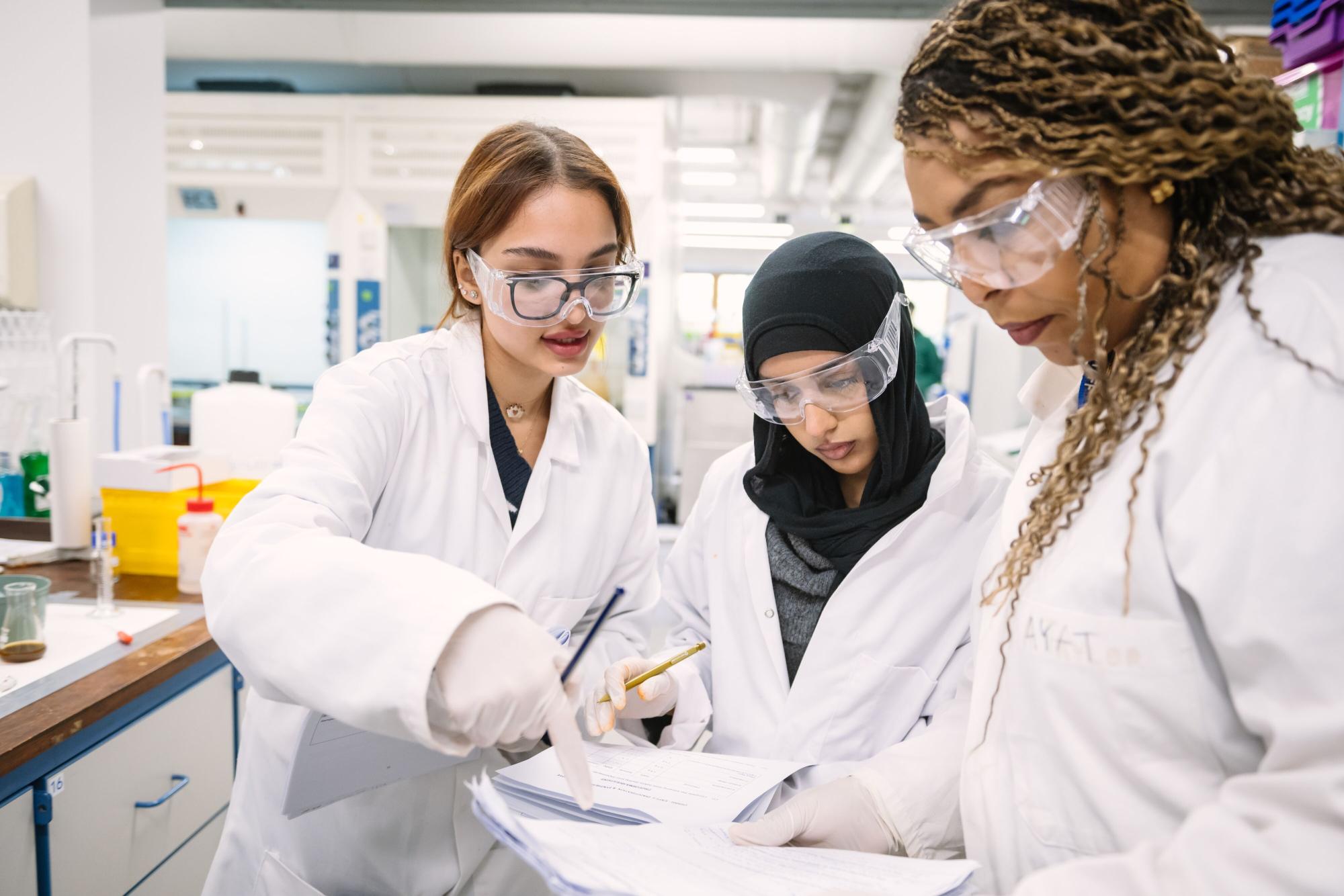
You'll gain extensive practical experience in new laboratories that reflect industry standards.
Through an independent research project, you will be able to study an area of interest in greater depth. You will also benefit from the latest views from visiting speakers and industry visits from global researchers and pharmaceutical companies.
At our Penrhyn Road campus, you will have access to a modern environment with the latest equipment, including:
- the £9.8 million Eadweard Muybridge building with state-of the art laboratories, including labs dedicated to analytical chemistry
- new work areas and dedicated laboratories for research
- specialist equipment, such as:
- gas and liquid chromatography
- electron microscopy
- a range of spectrometers, including mass spectrometers, infrared spectrometers and nuclear magnetic resonance spectrometers
- nuclear science equipment
- thermal analysis
- x-ray diffractometers
- electrochemical analysis
- computing laboratories and a team of IT technicians to offer assistance.
The teaching on this course is great, and the lecturers are very approachable. The practicals on the course are really helpful too. I've used loads of the analytical instruments, such as GC-MS, Infrared and UV-Vis.

Why choose this course
Throughout this course, you will build on your previous chemistry knowledge and continue to develop skills to prepare you for your career. These include problem solving, organisation, data collation, review and synopsis.
You will study good measurement and scientific practice, and the evaluation and interpretation of data. You will also undertake an independent research project, which can act as an excellent selling point when looking for employment after graduation.
Past projects have looked at dust sources at Hampton Court Palace, determination of Hexavalent Chromium, thermo-responsive polymers for water purification and radiochemical investigation of Uranium 232. You can undertake this as collaborative research with other laboratories.
Alternatively, you could do a placement year in industry to put your research skills into practice in the real world. Past students have undertaken project placements in the pharmaceutical industry, forensic labs, analytical consultancies, hospital labs and research labs.
In addition, many of our staff are research active. This ensures they are in touch with the latest thinking and bring best practice to your studies.
Course content
You will gain the key skills required in this specialised area of analytical chemistry, including good measurement and scientific practice, evaluation interpretation of data, and other professional and organisational skills. You will also study core analytical techniques and their applications. You may also be offered a placement within industry (depending on your results and project availability), where you will carry out your independent research project.
For a student to go on placement they are required to pass every module first time with no reassessments. It is the responsibility of individual students to find a suitable paid placement. Students will be supported by our dedicated placement team in securing this opportunity.
Please note, optional modules only run if there is enough demand. If we have an insufficient number of students interested in an optional module, that module will not be offered for this course.
Modules
Core modules
Optional modules
Career opportunities
There is an increasing demand for qualified analytical chemists in a variety of industrial and public sector settings. Other relevant roles are in chemical/pharmaceutical companies, teaching, sales, marketing, management and PhD research.
Recent graduates have gone on to a range of roles, including:
- chemists in large and SME chemical/pharmaceutical companies
- teaching
- PhD research
- sales and marketing
- managerial positions
Teaching and assessment
Fees and funding
Fees for future course years
Part time
If you start your second year straight after Year 1, you will pay the same fee for both years.
If you take a break before starting your second year, or if you repeat modules from Year 1 in Year 2, the fee for your second year may increase.
Funding support for postgraduate students
If you are a UK student living in England and under 60, you can apply for a loan to study for a postgraduate degree. Find out more through the government's website.

Scholarships and bursaries
For students interested in studying Analytical Chemistry MSc at Kingston, there are several opportunities to seek funding support:
Additional course costs
Some courses may require additional costs beyond tuition fees. When planning your studies, you’ll want to consider tuition fees, living costs, and any extra costs that might relate to your area of study.
Your tuition fees include costs for teaching, assessment and university facilities. So your access to libraries, shared IT resources and various student support services are all covered. Accommodation and general living expenses are not covered by these fees.
Where applicable, additional expenses for your course may include:

How to apply
Before you apply
Please read the entry criteria carefully to make sure you meet all requirements before applying.
How to apply online
Use the course selector drop-down at the top of this page to choose your preferred course, start date and mode, then click 'Apply now'. You will be taken to our Online Student Information System (OSIS) where you will complete your application.
If you’re starting a new application, you’ll need to select ‘new user’ and set up a username and password. This will allow you to save and return to your application.
Application deadlines
We encourage you to apply as soon as possible. Applications will close when the course is full.
Information required to confirm your place
If English is not your first language, we will require proof of your proficiency to allow us to confirm your place on the course. This will generally be either an IELTS or TOEFL test certificate, which can be forwarded to us after you have submitted your application. If you do not hold a formal English language qualification, please indicate how you have acquired your proficiency in written and spoken English.
After you have applied
If the postgraduate admissions tutor requires further information or wishes to invite you to further assessment by interview they will contact you directly. You will then hear whether your application has been successful.
If you do not clearly meet the standard entry requirements and the admission tutor wishes to see a portfolio from you, you will be sent an email asking you to upload your portfolio to your Kingston University OSIS account. Further details on how to do this will be provided at the time.
Course changes and regulations
The information on this page reflects the currently intended course structure and module details. To improve your student experience and the quality of your degree, we may review and change the material information of this course. Find out more about course changes
Programme Specifications for the course are published ahead of each academic year.
Regulations governing this course can be found on our website.
What our students and graduates say
I chose to do the Analytical Chemistry MSc because I did a bioanalysis module during my undergraduate degree. This led me to develop an interest in analytical chemistry.
During the course, I spent three months at GSK on a placement, working as a development scientist for the New Product Development Aquafresh team. This allowed me to gain invaluable experience for a global organisation, which automatically makes me more employable.