Foundation Year in Computing
- Foundation
- Undergraduate
Ready to start your journey towards a computing honours degree? This Foundation Year in Computing will give you the knowledge and skills to progress your studies and establish your ambitions. You’ll get a taste of academic life in a supportive university environment, with access to cutting-edge facilities.
This is an integrated foundation year, not a standalone course. If you complete it successfully, you can progress to the first year of your chosen degree.

Pave the way for an exciting career
Your first step towards gaining a full bachelors degree in computing.
Maybe you don’t have the right qualifications to join the first year of a computing-based degree. Perhaps your previous studies have been in an unrelated field, or you’re returning to education after time in employment. Whatever your reason, this Foundation Year will help you realise your potential.
During the course, you’ll take core modules that cover everything from professional skills and project management to the basic concepts, theories and technologies of computing. It’s the perfect way to gain an overview of the field before you specialise.
Through a blend of studio practice, project-based learning and context driven lectures, you’ll develop technical and communication skills and apply your knowledge to real-life problems.
You’ll complete the Foundation Year in Computing ready to progress to Year 1 of an honours course.
Our foundation year includes dedicated mathematics teaching designed to build your knowledge, confidence and problem-solving skills before progressing onto your degree. The mathematical content is aligned to the level of A-level Mathematics, helping you develop a strong understanding of the concepts and techniques that underpin computing. This is a distinctive feature of our foundation year, giving you the opportunity to develop advanced mathematical skills and the confidence needed to succeed in your chosen subject area.

Why choose this course
While you study, you’ll benefit from top-quality teaching at Kingston University. Not only are we ranked Gold in the Teaching Excellence Framework, our staff are leading practitioners and researchers at the cutting-edge of their discipline.
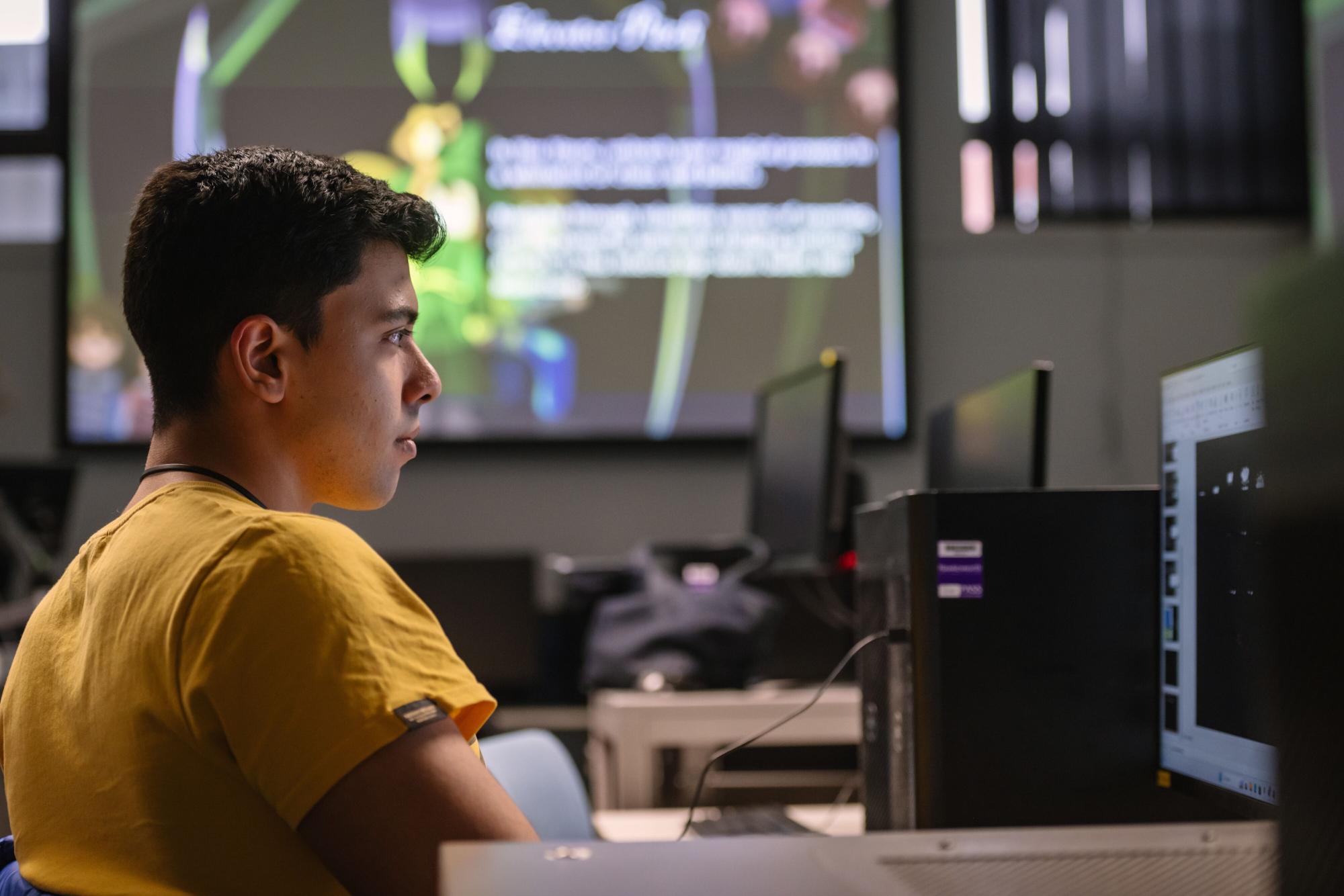
Your learning will be based at our Penrhyn Road campus, where you’ll have access to a modern environment with all the latest equipment. Facilities vary depending on the course and modules studied but typically you will benefit from the latest facilities, including:
- State-of-the-art computer laboratories with high-performance workstations and dual large-screen monitor configurations
- Our home-grown NoobLab environment, designed to make learning programming accessible and fun
- High-spec gaming PCs, with powerful AI and graphics processing units (GPUs)
- A High-Performance Computing (HPC) facility for more complex computation
- Integrated development environments for games and software development
- Immersive and mixed reality with VR and AR headsets
- Full Java, GitLab, Python and MATLAB environments for Software Engineering and AI Development, and network simulation from wireless (Wi-Fi, 5G, 6G) to multimedia streaming
- Our dedicated team of IT technicians.
Our insight hub, known as inKUbator, will give you opportunities to learn directly from the industry. Previous speakers have included Sony, Splash Damage, Aardvark Swift, Interactive Selection, CryTek and Unity.
Kingston University’s Computer Science BSc course is accredited by The Chartered Institute for IT (BCS), and our PlayStation First partnership with Sony will give you the chance to develop games for the PlayStation 5.

Course content
Throughout the year you will study a range of subjects relevant to subsequent study in Year 1 of your degree and beyond. These subjects are supported by modules where your study and technical skills are developed. The broad scope of subjects enables study in a range of subject areas and, in some instances, allows flexibility of choice of intended degree route. Subjects start at an elementary level, and there is a strong emphasis on the development of practical skills. In the skills module you will also undertake a project where you focus on a topic in computer science that will involve gathering and analysing some data and interpreting it for a "client" or general audience, which adds to your portfolio of things you can share with a future employer.
Modules
Core modules
What career opportunities does this course offer?
You’ll complete this year with the foundational knowledge and key academic skills you need to join a maths or computing-related bachelor’s degree course at Kingston University. Options include everything from Games Development and Computer Science to Digital Media Technology and more.
Tap into high-quality careers and recruitment guidance from our specialist employability team. From job-seeking tips to help with CV prep, application forms, interview techniques and finding work as an international student, it’s here to get you started after studying. The team even runs regular events to help you network with employers in an informal setting.
Future Skills
Our Future Skills programme is embedded within all our undergraduate courses and throughout the whole Kingston experience. These skills will help you to become a future-proof graduate by equipping you with the skills most valued by employers, such as problem-solving, digital competency and adaptability.
As you progress through your degree, you'll learn to navigate, explore and apply these graduate skills. You’ll also understand how to demonstrate and articulate to employers how these future skills give you the edge.

Teaching and assessment
Teaching uses a variety of approaches including lectures, seminars and tutorials, workshops and computer practical work. Sessions are designed to be active, involving students undertaking small projects and working in groups to solve problems. The use of technology to enhance learning is an important way in which students are supported. Particular emphasis is placed on developing study skills that will help mature applicants who are returning to education and those from non-computing and mathematics backgrounds.
Assessment includes a mixture of coursework and examination. Coursework may take the form of report writing, case studies and presentations with emphasis on real world problems. Examinations take place at the end of the year, giving you the opportunity to settle back into education and into the course. The style of assessment provides a natural progression to Year 1 of your chosen degree.
Fees and funding
Additional course costs
Some courses may require additional costs beyond tuition fees. When planning your studies, you’ll want to consider tuition fees, living costs, and any extra costs that might relate to your area of study.
Your tuition fees include costs for teaching, assessment and university facilities. So your access to libraries, shared IT resources and various student support services are all covered. Accommodation and general living expenses are not covered by these fees.
Where applicable, additional expenses for your course may include:
Course changes and regulations
The information on this page reflects the currently intended course structure and module details. To improve your student experience and the quality of your degree, we may review and change the material information of this course. Find out more about course changes
Specifications for this course are published ahead of each academic year.
Regulations governing this course can be found on our website.