Design and Systems Engineering MSc
- Engineering, electronics and robotics
- Postgraduate
The MSc in Design and Systems Engineering at Kingston University is designed for creative and technically-minded individuals who are passionate about designing innovative products. Join this accredited degree course, recognised by the Engineering Council and the Institution of Mechanical Engineers.
Please note: this course was previously named Advanced Product Design Engineering & Manufacturing MSc.
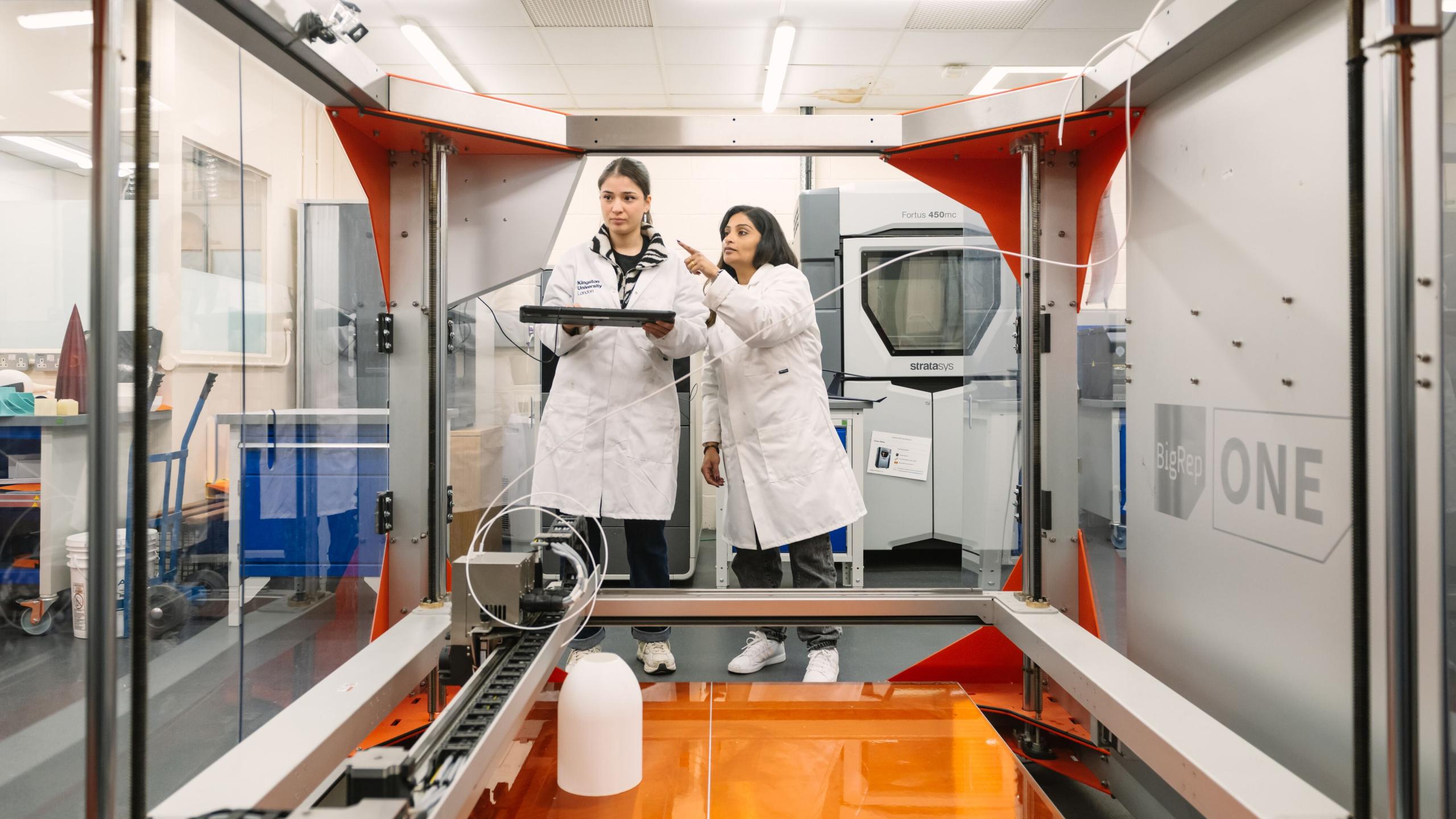
Turn creative ideas into manufacturable, real-world solutions
The MSc in Design and Systems Engineering is more than just a course; it’s an opportunity to transform your ideas into real-world solutions.
Design and Systems Engineering is a future-focused course, which blends innovative design with advanced engineering and manufacturing expertise. It equips you with the practical and analytical skills needed to develop high-quality, manufacturable products, which are both commercially viable and environmentally responsible.
Throughout the course, you will gain experience in engineering design, simulation, materials science and decision making. There is a strong focus on designing for performance, cost, sustainability and user needs. An emphasis on design for engineering also enables you to consider a wide range of real-world factors. These factors include functionality, manufacturability, environmental impact and product lifecycle.
Product Lifecycle Assessment (PLA) and Product Lifecycle Management (PLM) are embedded throughout the course. This will help you make informed, system-level decisions from concept to end-of-life.
Interdisciplinary collaboration is a core part of the learning experience too. You will work on projects alongside peers from other programmes, gaining valuable insight into the dynamics of professional teamwork across disciplines. This reflects the way modern design and manufacturing teams operate in industry.
With access to our state-of-the-art facilities, expert academic support and live industry briefs, you will develop the knowledge, creativity and confidence to succeed in product development, advanced manufacturing or entrepreneurial ventures.
This course has been instrumental in bridging my practical technician experience with academic and engineering perspectives. Particularly, the Advanced CAD/CAM module significantly expanded my proficiency in Siemens NX, bolstering my confidence in my professional capabilities. I'm also grateful for the unwavering support of the professors, who have been consistently available to provide guidance and assistance throughout my journey.
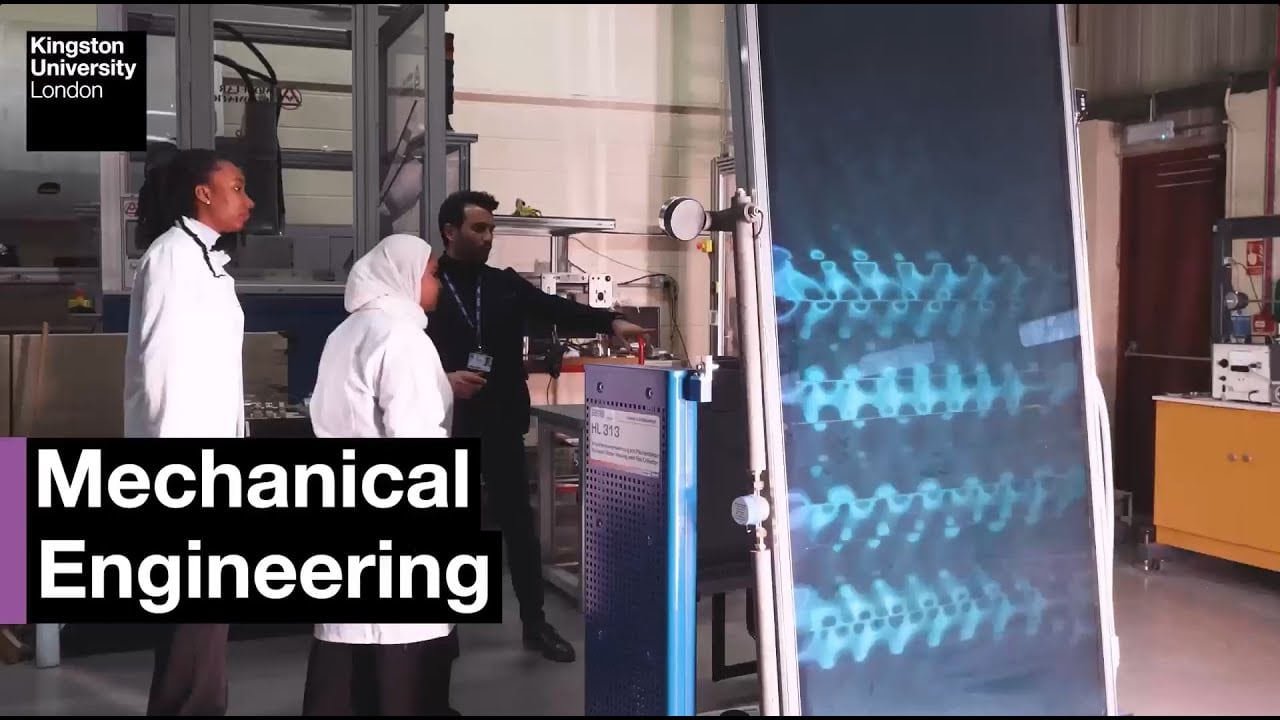
Discover mechanical engineering
Hear from our students and academics as they share what it's like to study mechanical engineering at Kingston. Learn about the facilities, opportunities and skills you can develop throughout your studies.
Why choose this course
Our Design and Systems Engineering MSc combines creative design thinking with practical engineering and manufacturing knowledge. It is designed to help you develop innovative, functional and sustainable products that meet real-world challenges.
You will work on industry-informed, interdisciplinary projects, developing your problem-solving and teamworking skills in a modern engineering practice setting. The course provides practical experience in digital product development. You will use Computer Aided Design (CAD), Computer Aided Manufacturing (CAM) and Computer Aided Engineering (CAE) tools such as:
- 3D modelling and visualisation
- 3D scanning and model reconstruction
- 3D printing and prototyping
- CNC machining
- Finite Element Analysis (FEA) and simulation
You will also explore materials, manufacturing processes and sustainability. Your learning will focus on how to make informed decisions through Product Lifecycle Assessment (PLA) and Product Lifecycle Management (PLM).
Project-based learning is at the heart of the course, supported by experienced academic staff and access to well-equipped laboratories and workshops. You will gain a clear understanding of the full product development process from concept and design through to validation and manufacture. This will prepare you for careers in design, engineering, manufacturing or consultancy.

This course is currently going through the process of reaccreditation with the Institution of Mechanical Engineers (IMechE) for the intake of 2026 and beyond.
Accredited by the Institution of Mechanical Engineers (IMechE) on behalf of the Engineering Council as meeting the requirements for Further Learning for registration as a Chartered Engineer. Candidates must hold a CEng accredited BEng/BSc (Hons) undergraduate first degree to comply with full CEng registration requirements.
The MSc will meet, in part, the academic benchmark requirements for registration as a Chartered Engineer. Accredited MSc graduates who also have a BEng(Hons) accredited for CEng, will be able to show that they have satisfied the educational base for CEng registration.
It should be noted that graduates from an accredited MSc programme, who do not also have an appropriately accredited honours degree, will not be regarded as having the exemplifying qualifications for professional registration as a chartered engineer with the Engineering Council; and will need to have their first qualification individually assessed through the individual case procedure if they wish to progress to CEng.
Further learning details are available on the Institution of Mechanical Engineers website.
All accredited degrees are displayed on the Institution of Mechanical Engineers website.
Accreditation is a mark of assurance that the degree meets the standards set by the Engineering Council in the UK Standard for Professional Engineering Competence (UK-SPEC). Some employers recruit preferentially from accredited degrees, and an accredited degree is likely to be recognised by other countries that are signatories to international accords.
Check the Engineering Council website for more information.
Course content
This programme is structured to provide you with the latest developments in this still-evolving discipline of digital product development. It gives you with hands-on experience of the latest computing applications throughout the entire product development cycle, from simple 3D modelling techniques to an extended capability of 3D laser scanning to generate complex Class A surfaces.
You will gain practical and theoretical knowledge of analytical design tools to assist the product validation process by applying advanced mechanism design simulation and finite elements analysis techniques. Additionally, you will examine the importance of advanced manufacturing techniques and the methods used to integrate Computer Aided Manufacturing CAM with computer numerical control, 3D printing technologies into product data management PDM.
The programme enables you to gain the entrepreneurship, management and business skills necessary to take on leadership roles in major product design engineering projects.
The hands-on approach, using our state-of-the art multidisciplinary laboratories with state-of-the-art equipment from 3D Printing, CNC machining, Laser Scanning, Metrology, Materials Testing and many more, is a valuable part of the course. The course dovetails with research activities of the teaching staff, implementing the latest advances in our research. Using applied research, you will have the opportunity to do your own research within an individual industry-relevant 'capstone' project. This includes preparation of a scientific paper, providing an opportunity for that first breakthrough into publishing your work.
You will be required to pass every module to then go on placement. It is the responsibility of individual students to find a suitable paid placement. You will be supported by our dedicated placement team in securing this opportunity.
Please note: optional modules only run if there is enough demand. If we have an insufficient number of students interested in an optional module, that module will not be offered for this course.
Modules
Core modules
Optional modules (choose one)
Professional placement
Professional placement

Career opportunities
This MSc prepares you for an exciting career in product design engineering. Graduates are equipped to work across a variety of sectors, including consumer electronics, automotive, healthcare and sustainable technologies. You will be prepared to take on roles such as:
- Product designer
- Design engineer
- Innovation consultant
- Sustainability specialist
- Prototyping and materials engineer
With our strong industry connections and expert mentorship, you will be ready to design products which are functional, user-friendly and sustainable. The emphasis on practical, hands-on learning ensures you graduate with the confidence and experience to make an immediate impact in the workplace.
Aligned with our Future Skills initiative, the course develops the transferable skills increasingly valued by employers. These include problem solving, critical thinking, digital competency, adaptability, collaboration and the ability to communicate ideas effectively across disciplines. Students take part in individual and group activities that promote collaboration, professional growth and reflective thinking.
Continuous feedback through formative assessment and tutor support will further prepare you for professional success in an evolving global marketplace.
Teaching and assessment
The assessment strategy is designed to support and enhance your learning experience. Assessment criteria are clear and transparent, and the scope of each task is discussed within modules to ensure expectations are well understood. A combination of assessment methods are used throughout the course.
Module leaders ensure assessment methods are aligned with the aims and learning outcomes of the module, are intellectually stimulating and are appropriate for master’s level study. Formative assessments are embedded across all modules. These will help you reflect on and improve your performance ahead of summative assessments. Reflective practice and regular feedback from personal tutors further support your development. Group activities are also central to the teaching and assessment strategy, promoting collaborative learning and peer feedback.

Interdisciplinary group project
A core feature of the course is the interdisciplinary group project. The project brings together students from different MSc programmes to work collaboratively on a shared challenge. This mirrors real industry practice and gives students the opportunity to apply design, engineering and project management skills in a team environment. The project is assessed through a combination of group presentations, reports and peer evaluation. This encourages both technical excellence and professional competencies such as communication, leadership, and systems thinking.
Individual project
The individual project challenges you to address a real-world problem. Most projects are industrially oriented. You will be supported in selecting a project relevant to their field of interest. Throughout the project, you are expected to apply course knowledge to deliver agreed outcomes while meeting set constraints. Key skills in communication, presentation, literature review, problem analysis, planning, report writing, and solution justification are all developed.
Coursework
Coursework is primarily submitted electronically via the Canvas platform for each module. Students are reminded that any coursework submitted up to one week late will be capped at 50%. Work submitted more than one week late will receive a mark of zero, in line with Faculty policy.
Fees and funding
Fees for future course years
Part time
If you start your second year straight after Year 1, you will pay the same fee for both years.
If you take a break before starting your second year, or if you repeat modules from Year 1 in Year 2, the fee for your second year may increase.
Additional course costs
Some courses may require additional costs beyond tuition fees. When planning your studies, you’ll want to consider tuition fees, living costs, and any extra costs that might relate to your area of study.
Your tuition fees include costs for teaching, assessment and university facilities. So your access to libraries, shared IT resources and various student support services are all covered. Accommodation and general living expenses are not covered by these fees.
Where applicable, additional expenses for your course may include:
Funding support for postgraduate students
If you are a UK student living in England and under 60, you can apply for a loan to study for a postgraduate degree. Find out more through the government's website.

Scholarships and bursaries
For students interested in studying MSc in Product Design Engineering at Kingston, there are several opportunities to seek funding support:


How to apply
Before you apply
Please read the entry criteria carefully to make sure you meet all requirements before applying.
How to apply online
Use the course selector drop-down at the top of this page to choose your preferred course, start date and mode, then click 'Apply now'. You will be taken to our Online Student Information System (OSIS) where you will complete your application.
If you’re starting a new application, you’ll need to select ‘new user’ and set up a username and password. This will allow you to save and return to your application.
Application deadlines
We encourage you to apply as soon as possible. Applications will close when the course is full.
Information required to confirm your place
If English is not your first language, we will require proof of your proficiency to allow us to confirm your place on the course. This will generally be either an IELTS or TOEFL test certificate, which can be forwarded to us after you have submitted your application. If you do not hold a formal English language qualification, please indicate how you have acquired your proficiency in written and spoken English.
After you have applied
For courses that select on application alone, applicants should normally receive an initial decision or a request for more information within four to six weeks of receipt of their application. Our admissions team will notify you of the decision by email.
Course changes and regulations
The information on this page reflects the currently intended course structure and module details. To improve your student experience and the quality of your degree, we may review and change the material information of this course. Find out more about course changes
Programme Specifications for the course are published ahead of each academic year.
Regulations governing this course can be found on our website.
What our students and graduates say
The best part about my course has to be the amazing faculty members that teach each module. They each bring a different approach to the lectures, and it is always an interactive session which helps me understand the topics being discussed. It's easy to reach out to them, be it through email or an in-person meeting. It's always easy to clear your doubts or ask for support.
I was able to shine during interviews at esteemed organisations thanks to my masters degree from Kingston University. In my day-to-day work, I am able to use the techniques learned in this course, which makes the investment worthwhile. For engineers who are interested in deep-diving into advanced technologies and receiving hands-on experience to polish their expertise, I would recommend this MSc course.
The curriculum emphasised entrepreneurship and sustainability, providing me with a comprehensive understanding of the industry landscape. The course not only enhanced my design capabilities but equipped me with the knowledge and skills needed to thrive in the industry. The support from Kingston University's Career team was also invaluable. They helped me refine my CV which ultimately helped me to land a job before even getting my final results.