Civil Engineering BEng (Hons) Degree Apprenticeship
- Engineering: civil, construction and surveying
- Undergraduate
- Degree apprenticeship
Kingston University’s course provides a strong platform for pursuing and achieving an exciting career in civil engineering. You’ll typically have one day of study a week, while working in the industry.

Build the foundation for your career in civil engineering
Take the first step in your civil engineering career by learning essential industry knowledge while you work.
On this degree apprenticeship you will undertake three work-based learning modules. Combining your own civil engineering interests and learning with those of your employer. Whether that’s project management, sustainability or mechanics. The programme leads to the award of a BEng (Hons) Civil Engineering (Degree Apprenticeship) and a professional qualification through End-Point Assessment (EPA). An EPA is an impartial evaluation to determine whether you have developed the required skills, knowledge, and behaviours to complete your course.
This course is accredited by the Joint Board of Moderators (JBM), which comprises:
- The Institution of Civil Engineers (ICE)
- The Institution of Structural Engineers (IStructE)
- The Institute of Highway Engineers (IHE)
- The Chartered Institution of Highways and Transportation (CIHT)
- The Permanent Way Institution
on behalf of the Engineering Council.
Facilities






Why choose this course
Kingston University is the ideal place to study this Civil Engineering Degree Apprenticeship. We offer the perfect balance of theoretical, practical, academic, management and industrial-based skills. You will also benefit from high-quality teaching, reflected in our prestigious TEF Gold rating.
There is a wide range of facilities for practical work at our Penrhyn Road campus, where this course is based. You will have access to a modern environment with the latest technology and industry-standard equipment, including:
- extensive materials and structures facility for concrete, masonry, steel and timber
- geotechnical and hydraulics testing facilities
- surveying equipment, such as satellite global-positioning systems.
Dedicated computer-aided design facilities include:
- a range of CAD/CAM packages, such as Ideas, SolidWorks and AutoCAD
- finite element analysis
- computational fluid dynamics
- virtual instrumentation.
Accreditation
The programme is accredited by the Joint Board of Moderators (JBM), comprising the Institution of Civil Engineers, Institution of Structural Engineers, Institute of Highway Engineers, the Chartered Institution of Highways and Transportation, and the Permanent Way Institution on behalf of the Engineering Council for the purposes of fully meeting the academic requirement for registration as an Incorporated Engineer (IEng) and partially meeting the academic requirement for registration as a Chartered Engineer (CEng). Candidates must hold a masters or doctorate accredited as further learning for CEng to hold accredited qualifications for CEng registration.

See the Joint Board of Moderators website for further information and details of Further Learning programmes for CEng.
Please check the Engineering Council website for more information.
Kingston University's Civil Engineering Degree Apprenticeship programme has been designed to satisfy the requirements of the IfATE Apprenticeship Standard Civil Engineer (Degree). Specifically, this programme is designed to progress apprentices to IEng registration as part of the apprenticeship End-Point Assessment (EPA), following successful completion of the BEng (Hons) degree.
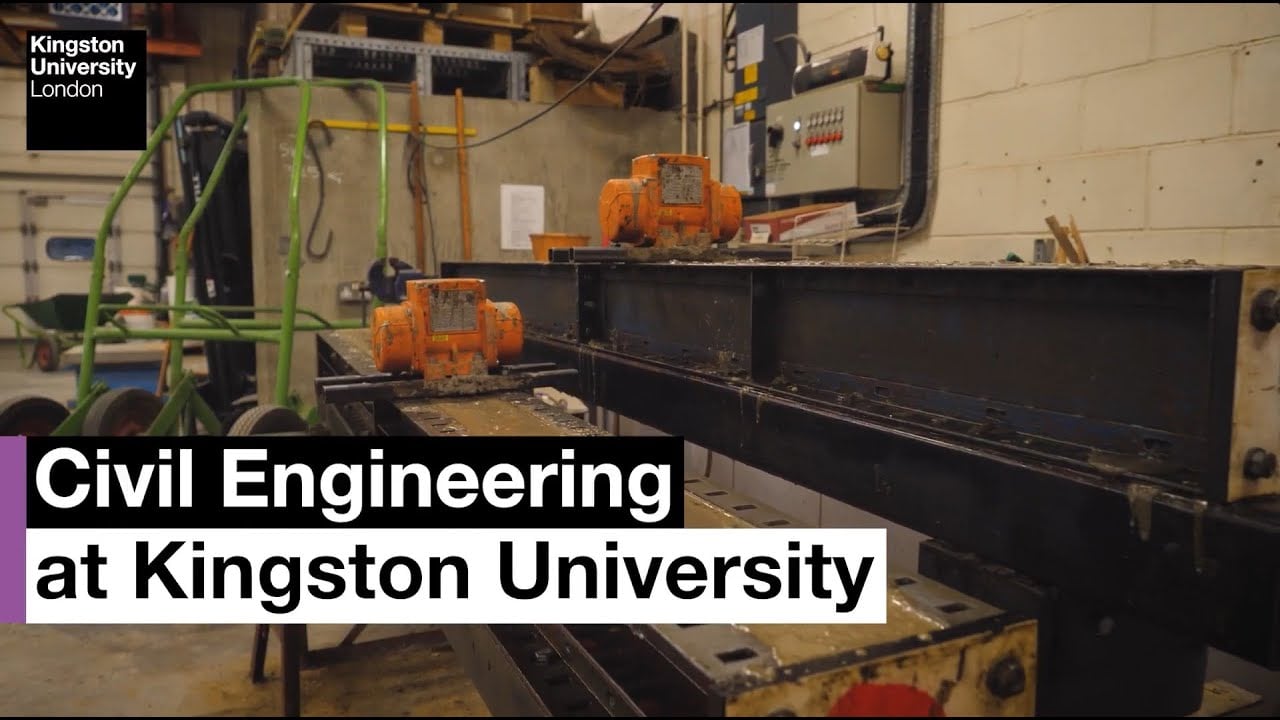
Civil engineering at Kingston University
Hear from our students and graduates as they share their experiences and insights on what it's like to study civil engineering at Kingston.
Course content
This programme is offered in a part-time mode, with weekly one-day release from employment and scheduled continuing learning at the workplace. It leads to the award of BEng (Hons) Civil Engineering Degree Apprenticeship.
An apprentice does not successfully finish their apprenticeship without successfully completing the End-Point Assessment (EPA).
The BEng (Hons) Civil Engineering Degree Apprenticeship is an integrated programme for apprentices who wish to study Civil Engineering to honours degree level through the five-year Degree Apprenticeship scheme and aspire to achieve the professional status of Chartered Engineer (following further learning). Thus, it offers the ideal preparation for a varied and interesting career in the world of civil engineering.
The programme embraces recent developments in education and industry. The curriculum and teaching benefits from the research interests of the academic staff. The design of the programme is based on the guidelines provided by the Engineering Council UK Standard for Professional Engineering Competence (UK-SPEC), the Quality Assurance Agency (QAA) Subject Benchmark Statement for Engineering, and the Joint Board of Moderators (JBM) Guidelines for Accredited BEng (Hons) Degree Programmes.
Modules
The programme is completed when apprentices have successfully achieved 330 credits through typical modules (120 credits at Level 4, 120 at Level 5 and 90 at Level 6) and 30 credits as the individual technical report and EPA.
Please refer to the current list of modules.
On this programme, you will gain a good mix of theoretical, practical, academic, management and industrial-based skills.
Entry level
Prior knowledge, skills and behaviours can exempt individuals from certain elements of the programme, resulting in different entry levels and learner journeys for the apprentices.
Please note: Optional modules only run if there is enough demand. If we have an insufficient number of students interested in an optional module, that module will not be offered for this course.
Level 4
Level 4 introduces Navigate. This is a Future Skills module, designed to assist students in making the transition to Higher Education, develop strong foundations of self-awareness, self-motivation and generate a sense of belonging to their course and Kingston University. Level 4 also focuses on sustainability, climate literacy, and the United Nations Sustainable Development Goals (UNSDGs).
You will also develop your skills in engineering analytics and mathematics, structures, mechanics and materials, fluid mechanics and soil mechanics. There is an emphasis on practical work, including laboratories and model-making.
Core modules
Level 5
Level 5 includes Exploring. This is a Future Skills module that includes the development of team-working, interpersonal and interdisciplinary skills, critical self-reflection, communication and presentation skills and the ability to organise, strategies and prioritise.
You will learn digitisation in Civil Engineering Construction using REVIT and BIM related software. Practical-focused studies cover specific civil engineering subjects such as structural analysis, construction materials, geotechnics, hydraulics and water engineering, engineering geodesy and geographic information system (GIS).
Core modules
Level 6
Level 6 involves the in-depth study and application of core civil engineering disciplines. These include advanced structural modelling and design, geotechnical and environmental engineering, and infrastructure such as transportation and highways. You will carry out an individual project focused on research into a specialised subject and take part in a major integrated design project with fellow students.
Core modules

What career opportunities does this course offer?
Upon completing your apprenticeship you’ll have learned a comprehensive understanding of civil engineering principles. You will also have gained practical experience through work-based learning, and industry-relevant skills tailored to your career ambitions. This ensures you are well-prepared to meet professional standards and excel in a range of civil engineering roles.
Future Skills
Our Future Skills programme is embedded within all our undergraduate courses and throughout the whole Kingston experience. These skills will help you to become a future-proof graduate by equipping you with the skills most valued by employers, such as problem-solving, digital competency and adaptability.
As you progress through your degree, you'll learn to navigate, explore and apply these graduate skills. You’ll also understand how to demonstrate and articulate to employers how these future skills give you the edge.

Teaching and assessment
As the predominant part of the 20% off-the-job training, the BEng programme in Civil Engineering Degree Apprenticeship has been designed, taking into account the Kingston University Curriculum Design Principles, to develop apprentices into graduates that are professional, thoughtful, creative, resilient, proactive, globally-aware and independent, ready to be lifelong learners.
In total, 75% of the degree element of the programme will be delivered at the University. The remaining 25% will be delivered through work-based learning. Associated tutorials, laboratory practicals, fieldwork, site visits and design classes are used to enhance the lecture material and continuing learning at work. The programme is devised to encourage and develop apprentices with confident interpersonal and communication skills, as well as emphasising group work, data analysis and ICT skills.
The contact hours associated with a module at the University depends on the module type. Typically a module would comprise 3 hours per week lecture/tutorial and one hour per week for a design/practical session. Apprentices are expected to spend the remaining hours for a 30 credit module in guided independent study. Typically, the contact hours associated with a work-based module would comprise an hour per week for a tutorial during teaching weeks and eight hours for lecture/practical sessions during non-teaching weeks (10% of the module). Apprentices are expected to spend the remaining hours for a 30 credit module in work-based learning (circa 70%) and guided independent study (circa 20%).
End-Point Assessment
Each apprentice on an approved Apprenticeship Standard is required to take an End-Point Assessment (EPA) to complete the programme. The EPA is delivered by an End-Point Assessment Organisation (EPAO) that is registered with the Education and Skills Funding Agency (ESFA).
The EPA is either integrated as part of the apprenticeship or completed after the course element. If an apprentice is completing the EPA after the course element, they must ensure they have successfully completed their learning, achieved the gateway requirements and finished uploading their evidence prior to taking the EPA.

Fees and funding
This degree apprenticeship programme is funded through the Government's Apprenticeship Levy within the approved funding band.
Additional course costs
Some courses may require additional costs beyond tuition fees. When planning your studies, you’ll want to consider tuition fees, living costs, and any extra costs that might relate to your area of study.
Your tuition fees include costs for teaching, assessment and university facilities. So your access to libraries, shared IT resources and various student support services are all covered. Accommodation and general living expenses are not covered by these fees.
Where applicable, additional expenses for your course may include:
Next steps
Employees
If you are currently employed full time and would like to find out more about apprenticeships, please ask your employer to contact the Kingston University apprenticeship team.
Employers
If you are an employer interested in how apprenticeships can support your organisation and employees, please contact the apprenticeship team for further details.
Partner with us for industry-led apprenticeships
Enhance your workforce with our expert-designed apprenticeship programmes, combining academic excellence with practical training. Join us in shaping the future of skilled professionals.

What are the facilities like?
When you join Kingston University, you will have access to a wide range of facilities and resources designed to support your studies. Use the virtual tour below to explore some of the facilities and learning environments that students within this subject area may experience during their studies.
Course changes and regulations
The information on this page reflects the currently intended course structure and module details. To improve your student experience and the quality of your degree, we may review and change the material information of this course. Find out more about course changes
Specifications for this course are published ahead of each academic year.
Regulations governing this course can be found on our website.