Robotic Engineering and Artificial Intelligence MEng/BEng (Hons)
Subject and course type
- Computing, cyber and AI
- Engineering: mechanical and electronic
- Undergraduate
Focus on the core principles of robotic engineering and applied AI on our Robotic Engineering and Artificial Intelligence MEng/BEng (Hons) course. You’ll gain the skills and knowledge you need to thrive in the rapidly evolving industrial, commercial and domestic sectors.
You are reading:
Solve real-world robotics challenges using artificial intelligence
Take advantage of the opportunities presented by the Fourth Industrial Revolution.
On our Robotic Engineering and Artificial Intelligence MEng/BEng (Hons), you’ll explore autonomous systems, machine learning, computer vision and intelligent control systems. This is all while working alongside peers from various cultural, social and professional backgrounds on team-based projects. As a result, you'll develop an appreciation for diverse perspectives which is essential for future engineering professionals.
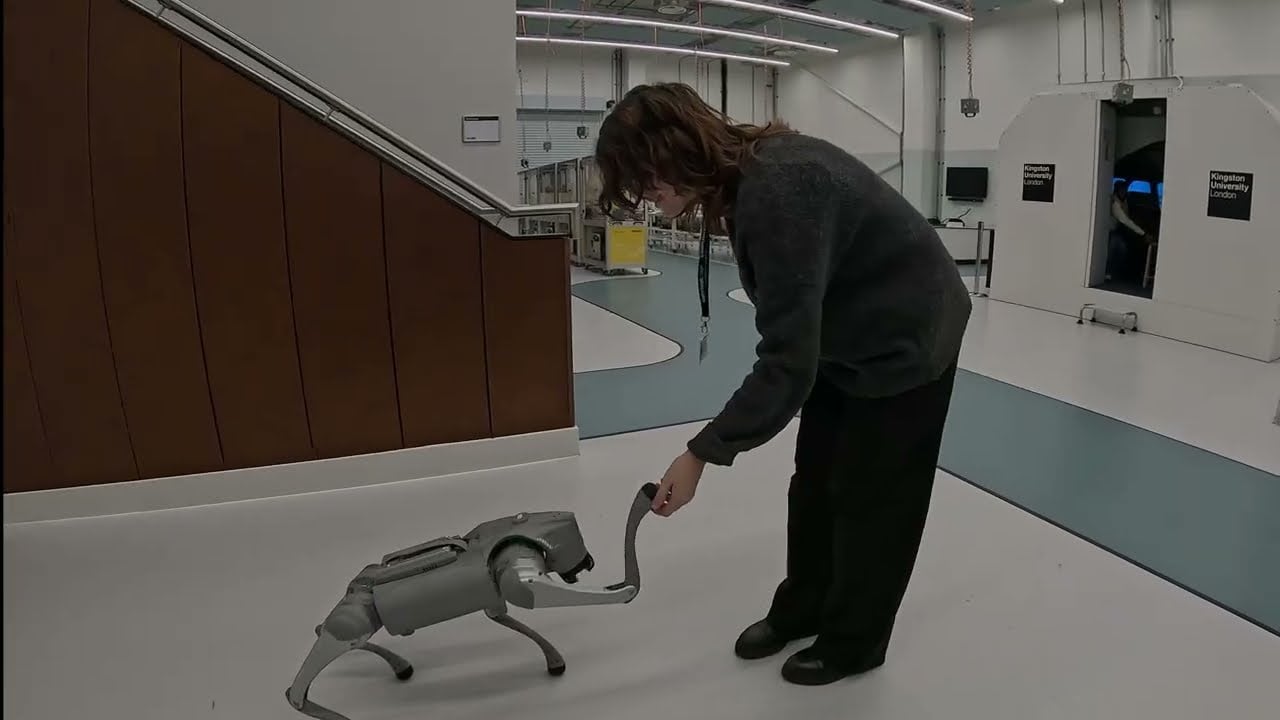
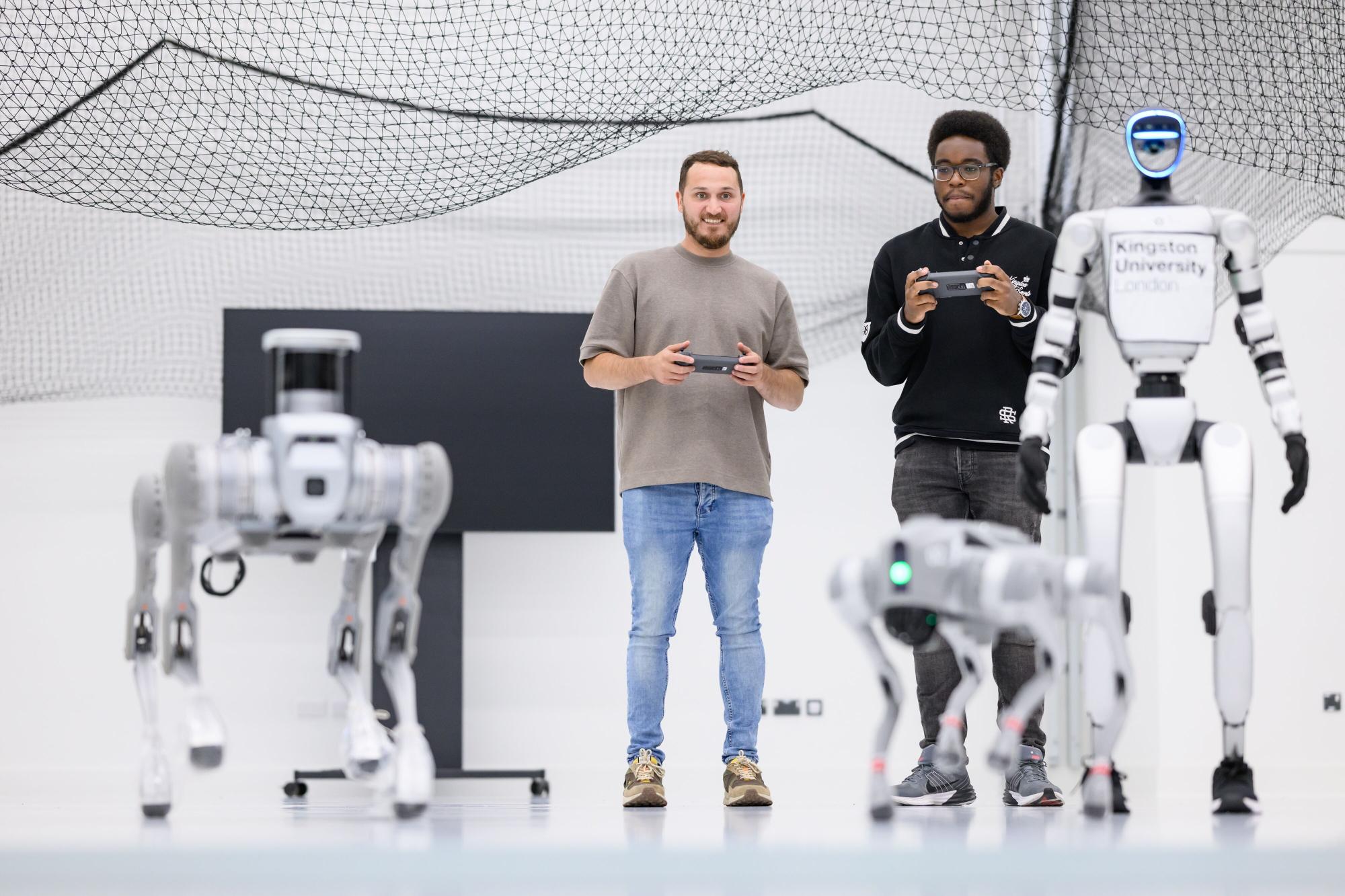
You will be also able to take full advantage of the wide range of facilities available for practical work at our Roehampton Vale campus. Our applied approach to teaching is supported by our dedicated laboratories. These include state-of-the-art facilities for rapid prototyping and manufacturing, a fully equipped materials laboratory, and a modern electronics and robotics lab.
Other technology and industry-standard equipment you will have access to includes:
- Electronics and robotics labs
- 3D design studio and workshop
- Mechanical engineering workshop
You'll also have access to the following robotics products and software:
- NAO
- Pepper
- Unitree H1, Unitree G1, Unitree B2, Unitree Go2
- Fanuc Educational cell
- Franka Emika R3
- AgileX Hunter
- Quanser Qcar
- Qarm
Engineering at Kingston University
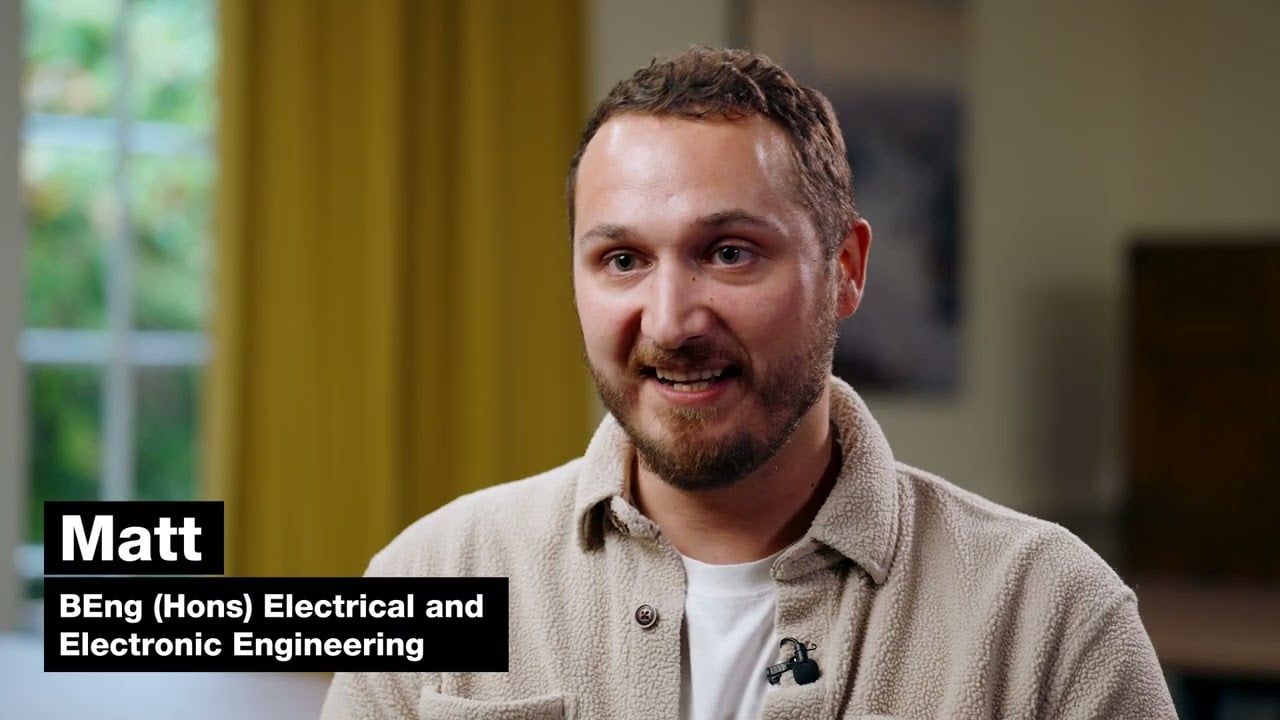
Follow along as our students talk through the skills they're developing to design their future careers.
Why choose this course
Robotic Engineering and Artificial Intelligence stand at the cutting edge of technological progress to address some of the most pressing challenges facing society today. These fields encompass innovations, such as industrial robotic arms, autonomous vehicles, aerial drones and space robots. As a student on this course, you will acquire the vital skills and knowledge required to thrive at the intersection of these two potent fields and make a significant impact on a global level.
Our hands-on course will equip you with the Future Skills needed to thrive in the rapidly evolving technological landscape. Discover how to harness the power of artificial intelligence and other state-of-the-art technologies to develop intelligent systems and innovative solutions that can make a positive impact on society.
Throughout this course, you will also learn how to integrate the UN’s Sustainable Development Goals into your professional endeavours, actively contributing to their achievement.
Our diverse and inclusive curriculum, crafted to meet the needs of varied communities, is delivered by academics from diverse backgrounds. This unique learning experience allows students to engage with people from different cultures and perspectives, enriching their understanding and broadening their horizons.
Course content
Foundation year
An Engineering Foundation course with pathways in Aerospace, Civil and Mechanical Engineering is also available.
Year 1
Core modules
30 credits
This module introduces the fundamentals of engineering design and professional practice, preparing you for academic success and future professional roles. It covers key aspects of project planning, sustainable design processes, interdisciplinary collaboration, regulatory frameworks, and Health and Safety procedures. You will develop reflective skills and learn to document your professional development effectively. Practical elements include basic measurement techniques and manufacturing processes in workshop and testing environments. A significant feature is the Team Design Project, such as the IMechE Design Challenge, which gives you hands-on experience in collaborative engineering tasks. This fosters teamwork, problem-solving, and interpersonal skills, enhancing employability. Overall, the module provides a comprehensive foundation in engineering design and professional conduct, encouraging you to think critically, work effectively in teams, and engage with real-world engineering challenges.
30 credits
This module provides you with a solid foundation in the core mathematical and computational skills required for modern engineering practice. You are introduced to key areas of engineering mathematics and shown how these are applied to the analysis and design of engineering systems. Alongside the mathematical content, you develop scripting and computational problem-solving skills using industry-relevant software tools such as MATLAB, Excel, and Python.
You learn the fundamentals of programming, including data handling, task automation, and algorithmic thinking, enabling you to implement mathematical methods effectively in software. Through practical examples and exercises, you gain experience in translating mathematical concepts into computational solutions. This computational skillset provides you with a strong foundation for future study in areas such as machine learning, artificial intelligence, and advanced engineering analysis.
30 credits
This module provides a comprehensive introduction to electronic systems and robotics, covering fundamental circuit principles, actuators, sensors, and manipulators. Simulation tools will be used for circuit design and analysis, complemented by practical circuit building and testing to develop analytical, technical, and employability skills.
Hands-on programming projects enhance digital competency and proficiency with robotics tools, supporting innovation aligned with UN Sustainable Development Goal 9 (Industry, Innovation, and Infrastructure). The module also highlights sustainable robotics applications contributing to Goals 7 (Affordable and Clean Energy) and 12 (Responsible Consumption and Production).
Through teamwork, you will strengthen collaboration, adaptability, and resilience while cultivating an entrepreneurial mindset. Learning is delivered via lectures, laboratory sessions, and tutorials, supported by online materials through the virtual learning environment. Overall, the module will equip you with the practical and theoretical foundation to apply robotics and electronics across diverse engineering and industrial contexts.
30 credits
This module will introduce you to Future Skills through engagement with Navigate. You are guided to identify and take ownership of your personal academic journey by developing and applying academic skills aligned with Kingston University Graduate Attributes and your discipline-specific professional body learning outcomes.
You will first engage with the Navigate Programme and the Level 4 Personal Tutorial System (PTS) to explore and develop your academic and professional identity. You will be tutored in a range of learning-to-learn techniques and introduced to assessment for learning, along with the role of feedback, reflection, and feedforward as integrated parts of your learning journey. Through active participation in small-group discussions and discipline-focused tutorials, you will begin to understand and apply a design thinking approach to Future Skills development.
You will then learn about the operation and functionality of microcontrollers and explore techniques for connecting them to sensors and actuators, aiming to monitor and control simple closed-loop systems. You will gain practical experience in programming and developing microcontroller-based solutions, reinforcing your understanding of how these technologies are used in embedded system design.
Year 2
Core modules
30 credits
This module aims to equip students with the mathematical and control theory skills necessary for understanding and effectively applying engineering principles. The first part focuses on using mathematical tools to describe, analyse, and design engineering systems, particularly in electrical and electronic engineering, robotics, control systems, and signal processing. Students learn to apply mathematical techniques to solve practical engineering problems.
In the second half of the module, students will gain an understanding of the principles of control system engineering, including system modelling, stability, feedback, and the analysis of dynamic behaviour. Students will also learn how to apply control theory to solve feedback control problems and reinforce their understanding using MATLAB-based simulations and practical laboratory work.
The module content is delivered through formal lectures, supported by laboratory sessions, tutorials, and additional support materials available on the virtual learning environment. The assessment will be through coursework and examination.
30 credits
The Future Skills Explore Learning Outcomes are delivered in this module. It has been designed to scaffold Future Skills from Level 4 Navigate to Level 6 Apply. The Explore Experience will give you at least 8 hours of industry-relevant experiential learning that explicitly develops your Future Skills Graduate Attributes. It explores principles and practices in engineering project design and management, focusing on quality, time, risk, and sustainability constraints. You gain insight into how organisations plan, execute, and monitor projects while enhancing key transferable skills such as teamwork, communication, critical reflection, and time management.
A central feature is the interdisciplinary design thinking project, where you will collaborate to develop solutions to real-world challenges. This experience allows you to apply and contextualise subject-specific knowledge within a team environment, fostering interdisciplinary understanding and innovation. Through practical engagement and reflection, you strengthen your ability to organise, strategise, and prioritise effectively, preparing you for their Level 6 individual project and future professional engineering practice.
30 credits
This module is designed to equip you with an in-depth understanding of the fundamentals of computer vision and the role machine learning (ML) can play in optimising its functionality. You will gain insight into the principles of computer vision systems and the incorporation of ML into these systems. You will learn how to model and analyse the behaviour of dynamic computer vision systems. You will grasp the concepts of image analysis, pattern recognition and the effects of ML integration in a computer vision system. You will apply computer vision techniques to solve real-world image analysis problems, and you will learn the concepts of ML approaches used in computer vision systems. Python, along with libraries such as OpenCV and TensorFlow, is used to reinforce the concepts learned in the module through software simulations.
30 credits
In the first part of the module, you will focus on the design and virtual prototyping of a robot using CAD/CAE tools. You will define mechanisms and joints, select suitable sensors and actuators, and produce standards-compliant engineering drawings. Simulation and kinematic validation will be used to assess and refine performance.
In the second part, the module will introduce the mathematical foundations underlying robotic motion. You will develop and apply modelling tools for robotic manipulators, covering topics such as direct and inverse kinematics, differential kinematics, Lagrangian and Newton–Euler dynamics, and dynamic parameter identification. These analytical methods will be used to interpret and optimise the designs created earlier in the module.
The module contributes to UN SDG 9 (Industry, Innovation and Infrastructure) and SDG 12 (Responsible Consumption and Production) through design-driven modelling, simulation-based optimisation, and informed engineering decisions.
Year 3
Core modules
30 credits
The BEng Project is a capstone module that enables you to integrate and apply the knowledge, skills, and professional behaviours developed throughout the engineering programme.
Working independently under academic supervision, you will identify, justify, and investigate a significant engineering problem or opportunity. The module requires the development of a well-structured project proposal, incorporating a clear rationale, literature review, technical objectives, and a realistic plan of work. You then design, implement, and evaluate an engineering solution using appropriate analytical, simulation, experimental, or design methodologies. Emphasis is placed on innovation, critical thinking, project management, ethical practice, and the effective use of modern engineering tools.
The project culminates in a comprehensive technical report and an oral presentation, through which you will demonstrate your technical competence, communication skills, and readiness for professional engineering practice or postgraduate study.
30 credits
This module provides an in-depth understanding of the fundamental principles of communication, networks, and signal processing, combining technical knowledge with practical applications to build both analytical and employability skills.
Core topics include electronic communications, fibre optics, data communications, advanced digital signal analysis, filter design, Fourier analysis, spectral estimation, wavelet transforms, and time-frequency analysis.
You also explore real-world applications of digital signal processing in areas such as audio and image processing. Practical implementation and simulation exercises using software tools like MATLAB and/or Python allow you to apply theory to practice while developing digital competency, adaptability, and collaboration skills.
The module content is delivered through formal lectures, laboratory practicals, tutorials, and online learning resources, encouraging both technical expertise and research-driven inquiry. It enhances interpersonal and presentation skills, alongside critical thinking, problem-solving, and resilience, preparing you to address complex engineering challenges.
15 credits
This module gives you a dedicated opportunity to develop your Future Skills Graduate Attributes.
At the start of the module, you will be supported to self-assess your current skills profile. You will determine which attributes and skills you need to develop to support your career ambitions. In this process, you will be supported by a dedicated career coach, helping you explore a range of options that includes self-employment/freelancing, starting your own business, higher level study, and other professional graduate-level opportunities. Throughout the module, you will be given opportunities to engage with external mentors, to support reflection and to develop a professional network.
You will undertake a tailored series of activities and projects, aligned to your goals, from a menu of development options. This could include short courses, enrichment activities and experiential learning options such as micro-placements. You will also be able to reflect on activities outside the University that develop your graduate attributes, such as work or volunteering.
30 credits
This module provides students with knowledge and skills in the fields of artificial intelligence and motion planning for industrial manipulator. The module covers a range of topics, including artificial intelligence applied to computer vision. The module also introduces trajectory planning in joint and cartesian space, emphasizing orientation tasks for the end-effector.
Students will learn to design planning algorithms and to apply computer vision principles for efficient execution of industrial robot task. This technical and research-informed module will enhance students’ analytical and employability skills.
The integration of AI with robotics advances UN SDG 9 (Industry, Innovation and Infrastructure) by enabling intelligent robots that can transform manufacturing, healthcare, and logistics. At the same time, students strengthen their research, interpersonal, and presentation skills. By optimising resource use and reducing waste, AI-enabled robotics also supports UN SDG 7 (Affordable and Clean Energy) and SDG 12 (Responsible Consumption and Production) across a range of industries.
15 credits
This module aims to build on students’ technical knowledge by developing their understanding of sustainability as a core responsibility of modern professional engineers. It examines the environmental, ethical and economic challenges that engineers encounter throughout the lifecycle of a product, from design and manufacturing to utilisation and end-of-life disposal.
Students will critically explore how engineering decisions impact society and the planet, and how sustainable practices can be embedded into robotic engineering solutions. In addition, the module introduces sustainable and renewable energy technologies and evaluates their increasing role within the electrical and broader engineering sectors.
Through this module, students will gain the awareness and skills needed to contribute to a more sustainable and resilient industry. The module also integrates key professional responsibilities, including risk management, safety and security considerations, and the promotion of equality, diversity and inclusion within engineering practice.
Students collaborate with their peers, enhancing their collaboration skills, adaptability and resilience. Overall, this module contributes to the understanding of the following UN Sustainable Development Goals: Goal 4 (Quality Education), Goal 5 (Gender Equality), Goal 7 (Affordable and Clean Energy), Goal 11(Sustainable Cities and Communities) and Goal 12 (Responsible Consumption and Production) by optimising resource usage and reducing waste in various industries.
Year 4 (MEng)
Core modules
30 credits
This module covers biologically-inspired robotics. It focuses on legged robots, then progresses to their control, moving from model-based methods to reinforcement learning, to achieve adaptive, efficient, and robust locomotion.
In the first part of the module, core foundations in kinematics, dynamics, sensor–actuator integration, and feedback/feedforward control will be acquired. Emphasis is placed on gait generation, trajectory planning, balance control, and energy-efficient locomotion. Practical sessions will model, simulate, and test controllers in realistic environments.
In the second part, the module introduces reinforcement learning for control of quadrupedal and humanoid systems. Topics include reward design, policy learning and evaluation, robustness, and sim-to-real transfer. By developing controllers that deliver stable, autonomous, and energy-aware motion, the module contributes to UN SDG 7 (Affordable and Clean Energy) and UN SDG 9 (Industry, Innovation and Infrastructure).
30 credits
This module offers a comprehensive introduction to Human-Robot Interaction (HRI) within industrial environments. It explores the physical, cognitive, and social aspects of interaction between humans and robots, focusing on the design of safe, efficient, and intelligent collaborative systems. You will gain knowledge of key mechatronic components, including mechanical design, sensors and actuators, control strategies, and real-time software implementation.
Through theoretical study and practical laboratory sessions using industry-standard equipment, you will learn to design, implement, and evaluate HRI systems that support seamless human-robot communication and collaboration in industrial settings. Emphasis is placed on usability, safety, system integration, and technological innovation.
This module contributes to UN Sustainable Development Goal 9 (Industry, Innovation and Infrastructure) by promoting the development of advanced automation and robotics technologies. It also indirectly supports Goals 7 (Affordable and Clean Energy) and 12 (Responsible Consumption and Production) through the integration of efficient, sustainable, and human-centered robotic solutions.
30 credits
The MEng Team Project is a module which runs throughout the final year of the MEng programme. It provides a capstone element to the course by providing you an opportunity to work on a major engineering design problem in a team, in a way which closely parallels a real-world project.
The groups are assigned to a particular project which has an outline project description, specification, or customer requirements provided by the teaching team. It is the group's job to develop the specification in detail, to convert it to a technical specification and then carry out the tasks necessary to complete the project.
This module provides an opportunity for you to further develop academic skills delivered earlier in the programme. In order to successfully complete the module, you must establish a plan and work schedule, perform the technical tasks necessary to fulfil the plan, monitor progress, manage the team activities, hold and minute formal team design meetings, and resolve any problems that arise.
The module is delivered primarily through weekly formal design meetings and regular informal meetings.
30 credits
The module offers a comprehensive exploration of fundamental concepts and practical applications related to sensors, actuators, and embedded systems in the context of mechatronics and robotics.
You will delve into the intricate world of electronics, focusing on the critical components that drive autonomous systems. The module combines theoretical knowledge with hands-on projects, providing you with a strong foundation in the design, implementation, and optimisation of sensor-driven mechatronic systems.
This module will provide you with a solid foundation in the electronics and embedded systems aspects of mechatronics and robotics, preparing you for the challenges of designing and developing sensor-driven autonomous systems.
Extended degree with foundation year
If you would like to study one of our engineering degrees at Kingston University but are not yet ready for Year 1 of an undergraduate course, a foundation year is ideal.

International students: direct application
Are you an international student? Have you decided Kingston is the place for you? If so, you can apply for this course directly, rather than having to go through UCAS.

What career opportunities does this course offer?
You'll graduate ready for a successful career in industry, having gained hands-on experience, practical, professional and technical skills.
The Faculty has a specialist employability team. It provides friendly and high-quality careers and recruitment guidance, including advice and sessions on job-seeking skills such as CV preparation, application forms and interview techniques. Specific advice is also available for international students about the UK job market and employers' expectations and requirements.
The team runs employer events throughout the year, including job fairs, key speakers from industry and interviews on campus. These events give you the chance to hear from, and network with, employers in an informal setting.
Future Skills
Our Future Skills programme is embedded within all our undergraduate courses and throughout the whole Kingston experience. These skills will help you to become a future-proof graduate by equipping you with the skills most valued by employers, such as problem-solving, digital competency and adaptability.
As you progress through your degree, you'll learn to navigate, explore and apply these graduate skills. You’ll also understand how to demonstrate and articulate to employers how these future skills give you the edge.

Teaching and assessment
Scheduled learning and teaching on this course includes timetabled activities including lectures, seminars and small group tutorials. It may also include placements, project work, workshops, workshops in computer labs, and laboratory workshops.
Outside the scheduled learning and teaching hours, you will learn independently through self-study which will involve reading articles and books, working on projects, undertaking research, preparing for and completing your work for assessments. Some independent study work may need to be completed on-campus, as you may need to access campus-based facilities such as studios and labs.
When you arrive, we'll introduce you to your personal tutor. This is the member of academic staff who will provide academic guidance, be a support throughout your time at Kingston and show you how to make the best use of all the help and resources that we offer at Kingston University.
A course is made up of modules, and each module is worth a number of credits. You must pass a given number of credits in order to achieve the award you registered on, for example 360 credits for a typical undergraduate course or 180 credits for a typical postgraduate course. The number of credits you need for your award is detailed in the programme specification which you can access from the link at the bottom of this page.
One credit equates to 10 hours of study. Therefore 120 credits across a year (typical for an undergraduate course) would equate to 1,200 notional hours. These hours are split into scheduled and guided. On this course, the percentage of that time that will be scheduled learning and teaching activities is shown below for each year of study. The remainder is made up of guided independent study.
- Year 1: 28% scheduled learning and teaching
- Year 2: 27% scheduled learning and teaching
- Year 3: 19% scheduled learning and teaching
- Year 4 (MEng): 19% scheduled learning and teaching
The exact balance between scheduled learning and teaching and guided independent study will be informed by the modules you take.
Your course will primarily be delivered in person. It may include delivery of some activities online, either in real time or recorded.
Types of assessment
- Year 1: Coursework 100%
- Year 2: Coursework 100%
- Year 3: Coursework 75%; exam 25%
- Year 4: (MEng): Coursework 88%; exam 12%
Please note: the above breakdowns are a guide calculated on core modules only. If your course includes optional modules, this breakdown may change to reflect the modules chosen.
We aim to provide feedback on assessments within 20 working days.
Your individualised timetable is normally available to students within 48 hours of enrolment. Whilst we make every effort to ensure timetables are as student-friendly as possible, scheduled learning and teaching can take place on any day of the week between 9am and 6pm. For undergraduate students, Wednesday afternoons are normally reserved for sports and cultural activities, but there may be occasions when this is not possible. Timetables for part-time students will depend on the modules selected.
Fees and funding
| Fee category | Annual Fee |
|---|---|
| Home (UK students) | |
| £10,050* | |
| Foundation Year: | £10,050 |
| International | |
| Year 1 (2027/28): | £To be confirmed |
| Year 2 (2028/29): | £To be confirmed |
| Year 3 (2029/30): | £To be confirmed |
| Year 4 (2030/31): | £To be confirmed |
The tuition fee you pay depends on whether you are assessed as a 'Home' (UK), 'Islands' or 'International' student. In 2026/27 the fees for this course are above.
For courses with Professional Placement, the fee for the placement year can be viewed in our Fees and Funding section. The placement fee published is for the relevant academic year stated in the table. This fee is subject to annual increases but will not increase by more than the fee caps as prescribed by the Office for Students or such other replacing body.
*For full-time programmes lasting more than one academic year, a tuition fee is payable for each academic year of the course.
Your annual tuition fee covers your first attempt at all modules required for that academic year. Any re-study or repeat of modules will incur additional charges, calculated according to the number of credits taken.
Home students (UK): Tuition fees are subject to inflation-linked increases in line with government policy. Updated fees will be confirmed in line with the maximum fee cap set by the Government or the Office for Students (OfS) for each academic year. This means your fee may increase for each academic year of study, but only up to the maximum amount permitted for that year.
Eligible UK students can apply to the Government for a tuition loan, which is paid direct to the University. This has a low interest-rate which is charged from the time the first part of the loan is paid to the University until you have repaid it.
International students: Full-time taught international student fees are subject to an annual increase, which is published in advance for the full duration of your programme.
| Fee category | Annual Fee |
|---|---|
| Home (UK students) | |
| £9,790* | |
| Foundation Year: | £9,790* |
| International | |
| Year 1 (2026/27): | £19,200 |
| Year 2 (2027/28): | £19,900 |
| Year 3 (2028/29): | £20,700 |
| Year 4 (2029/30): | £21,500 |
The tuition fee you pay depends on whether you are assessed as a 'Home' (UK), 'Islands' or 'International' student. In 2026/27 the fees for this course are above.
For courses with Professional Placement, the fee for the placement year can be viewed in our Fees and Funding section. The placement fee published is for the relevant academic year stated in the table. This fee is subject to annual increases but will not increase by more than the fee caps as prescribed by the Office for Students or such other replacing body.
*For full-time programmes lasting more than one academic year, a tuition fee is payable for each academic year of the course.
Your annual tuition fee covers your first attempt at all modules required for that academic year. Any re-study or repeat of modules will incur additional charges, calculated according to the number of credits taken.
Home students (UK): Tuition fees are subject to inflation-linked increases in line with government policy. Updated fees will be confirmed in line with the maximum fee cap set by the Government or the Office for Students (OfS) for each academic year. This means your fee may increase for each academic year of study, but only up to the maximum amount permitted for that year.
Eligible UK students can apply to the Government for a tuition loan, which is paid direct to the University. This has a low interest-rate which is charged from the time the first part of the loan is paid to the University until you have repaid it.
International students: Full-time taught international student fees are subject to an annual increase, which is published in advance for the full duration of your programme.
| Fee category | Annual Fee |
|---|---|
| Home (UK students) | £9,535* |
| International | |
| Year 1 (2025/26): | £18,500 |
| Year 2 (2026/27): | £19,200 |
| Year 3 (2027/28): | £19,900 |
| Year 4 (2028/29): | £20,700 |
The tuition fee you pay depends on whether you are assessed as a 'Home' (UK), 'Islands' or 'International' student. In 2025/26 the fees for this course are above.
For courses with Professional Placement, the fee for the placement year can be viewed in our Fees and Funding section. The placement fee published is for the relevant academic year stated in the table. This fee is subject to annual increases but will not increase by more than the fee caps as prescribed by the Office for Students or such other replacing body.
*The fees shown above apply for Year 1 of the degree from 2025/26 onwards (fees may rise in line with inflation for future academic years). For full-time programmes lasting more than one academic year, a tuition fee is payable for each academic year of the course. Your annual tuition fees cover your first attempt at all of the modules necessary to complete that academic year. A re-study of any modules will incur additional charges calculated by the number of credits. Home tuition fees may be subject to annual increases but will not increase by more than the fee caps as prescribed by the Office for Students or such other replacing body. Full-time taught International fees are subject to an annual increase and are published in advance for the full duration of the programme.
Eligible UK students can apply to the Government for a tuition loan, which is paid direct to the University. This has a low interest-rate which is charged from the time the first part of the loan is paid to the University until you have repaid it.
Additional course costs
Some courses may require additional costs beyond tuition fees. When planning your studies, you’ll want to consider tuition fees, living costs, and any extra costs that might relate to your area of study.
Your tuition fees include costs for teaching, assessment and University facilities. So your access to libraries, shared IT resources and various student support services are all covered. Accommodation and general living expenses are not covered by these fees.
Where applicable, additional expenses for your course may include:
Our libraries have an extensive collection of books and journals, as well as open-access computers and laptops available to rent. However, you may want to buy your own computer or personal copies of key textbooks. Textbooks may range from £50 to £250 per year. And a personal computer can range from £100 to £3,000 depending on your course requirements.
While most coursework is submitted online, some modules may require printed copies. You may want to allocate up to £100 per year for hard-copies of your coursework.
Kingston University will pay for all compulsory field trips. Fees for optional trips can range from £30 to £350 per trip.
Your tuition fees don’t cover travel costs. To save on travel costs, you can use our intersite bus service. This route links the campuses and halls of residence with local train stations - Surbiton, Kingston upon Thames, and Norbiton.
Kingston University will supply you with a lab coat, safety shoes and goggles at the start of the first year.
Scholarships and bursaries
For students interested in studying this course at Kingston, there are several opportunities to seek funding support.

Course changes and regulations
The information on this page reflects the currently intended course structure and module details. To improve your student experience and the quality of your degree, we may review and change the material information of this course. Find out more about course changes
Programme Specifications for the course are published ahead of each academic year.
Regulations governing this course can be found on our website.

Key information
The scrolling banner below displays some key factual data about this course (including different course combinations or delivery modes of this course where relevant).