Mechanical Engineering MEng/BEng (Hons)
Subject and course type
- Engineering: mechanical and electronic
- Undergraduate
Kickstart your career as a mechanical engineer with the Mechanical Engineering MEng/BEng degree course from Kingston University. Our programme is designed to immerse you in a curriculum designed for the real world. This course offers both a Mechanical Engineering pathway and an Automotive Engineering pathway.

You are reading:
Develop the design and manufacturing skills that keep our world moving
Gain theoretical and practical knowledge in engineering design, thermodynamics, fluid mechanics, applied mechanics and electronics.
Our BEng (Hons) course partly meets, and the MEng fully meets, the exemplifying academic benchmark requirements for registration as a Chartered Engineer (CEng). In addition, by joining our Department of Mechanical Engineering, you could begin your Monitored Professional Development Scheme (MPDS) journey concurrently with your studies. MPDS is a pathway for students to achieve Chartered Engineer (CEng) or Incorporated Engineer (IEng) status.
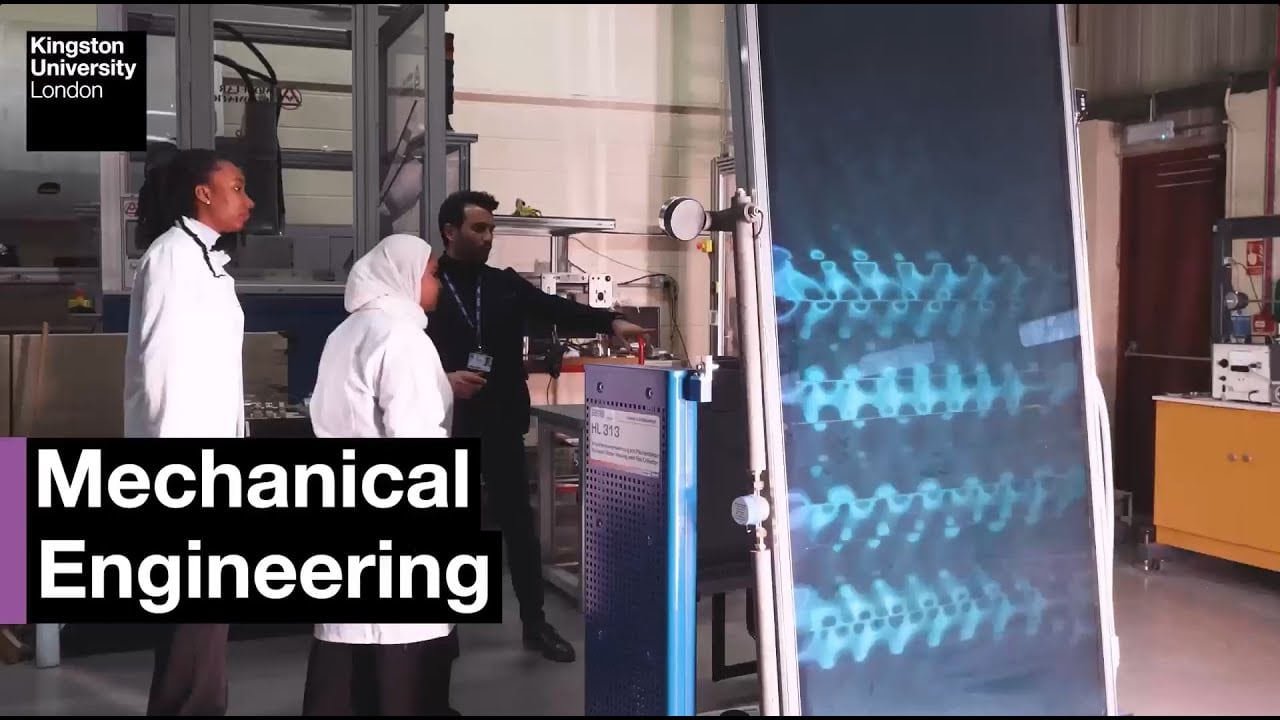
On this course, you will be able to take full advantage of the wide range of facilities available for practical work at our Roehampton Vale campus.
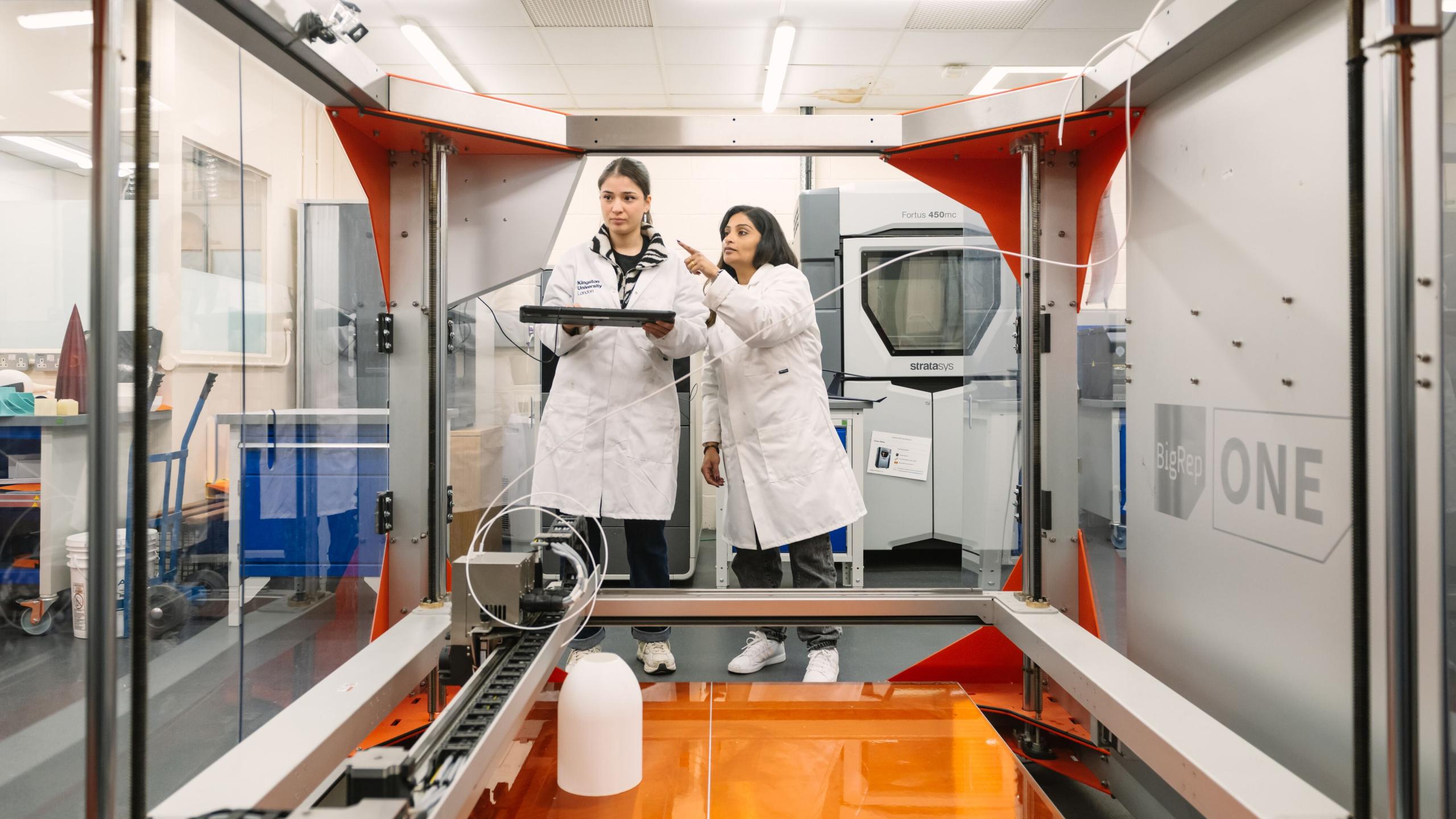
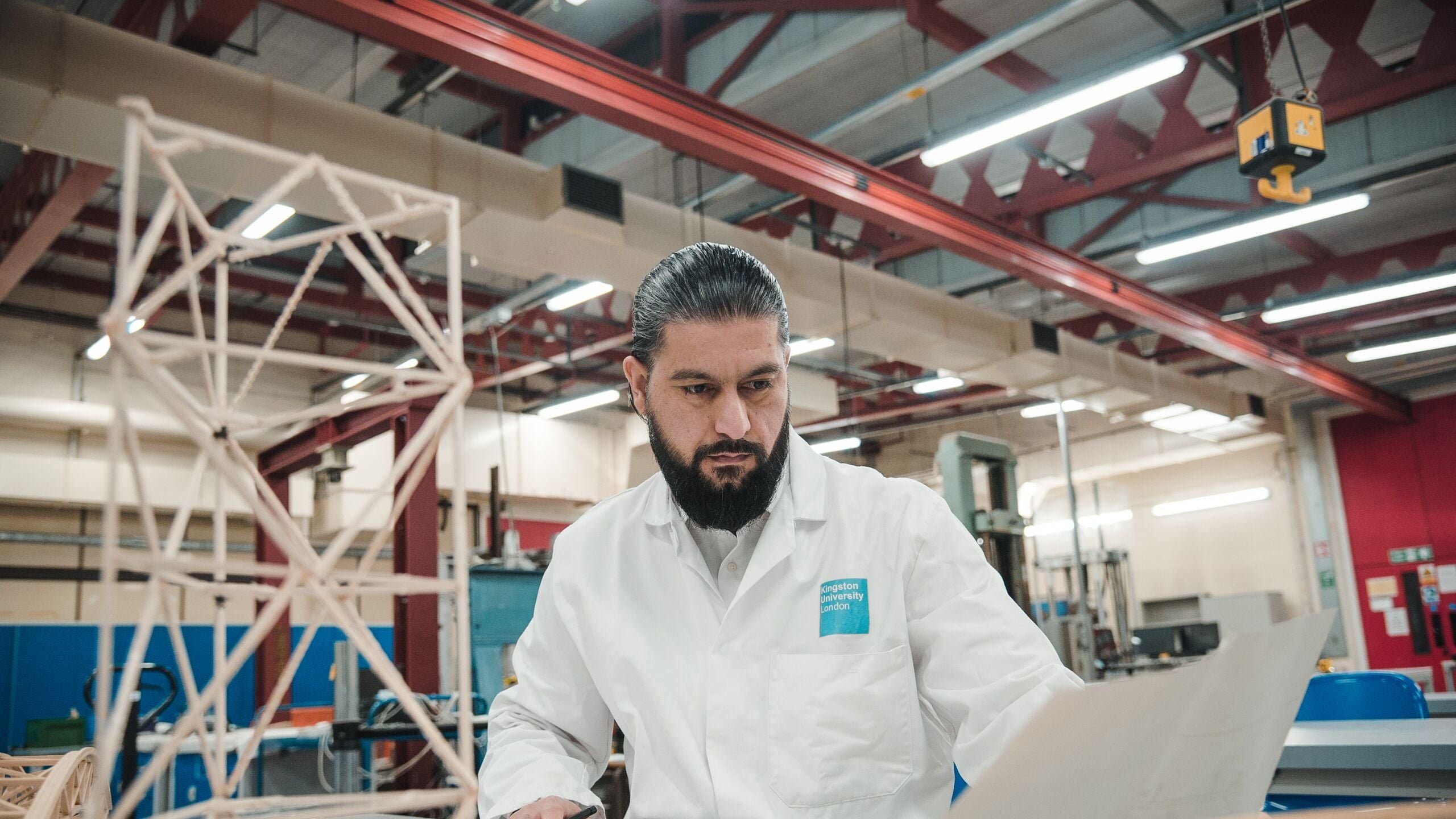
Our applied approach to teaching is supported by our dedicated laboratories. These include state-of-the-art facilities for rapid prototyping and manufacturing, a fully equipped materials laboratory, and a modern electronics and robotics lab.
Other technology and industry-standard equipment you will have access to includes:
- 3D design studio and workshop
- Mechanical engineering workshop
- 3D printers
- CNC 4 axis machine
- Rolling roads
- Automotive testing facilities
- A Lotus Exige
- Cars and motorcycles built by engineering students
- Electronics and robotics labs
Engineering at Kingston University
Follow along as our students talk through the skills they're developing to design their future careers.
Why choose this course
Mechanical Engineering at Kingston immerses you in a curriculum designed for the real world. You'll obtain a strong theoretical background and excellent hands-on skills in engineering design, thermodynamics, fluid mechanics, applied mechanics and electronics.
Our curriculum will equip you with crucial skills in business and project management. Emphasising sustainable practices, this programme aligns with key United Nations Sustainable Development Goals. Meaning you will graduate with the knowledge and understanding you need to tackle the pressing environmental and societal challenges of our time.
Through team-based design activities and industrially-based projects, you'll have lots of opportunities to enhance your communication skills and develop your ability to work collaboratively.
You can also choose to focus your studies and develop specialised knowledge through the Automotive Engineering pathway on this course.
Formula Student and motorsport
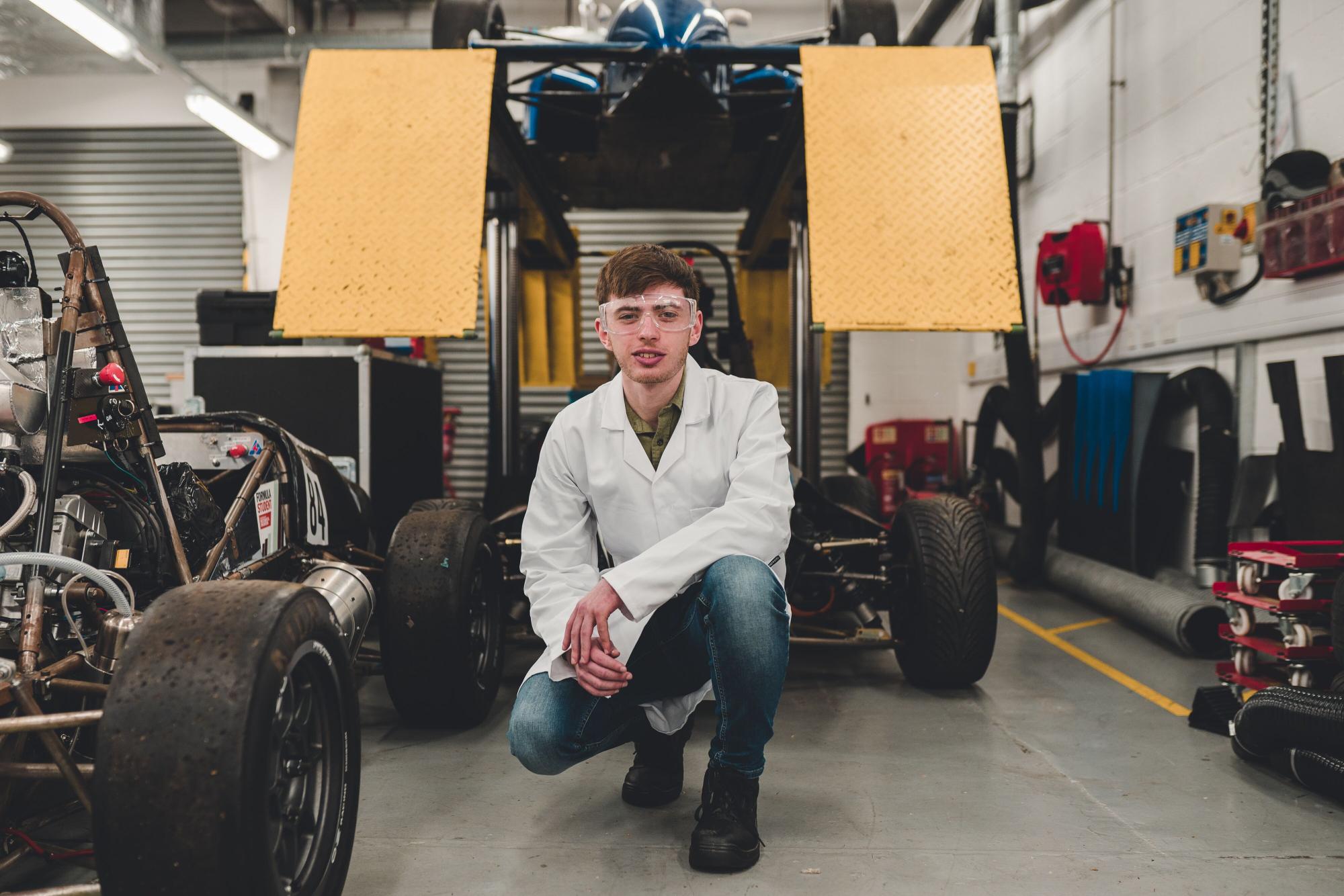
Join this course at Kingston and you too could join the KU e-Racing team and help them drive for success in Formula Student year after year.
IMechE's Formula Student is the largest annual student motorsport event in the world. With its real-world bias, Formula Student is viewed by the motor industry as the standard for engineering graduates to meet. In fact, many high-profile motorsports engineers have participated in Formula Student whilst at university. These include Andrew Shovlin, chief race engineer of Mercedes-AMG Petronas F1 team and James Painter, engineering lead of vehicle integration working on the BLOODHOUND land speed record.
Students on this course can also get involved with the successful Kingston University motorsport team.
KU e-Racing shines at Silverstone
The week after the likes of Lewis Hamilton and Sebastian Vettel raced at the British Grand Prix, students from around the world competed in their own motorsport event at Silverstone in the Institution of Mechanical Engineers' Formula Student competition. Kingston University's KU e-Racing proved to be the only UK team with a viable electric vehicle.
You can also watch this video produced by KU students to see the KU e-Racing car being assembled, the chassis being constructed and the car being transported to Silverstone. In addition, catch glimpses of the business presentation made as part of the University's entry. Watch their full-length documentary on Formula Student.
Accreditations
The MEng fully meets the exemplifying academic benchmark requirements for registration as a Chartered Engineer (CEng).
The BEng (Hons) will meet, in part, the exemplifying academic benchmark requirements for registration as a Chartered Engineer. Students will need to complete an approved format of further learning pursuant to the requirements of UK-SPEC.
The BEng (Hons) will also meet the exemplifying academic benchmark requirements for registration as an Incorporated Engineer (IEng).
- Further learning details are available on the Institution of Mechanical Engineers website.
- All accredited degrees are displayed on the Institution of Mechanical Engineers website.
Accreditation is a mark of assurance that the degree meets the standards set by the Engineering Council in the UK Standard for Professional Engineering Competence (UK-SPEC). Some employers recruit preferentially from accredited degrees, and an accredited degree is likely to be recognised by other countries that are signatories to international accords.
Monitored Professional Development Scheme
The Monitored Professional Development Scheme (MPDS), also known as the PTU scheme, offered by the Institution of Mechanical Engineers (IMechE), provides a pathway for students to achieve Chartered Engineer (CEng) or Incorporated Engineer (IEng) status. Students can begin their MPDS journey concurrently with their studies at our Department of Mechanical Engineering. Upon graduation, students may need to complete an academic review or further learning whilst still being registered on the MPDS.
Discover mechanical engineering
Hear from our staff and students about studying mechanical engineering at Kingston University.
Course content
This course offers both a Mechanical Engineering pathway and an Automotive Engineering pathway. The modules for each pathway are listed below.
MEng and BEng students take the same modules until Year 3 when the routes diverge. The MEng contains an extra year of advanced-level study.
Foundation year
An Engineering Foundation course with pathways in Aerospace, Electronic, Mechanical and Robotic Engineering is available.
Year 1
Core modules (both pathways)
30 credits
This module provides you with a solid foundation in the core mathematical and computational skills required for modern engineering practice. You are introduced to key areas of engineering mathematics and shown how these are applied to the analysis and design of engineering systems. Alongside the mathematical content, you develop scripting and computational problem-solving skills using industry-relevant software tools such as MATLAB, Excel, and Python.
You learn the fundamentals of programming, including data handling, task automation, and algorithmic thinking, enabling you to implement mathematical methods effectively in software. Through practical examples and exercises, you gain experience in translating mathematical concepts into computational solutions. This computational skillset provides you with a strong foundation for future study in areas such as machine learning, artificial intelligence, and advanced engineering analysis.
30 credits
This module introduces you to the fundamentals of structural analysis, including statics and dynamics, and to the mechanical behaviour of a wide range of engineering materials. In the mechanics component, you develop an understanding of the behaviour of particles and rigid bodies when stationary and in motion. You study bodies such as trusses in equilibrium and learn to define and calculate external and internal parameters, including force, moment, stress, and strain.
You apply theoretical and numerical methods to analyse structural components, developing skills that are essential for the design of real engineering structures. The module also introduces the dynamics of particles and rigid bodies and explores their engineering applications. Through material testing methods, you investigate the deformation and failure of different engineering materials.
30 credits
This module introduces you to core principles of mechanical engineering across fluid mechanics, thermodynamics, and electronics. In the Fluid Mechanics section, you explore fundamental fluid properties, the basic conservation equations, and their engineering applications, alongside an introduction to dimensions and SI units. The Thermodynamics section examines the relationship between heat and other forms of energy, highlighting the central role of thermodynamic concepts across engineering and science, with practical examples such as internal combustion engines and air-conditioning systems. The governing laws of thermodynamics are studied in depth due to their wide applicability. The Electronics section introduces essential electrical quantities: charge, current, resistance, voltage, power, and energy, before progressing to fundamental components and their use in AC and DC circuits, and extending to more advanced devices and circuit analysis methods. The module is delivered primarily through lectures, supported by tutorials and laboratory-based practical sessions.
30 credits
This module will introduce you to Future Skills through engagement with Navigate, supporting the development of engineering design skills and good academic and professional practice to help you succeed during your course and progress towards professional status. You are introduced to the key aspects of planning an engineering project from start to finish, including design processes that incorporate sustainability, an awareness of interactions across different engineering disciplines, relevant regulatory frameworks, and Health and Safety procedures.
You are supported in developing effective learning techniques related to assessment, including the use of feedback, reflection, and feed-forward as integrated elements of your learning journey. These activities are reinforced through active participation in the Navigate Programme, enabling you to begin developing a design-thinking approach to Future Skills development.
Year 2
Mechanical Engineering pathway: core modules
30 credits
Building on your foundational knowledge from Level 4 modules, this module develops your understanding of thermofluids and solid mechanics principles and their engineering applications. In the Thermofluids section, you study thermodynamics, heat transfer, combustion, and fluid mechanics, exploring thermodynamic cycles and their application to steam power plants, gas turbines, and internal combustion engines. You examine heat transfer by conduction and convection, as well as combustion processes and boundary-layer behaviour, supported by engineering examples and problem-solving activities that develop your ability to analyse thermofluid systems.
In the Solid Mechanics section, you explore the principles governing the behaviour of deformable solids made from different materials under static and dynamic loading. Topics include mechanical properties of materials, types of loading, plane-stress and plane-strain conditions, beam design, torsion of shafts, and buckling. You develop the ability to design solid components and structures by selecting appropriate materials and geometry, and to apply analytical methods to evaluate stresses, strains, deformation, and dynamic response under varying load conditions.
The module strengthens your analytical and problem-solving skills for the design and evaluation of engineering systems.
30 credits
The Future Skills Explore Learning Outcomes are delivered in this module by immersing you in an interdisciplinary, industry-informed project environment. You work on a live brief shaped by industry input and professional practice expectations, applying subject-specific knowledge to authentic engineering and business challenges while developing professional behaviours in communication, teamwork, leadership, and project delivery.
You explore the links between engineering and business decisions using systems- and design-thinking approaches. Beginning with customer and stakeholder requirements, you apply tools to organise insights, translate needs into measurable objectives, and use the House of Quality to prioritise engineering characteristics. These analyses inform the development of a Product Design Specification, guiding concept generation and selection to ensure creative, research-driven, and well-justified solutions.
Alongside design and project activities, you develop essential business awareness, including value proposition design, business model development, customer analysis, cost modelling, budgeting, and commercial evaluation. Strong emphasis is placed on Corporate Social Responsibility and Environmental, Social and Governance principles, showing how ethics, sustainability, environmental impact, and stakeholder expectations shape engineering practice and venture development. Through reflection, industry engagement, and Future Skills development, you articulate your professional identity and prepare for Level 6 project work and career pathways.
30 credits
This module builds on your Level 4 Engineering Design module and deepens your knowledge of design communication in accordance with British Standard BS8888. You develop skills in reading engineering drawings and producing product design specifications, as well as undertaking design analysis, validation, and optimisation. Design for Excellence (DfX) principles are supported through the use of integrated CAD/CAM/CAE software to help you solve and analyse engineering design problems.
You progress from 2D conventional engineering drawings to 3D digital models using parametric and free-form modelling techniques. Digital simulation activities introduce two key types of analysis: mechanism design and simulation, and finite element modelling (FEM) and analysis (FEA) using advanced industry-standard solvers.
The second part of the module focuses on the manufacturing stage of the engineering design process. You explore traditional design for machining and assembly methods, supported by CAD/CAM software to optimise design decisions, machining strategies, and manufacturing costs. Digital manufacturing techniques extend your skills from conventional approaches to 3D digital machining simulation using feature-based recognition, preparing you for modern engineering design and manufacturing practice.
30 credits
Technological advancements across engineering increasingly rely on intelligent and automated systems. In this module, you build on your Level 4 knowledge to develop a strong foundation in microcontrollers, control engineering, automation, and applied artificial intelligence for mechanical and automotive applications. You deepen your understanding of microcontroller platforms, sensors, actuators, and system integration, while learning to model, analyse, and design dynamic control systems.
Core topics include system dynamics, stability, feedback behaviour, signal conditioning, embedded programming, and advanced control approaches. You explore how AI-enabled decision-making and control enhance mechatronic and autonomous systems used in robotics, the automotive industry, and industrial automation.
You use MATLAB and microcontroller programming environments to connect theory with practice through simulation and hands-on experimentation. Learning is delivered through lectures, computing laboratories, practical workshops, and guided independent study. The module strengthens your analytical capability, applied problem-solving, and system-level engineering skills relevant to modern engineering practice.
Automotive Engineering pathway: core modules
30 credits
The Future Skills Explore Learning Outcomes are delivered in this module by immersing you in an interdisciplinary, industry-informed project environment. You work on a live brief shaped by industry input and professional practice expectations, applying subject-specific knowledge to authentic engineering and business challenges while developing professional behaviours in communication, teamwork, leadership, and project delivery.
You explore the links between engineering and business decisions using systems- and design-thinking approaches. Beginning with customer and stakeholder requirements, you apply tools to organise insights, translate needs into measurable objectives, and use the House of Quality to prioritise engineering characteristics. These analyses inform the development of a Product Design Specification, guiding concept generation and selection to ensure creative, research-driven, and well-justified solutions.
Alongside design and project activities, you develop essential business awareness, including value proposition design, business model development, customer analysis, cost modelling, budgeting, and commercial evaluation. Strong emphasis is placed on Corporate Social Responsibility and Environmental, Social and Governance principles, showing how ethics, sustainability, environmental impact, and stakeholder expectations shape engineering practice and venture development. Through reflection, industry engagement, and Future Skills development, you articulate your professional identity and prepare for Level 6 project work and career pathways.
30 credits
This core module for Mechanical Engineering (Automotive Engineering) students provides a strong foundation in team-based engineering design. You develop your design capability through the use of industry-standard software and established design principles, supported by a project-based assessment approach that promotes robust, high-quality engineering outcomes and prepares you for Level 6 study.
Each year, you work in groups on the design of a different automotive subsystem, applying your technical knowledge to produce a comprehensive design report that covers design justification, CAD modelling, cost estimation, and manufacturing considerations. British Standards are applied throughout the module to reflect industrial practice and to strengthen your understanding of professional engineering requirements.
30 credits
This module introduces you to the fundamental principles of automotive powertrain, suspension, and chassis systems used in modern vehicles and race cars. Delivered through a project-based approach, the module combines lectures, tutorials, and practical laboratory sessions to develop both theoretical understanding and applied engineering skills.
You study internal combustion and electric powertrains, autonomous vehicle technologies, and key aspects of suspension and chassis design. Emphasis is placed on linking theoretical and mathematical models with experimental validation through simulation and laboratory-based exercises.
The module develops your analytical, problem-solving, and digital design skills in alignment with Kingston’s Future Skills framework, preparing you to tackle complex engineering challenges and work effectively within multidisciplinary automotive engineering teams.
30 credits
Technological advancements across engineering increasingly rely on intelligent and automated systems. In this module, you build on your Level 4 knowledge to develop a strong foundation in microcontrollers, control engineering, automation, and applied artificial intelligence for mechanical and automotive applications. You deepen your understanding of microcontroller platforms, sensors, actuators, and system integration, while learning to model, analyse, and design dynamic control systems.
Core topics include system dynamics, stability, feedback behaviour, signal conditioning, embedded programming, and advanced control approaches. You explore how AI-enabled decision-making and control enhance mechatronic and autonomous systems used in robotics, the automotive industry, and industrial automation.
You use MATLAB and microcontroller programming environments to connect theory with practice through simulation and hands-on experimentation. Learning is delivered through lectures, computing laboratories, practical workshops, and guided independent study. The module strengthens your analytical capability, applied problem-solving, and system-level engineering skills relevant to modern engineering practice.
Year 3
Year 3 comprises core engineering topics and advanced mechanical engineering modules, plus a strong focus on independent and group project work. You will gain an understanding of the business world. MEng students will continue to deepen their knowledge in areas such as computer-aided design and mathematics.
Mechanical Engineering pathway: core modules
30 credits
The individual project module provides you with a capstone learning experience in which you independently research, analyse, and develop a topic of personal and disciplinary relevance. You deepen your understanding of material studied earlier in the course while also engaging with new and advanced knowledge specific to your chosen area. Through the project, you demonstrate independent judgement, creativity, and critical thinking as you address a complex engineering or research problem.
The module supports the development of key professional competencies, including effective planning, time management, and maintaining regular communication with your supervisor. You are expected to define clear goals, work to agreed deadlines, and document your progress through written reports, a presentation, and a maintained project record.
30 credits
This module integrates control systems engineering with microcontroller-based systems to enable you to design, model, and control mechatronic systems. You apply engineering principles from control theory and microcontroller technology to develop systems that sense, process, and control real-world events.
You study the modelling of dynamic behaviour, including multi-degree-of-freedom systems, and the design of microcontroller-based sensor–actuator systems. Using appropriate software tools and hands-on programming of microcontrollers, you gain practical experience in implementing system control and translating theoretical models into working mechatronic solutions.
30 credits
This module offers you a comprehensive study of the modelling, design, and integration of key machine elements, including bearings, springs, gears, cams, and mechanisms. You analyse and model these elements using principles drawn from physics, mathematics, and mechanical engineering, including solid mechanics, fluid mechanics, manufacturing processes, and computer simulation through Finite Element Analysis (FEA).
You gain practical experience through a design project in which you design, model, and characterise a mechanical system relevant to real-world engineering applications. Problem sets linked to each topic reinforce the principles introduced in lectures and support the development of analytical and problem-solving skills.
15 credits
This module is designed to extend your knowledge of analytical and numerical techniques in thermofluids. Building on the material studied at Level 5, you further develop your understanding and skills in fluid and thermal analysis. You use computer simulations to solve complex engineering problems involving fluid flow and heat transfer through Computational Fluid Dynamics (CFD).
You study thermofluid mechanics with a focus on energy conversion and transfer in engineering systems, including turbomachines such as pumps and turbines, and heat exchangers. Through theoretical study and practical application, you develop the ability to analyse and model advanced thermofluid systems relevant to real engineering applications.
15 credits
This module gives you a dedicated opportunity to develop your Future Skills Graduate Attributes.
At the start of the module, you will be supported to self-assess your current skills profile. You will determine which attributes and skills you need to develop to support your career ambitions. In this process, you will be supported by a dedicated career coach, helping you explore a range of options that includes self-employment/freelancing, starting your own business, higher level study, and other professional graduate-level opportunities. Throughout the module, you will be given opportunities to engage with external mentors, to support reflection and to develop a professional network.
You will undertake a tailored series of activities and projects, aligned to your goals, from a menu of development options. This could include short courses, enrichment activities and experiential learning options such as micro-placements. You will also be able to reflect on activities outside the University that develop your graduate attributes, such as work or volunteering.
Automotive Engineering pathway: core modules
30 credits
The individual project module provides you with a capstone learning experience in which you independently research, analyse, and develop a topic of personal and disciplinary relevance. You deepen your understanding of material studied earlier in the course while also engaging with new and advanced knowledge specific to your chosen area. Through the project, you demonstrate independent judgement, creativity, and critical thinking as you address a complex engineering or research problem.
The module supports the development of key professional competencies, including effective planning, time management, and maintaining regular communication with your supervisor. You are expected to define clear goals, work to agreed deadlines, and document your progress through written reports, a presentation, and a maintained project record.
15 credits
This module is designed to develop, refine, and apply the knowledge and proficiency you gained in Level 5 modules covering electronics, control, and computing. You build the skills required to identify and solve problems related to the design and implementation of mechatronic systems and automation.
You are introduced to the techniques and knowledge needed to design and embed microprocessors within systems that integrate a range of sensors and actuators to sense, process, and control real-world events. Core topics include advanced microcontroller programming, understanding the operation and performance of sensors and actuators, interfacing techniques for signal optimisation and control, and the use of feedback to achieve accurate and reliable system performance. These concepts reflect systems commonly found in industrial instrumentation and process control.
30 credits
This module offers you a comprehensive study of the modelling, design, and integration of key machine elements, including bearings, springs, gears, cams, and mechanisms. You analyse and model these elements using principles drawn from physics, mathematics, and mechanical engineering, including solid mechanics, fluid mechanics, manufacturing processes, and computer simulation through Finite Element Analysis (FEA).
You gain practical experience through a design project in which you design, model, and characterise a mechanical system relevant to real-world engineering applications. Problem sets linked to each topic reinforce the principles introduced in lectures and support the development of analytical and problem-solving skills.
30 credits
Building on your Level 5 knowledge, this module introduces you to industry-standard software and advanced techniques for aerodynamic analysis and automotive design optimisation. Through practical CAD, CFD, and structural simulation activities, you develop creative problem-solving skills while addressing challenges in surface modelling, flow simulation, structural assessment, and design improvement.
Your digital competency is strengthened through the use of professional engineering tools for design, analysis, and optimisation, enabling you to apply modern engineering workflows to real-world automotive applications. The module encourages an enterprise mindset by emphasising industry relevance, adaptability, and iterative design development.
15 credits
This module gives you a dedicated opportunity to develop your Future Skills Graduate Attributes.
At the start of the module, you will be supported to self-assess your current skills profile. You will determine which attributes and skills you need to develop to support your career ambitions. In this process, you will be supported by a dedicated career coach, helping you explore a range of options that includes self-employment/freelancing, starting your own business, higher level study, and other professional graduate-level opportunities. Throughout the module, you will be given opportunities to engage with external mentors, to support reflection and to develop a professional network.
You will undertake a tailored series of activities and projects, aligned to your goals, from a menu of development options. This could include short courses, enrichment activities and experiential learning options such as micro-placements. You will also be able to reflect on activities outside the University that develop your graduate attributes, such as work or volunteering.
Year 4 - MEng only
The final year of the MEng course will continue to deepen and broaden expertise. A strong emphasis is again on independent learning, as well as an industrially focused group project.
Mechanical Engineering pathway: core modules
30 credits
The MEng Group Design Project provides you with a capstone learning experience in which you work as part of a team on a major engineering design problem that closely reflects real-world professional practice. You are assigned to a project with an outline description, specification, or customer requirements provided by the teaching team. As a group, you develop these requirements into a detailed technical specification and carry out the tasks needed to complete the project.
The module allows you to further develop academic and professional skills introduced earlier in the programme. To successfully complete the project, you establish a project plan and work schedule, undertake the necessary technical tasks, monitor progress, manage team activities, conduct and record formal design meetings, and resolve problems as they arise.
30 credits
The module is structured in a way that develops an understanding of the different stages in the lifecycle of a designed product, for example, from inception, through design and manufacturing, then into service and finally retirement. This module aims to help students develop an understanding of these stages in a product lifecycle and processes need to be undertaken in these stages and their interrelationships.
This module also aims to help students develop a fundamental understanding of the product lifecycle from a business and organisational perspective. Case studies are used to illustrate the application and relevance of taught concepts. Students will be asked to work in a team to perform a comprehensive product lifecycle analysis, using the knowledge learnt in this module as well as applying the knowledge acquired in pre-requisite modules. This will enable students to develop a set of skills to enhance their employability prospects in this demanding area. Core factual materials are provided via Canvas with keynote lectures.
30 credits
This module is designed for you as a Mechanical Engineering student, or from a related discipline, with prior exposure to relevant computational techniques and advanced mathematics. It extends your knowledge and skills beyond the basic fluid mechanics methods typically introduced at early undergraduate level and provides a theoretical and practical introduction to computational fluid dynamics (CFD).
During practical sessions, you focus on solving fluid mechanics problems in realistic mechanical engineering contexts. Emphasis is placed on developing your awareness of the limitations of CFD software and on understanding good practice in its application, including model selection, boundary condition definition, and result interpretation.
The module also develops your advanced computational skills in fluid dynamics, enhancing your employability in sectors such as energy and related engineering industries. Through a combination of theory, simulation, and applied problem-solving, you gain the confidence and competence to use CFD tools effectively and responsibly in professional engineering practice.
30 credits
This module provides you with an in-depth understanding of materials science and structural analysis by integrating advanced materials engineering with the theory and practical application of finite element analysis (FEA) and structural dynamics. In the materials component, you develop comprehensive knowledge of advanced materials, their development, and their performance in engineering applications. You examine how material design, manufacturing processes, and resulting properties are interconnected, supported by real industrial examples. This foundation enables informed materials selection, enhances employability, and prepares you for research-oriented study.
The analytical component introduces the theory and application of FEA as a numerical method for solving engineering and physical problems, with a focus on stresses, deflections, and temperature distributions. You also study key principles of structural dynamics, including natural frequencies, damping, mode shapes, and the response of flexible structures under dynamic loading - critical for avoiding vibration-related failures.
Automotive Engineering pathway: core modules
30 credits
The MEng Group Design Project provides you with a capstone learning experience in which you work as part of a team on a major engineering design problem that closely reflects real-world professional practice. You are assigned to a project with an outline description, specification, or customer requirements provided by the teaching team. As a group, you develop these requirements into a detailed technical specification and carry out the tasks needed to complete the project.
The module allows you to further develop academic and professional skills introduced earlier in the programme. To successfully complete the project, you establish a project plan and work schedule, undertake the necessary technical tasks, monitor progress, manage team activities, conduct and record formal design meetings, and resolve problems as they arise.
30 credits
The module is structured in a way that develops an understanding of the different stages in the lifecycle of a designed product, for example, from inception, through design and manufacturing, then into service and finally retirement. This module aims to help students develop an understanding of these stages in a product lifecycle and processes need to be undertaken in these stages and their interrelationships.
This module also aims to help students develop a fundamental understanding of the product lifecycle from a business and organisational perspective. Case studies are used to illustrate the application and relevance of taught concepts. Students will be asked to work in a team to perform a comprehensive product lifecycle analysis, using the knowledge learnt in this module as well as applying the knowledge acquired in pre-requisite modules. This will enable students to develop a set of skills to enhance their employability prospects in this demanding area. Core factual materials are provided via Canvas with keynote lectures.
30 credits
This module provides you with an in-depth understanding of materials science and structural analysis by integrating advanced materials engineering with the theory and practical application of finite element analysis (FEA) and structural dynamics. In the materials component, you develop comprehensive knowledge of advanced materials, their development, and their performance in engineering applications. You examine how material design, manufacturing processes, and resulting properties are interconnected, supported by real industrial examples. This foundation enables informed materials selection, enhances employability, and prepares you for research-oriented study.
The analytical component introduces the theory and application of FEA as a numerical method for solving engineering and physical problems, with a focus on stresses, deflections, and temperature distributions. You also study key principles of structural dynamics, including natural frequencies, damping, mode shapes, and the response of flexible structures under dynamic loading - critical for avoiding vibration-related failures.
30 credits
This module develops your advanced and integrated understanding of modern automotive powertrain systems across internal combustion, hybrid, and fully electric architectures. Delivered through lectures, simulation-led tutorials, and research-informed design activities, the module equips you with the theoretical, mathematical, and computational tools required to analyse, optimise, and validate high-performance and high-efficiency powertrains.
You explore state-of-the-art propulsion technologies, including downsized and boosted internal combustion engines, hybrid energy management systems, power electronics, electric machines, battery systems, hydrogen internal combustion engines, and fuel cell powertrains. Emphasis is placed on modelling, control, and optimisation, alongside understanding the trade-offs between efficiency, emissions, performance, cost, and thermal constraints.
You critically evaluate contemporary industry developments, apply advanced analytical and simulation techniques, and develop the capability to propose and justify innovative powertrain solutions for future vehicles and motorsport applications.
Extended degree with foundation year
If you would like to study one of our engineering degrees at Kingston University but are not yet ready for Year 1 of an undergraduate course, a foundation year is ideal.
International students: direct application
Are you an international student? Have you decided Kingston is the place for you? If so, you can apply for this course directly, rather than having to go through UCAS.

Future Skills and career opportunities
What career opportunities does this course offer?
You'll graduate from this course ready for a successful career in industry, having gained hands-on experience, practical, professional and technical skills.
Our graduates typically go on to jobs such as:
- Design Engineer
- Product Development Engineer
- Additive Manufacturing / 3D Printing Specialist
- Biomechanical Engineer
- Structural Analyst
- Simulation Engineer (FEA/CFD)
- Control Systems Engineer
- Data Analyst
- Motorsports Engineer
- Defense / Military Tech Engineer
- Spacecraft Propulsion Engineer
- Startups & Entrepreneurship
- Robotics Engineer
- Railway Engineer
- Vehicle Dynamics Engineer
Employers include Rolls-Royce, Formula 1, Lockheed Martin, British Aerospace, British Airways, McLaren, Subsea 7, Mitsubishi, Eurostar and BAE Systems.
Future Skills
Our Future Skills programme is embedded within all our undergraduate courses and throughout the whole Kingston experience. These skills will help you to become a future-proof graduate by equipping you with the skills most valued by employers, such as problem-solving, digital competency and adaptability.
As you progress through your degree, you'll learn to navigate, explore and apply these graduate skills. You’ll also understand how to demonstrate and articulate to employers how these future skills give you the edge.

Teaching and assessment
Scheduled learning and teaching on this course includes timetabled activities including lectures, seminars and small group tutorials. It may also include placements, project work, workshops, workshops in computer labs, and laboratory workshops.
Outside the scheduled learning and teaching hours, you will learn independently through self-study which will involve reading articles and books, working on projects, undertaking research, preparing for and completing your work for assessments. Some independent study work may need to be completed on-campus, as you may need to access campus-based facilities such as studios and labs.
Our academic support team here at Kingston University provides help in a range of areas.
When you arrive, we'll introduce you to your personal tutor. This is the member of academic staff who will provide academic guidance, be a support throughout your time at Kingston and show you how to make the best use of all the help and resources that we offer at Kingston University.
A course is made up of modules, and each module is worth a number of credits. You must pass a given number of credits in order to achieve the award you registered on, for example 360 credits for a typical undergraduate course or 180 credits for a typical postgraduate course. The number of credits you need for your award is detailed in the programme specification which you can access from the link at the bottom of this page.
One credit equates to 10 hours of study. Therefore 120 credits across a year (typical for an undergraduate course) would equate to 1,200 notional hours. These hours are split into scheduled and guided. On this course, the percentage of that time that will be scheduled learning and teaching activities is shown below for each year of study. The remainder is made up of guided independent study.
Mechanical Engineering pathway
- Year 1: 30% scheduled learning and teaching
- Year 2: 25% scheduled learning and teaching
- Year 3: 17% scheduled learning and teaching
- Year 4 (MEng): 23% scheduled learning and teaching
Mechanical Engineering (Automotive Engineering) pathway
- Year 1: 30% scheduled learning and teaching
- Year 2: 26% scheduled learning and teaching
- Year 3: 18% scheduled learning and teaching
- Year 4 (MEng): 23% scheduled learning and teaching
The exact balance between scheduled learning and teaching and guided independent study will be informed by the modules you take.
Your course will primarily be delivered in person. It may include delivery of some activities online, either in real time or recorded.
Types of assessment
Mechanical Engineering pathway
- Year 1: Coursework 100%
- Year 2: Coursework 100%
- Year 3: Coursework 100%
- Year 4: Coursework 100%
Mechanical Engineering (Automotive Engineering) pathway
- Year 1: Coursework 100%
- Year 2: Coursework 100%
- Year 3: Coursework 100%
- Year 4: Coursework 90%; exam 10%
Please note: the above breakdowns are a guide calculated on core modules only. If your course includes optional modules, this breakdown may change to reflect the modules chosen.
We aim to provide feedback on assessments within 20 working days.
Your individualised timetable is normally available to students within 48 hours of enrolment. Whilst we make every effort to ensure timetables are as student-friendly as possible, scheduled learning and teaching can take place on any day of the week between 9am and 6pm. For undergraduate students, Wednesday afternoons are normally reserved for sports and cultural activities, but there may be occasions when this is not possible. Timetables for part-time students will depend on the modules selected.
Fees and funding
| Fee category | Annual Fee |
|---|---|
| Home (UK students) | |
| £10,050* | |
| Foundation Year: | £10,050* |
| International | |
| Year 1 (2027/28): | £To be confirmed |
| Year 2 (2028/29): | £To be confirmed |
| Year 3 (2029/30): | £To be confirmed |
| Year 4 (2030/31): | £To be confirmed |
The tuition fee you pay depends on whether you are assessed as a 'Home' (UK), 'Islands' or 'International' student. In 2026/27 the fees for this course are above.
For courses with Professional Placement, the fee for the placement year can be viewed on the undergraduate fees table. The placement fee published is for the relevant academic year stated in the table. This fee is subject to annual increases but will not increase by more than the fee caps as prescribed by the Office for Students or such other replacing body.
*For full-time programmes lasting more than one academic year, a tuition fee is payable for each academic year of the course.
Your annual tuition fee covers your first attempt at all modules required for that academic year. Any re-study or repeat of modules will incur additional charges, calculated according to the number of credits taken.
Home students (UK): Tuition fees are subject to inflation-linked increases in line with government policy. Updated fees will be confirmed in line with the maximum fee cap set by the Government or the Office for Students (OfS) for each academic year. This means your fee may increase for each academic year of study, but only up to the maximum amount permitted for that year.
Eligible UK students can apply to the Government for a tuition loan, which is paid direct to the University. This has a low interest-rate which is charged from the time the first part of the loan is paid to the University until you have repaid it.
International students: Full-time taught international student fees are subject to an annual increase, which is published in advance for the full duration of your programme.
| Fee category | Annual Fee |
|---|---|
| Home (UK students) | |
| £9,790* | |
| Foundation Year: | £9,790 |
| International | |
| Year 1 (2026/27): | £19,200 |
| Year 2 (2027/28): | £19,900 |
| Year 3 (2028/29): | £20,700 |
| Year 4 (2029/30): | £21,500 |
The tuition fee you pay depends on whether you are assessed as a 'Home' (UK), 'Islands' or 'International' student. In 2026/27 the fees for this course are above.
For courses with Professional Placement, the fee for the placement year can be viewed on the undergraduate fees table. The placement fee published is for the relevant academic year stated in the table. This fee is subject to annual increases but will not increase by more than the fee caps as prescribed by the Office for Students or such other replacing body.
*For full-time programmes lasting more than one academic year, a tuition fee is payable for each academic year of the course.
Your annual tuition fee covers your first attempt at all modules required for that academic year. Any re-study or repeat of modules will incur additional charges, calculated according to the number of credits taken.
Home students (UK): Tuition fees are subject to inflation-linked increases in line with government policy. Updated fees will be confirmed in line with the maximum fee cap set by the Government or the Office for Students (OfS) for each academic year. This means your fee may increase for each academic year of study, but only up to the maximum amount permitted for that year.
Eligible UK students can apply to the Government for a tuition loan, which is paid direct to the University. This has a low interest-rate which is charged from the time the first part of the loan is paid to the University until you have repaid it.
International students: Full-time taught international student fees are subject to an annual increase, which is published in advance for the full duration of your programme.
| Fee category | Annual Fee |
|---|---|
| Home (UK students) | |
| £9,535* | |
| Foundation Year: | £9,535 |
| International | |
| Year 1 (2025/26): | £18,500 |
| Year 2 (2026/27): | £19,200 |
| Year 3 (2027/28): | £19,900 |
| Year 4 (2028/29): | £20,700 |
The tuition fee you pay depends on whether you are assessed as a 'Home' (UK), 'Islands' or 'International' student. In 2025/26 the fees for this course are above.
For courses with Professional Placement, the fee for the placement year can be viewed on the undergraduate fees table. The placement fee published is for the relevant academic year stated in the table. This fee is subject to annual increases but will not increase by more than the fee caps as prescribed by the Office for Students or such other replacing body.
* If your course involves a foundation year, the fee for that year for Home (UK) students will be £9,535 in 2025/26. The fees shown above apply for Year 1 of the degree from 2025/26 onwards (fees may rise in line with inflation for future academic years). For full-time programmes lasting more than one academic year, a tuition fee is payable for each academic year of the course. Your annual tuition fees cover your first attempt at all of the modules necessary to complete that academic year. A re-study of any modules will incur additional charges calculated by the number of credits. Home tuition fees may be subject to annual increases but will not increase by more than the fee caps as prescribed by the Office for Students or such other replacing body. Full time taught International fees are subject to an annual increase and are published in advance for the full duration of the programme.
Eligible UK students can apply to the Government for a tuition loan, which is paid direct to the University. This has a low interest-rate which is charged from the time the first part of the loan is paid to the University until you have repaid it.
Additional course costs
Some courses may require additional costs beyond tuition fees. When planning your studies, you’ll want to consider tuition fees, living costs, and any extra costs that might relate to your area of study.
Your tuition fees include costs for teaching, assessment and university facilities. So your access to libraries, shared IT resources and various student support services are all covered. Accommodation and general living expenses are not covered by these fees.
Where applicable, additional expenses for your course may include:
Our libraries have an extensive collection of books and journals, as well as open-access computers and laptops available to rent. However, you may want to buy your own computer or personal copies of key textbooks. Textbooks may range from £50 to £250 per year. And a personal computer can range from £100 to £3,000 depending on your course requirements.
While most coursework is submitted online, some modules may require printed copies. You may want to allocate up to £100 per year for hard-copies of your coursework.
Kingston University will pay for all compulsory field trips. Fees for optional trips can range from £30 to £350 per trip.
Your tuition fees don’t cover travel costs. To save on travel costs, you can use our intersite bus service. This route links the campuses and halls of residence with local train stations – Surbiton, Kingston upon Thames and Norbiton.
Courses involving placements or direct work with vulnerable groups may require a DBS check or other security checks.
Kingston University will supply you with a lab coat and safety goggles at the start of the year.
Scholarships and bursaries
For students interested in studying this course at Kingston, there are several opportunities to seek funding support.

Course changes and regulations
The information on this page reflects the currently intended course structure and module details. To improve your student experience and the quality of your degree, we may review and change the material information of this course. Find out more about course changes
Programme Specifications for the course are published ahead of each academic year.
Regulations governing this course can be found on our website.
What our students and graduates say
I studied a project management module, which enabled me to take a Prince 2 foundation certification. This set me up with the ideal dissertation subject to enhance my aerodynamic knowledge and skillset.
Kingston has prepared me for my future career by exposing me to the motorsport industry through Formula Student. I've also developed my leadership, management and communication skills through group projects.
Key information
The scrolling banner below displays some key factual data about this course (including different course combinations or delivery modes of this course where relevant).