

Photography BA (Hons)
- Animation, film and photography
- Undergraduate
Launch your career in photography with the Photography BA (Hons) degree course from Kingston University, ranked No.1 in London and No.9 in the UK for Film Production & Photography (The Guardian University Guide 2027).

Capture your creativity by delving into a world of still imagery
Develop your ideas and professional skills, within our multi-genre approach to photography.
As part of Kingston School of Art, you’ll benefit from a creative community where collaborative working and critical practice are encouraged. Our workshops and studios are open to all disciplines, enabling students and staff to work together, share ideas and explore multi-disciplinary making.
You'll get to use a range of professional-grade facilities and equipment, such as high-end digital capture, dedicated photography studios and darkrooms (analogue and digital). Our faculty workshops, supervised by qualified technical staff, also support and enable further development and the production of studio work across all the areas of digital and analogue photography.
Our technical staff are practising artists who publish and present their work nationally and internationally and will support you in the bespoke photography workshop.
Animation, film and photography at Kingston School of Art
Discover the collaborative atmosphere at Kingston School of Art, where academics encourage film, animation and photography students to value the skills they have and understand how to advocate for themselves in their future careers.

Gallery of student work

Benjamin Martinaud
Corpus Terrae series
Benjamin Martinaud
Corpus Terrae series

Denis Colebourne
Transient Luminescence
Mia Cassels
Two Gardens, Two Months series
Mia Cassels
Two Gardens, Two Months series

Beth Holroyde
Vessel series
Beth Holroyde
Vessel series

Elene Mgaloblishvili
In the Ink, A Study in Self series

Elene Mgaloblishvili
In the Ink, A Study in Self series
Why choose this course
Photography plays a pivotal role in fine art, fashion, advertising, editorial and digital applications. This course is centred on the making and understanding of photographic production and critical thinking, applied to any subject area.
You'll study both analogue and digital photography. The key focus of this course is for you to develop your creative ideas alongside your professional skills, within a multi-genre approach to the medium. There will also be opportunities to work with historic manual processes, such as cyanotypes and salt prints, as well as other 'craft' processes, such as creating unique one-off photo books.
This course takes maximum advantage of Kingston's proximity to the vibrant art, photography and cultural life of London – one of the major photographic art and commercial centres of the world.
It also offers the opportunity for you to prepare yourself for employment and increase your workplace skills with an optional work placement. In the past, we have worked with industry organisations, including:
- Impressions Gallery
- The Photographers' Gallery
- Magnum Photos
- British Journal of Photography
- The Association of Photographers
- Institute of Contemporary Arts (ICA)
- National Archives
- Autograph-ABP
Follow us on Instagram @ku.ksa.photography to see some of the great work our students are doing.
Kingston University is ranked No.1 in London and No.9 in the UK for Film Production & Photography, The Guardian University Guide 2027.
The Art School Experience
As part of Kingston School of Art, students benefit from joining a creative community where we encourage collaborative working and critical practice.
Our workshops and labs are open to all disciplines, enabling students and staff to work together, share ideas and explore multi-disciplinary making.

Course content
You'll develop your creativity and photography through workshops and self-initiated projects. A programme of seminars, lectures, workshops and tutorials will enhance your learning and prepare you for your professional future. Our teaching relates your own ideas and ambitions to the critical, contemporary and historical contexts of photography.
The degree programme sets out to structure your learning and appreciation of, and about, photography and its potential through a process which identifies distinct aims and progress each year.
Years 1 and 2 are made up of four modules, each worth 30 credit points. Year 3 is made up of three modules – two worth 30 credits and one worth 60 credits. Typically, a student must complete 120 credits at each level.
Year 1
In your first year, you'll become aware and critical of the range of photography practices and the possibilities of a personal photography practice. You will be encouraged to experiment with new approaches and techniques.
Core modules
Year 2
In Year 2, you will develop your own independent and self-directed photography practice with critical support. You will continue to develop your ideas, skills and folios in more depth.
Core modules
Optional year
You can opt to study or work abroad through the University's Study Abroad programme or the Erasmus programme during your Photography degree.
Final year
In Year 3, you will become proficient, professional, assured, innovative and outward-facing through a more fully realised and engaged personal photography practice. You will refine your photography and define your ambitions more succinctly.
Core modules
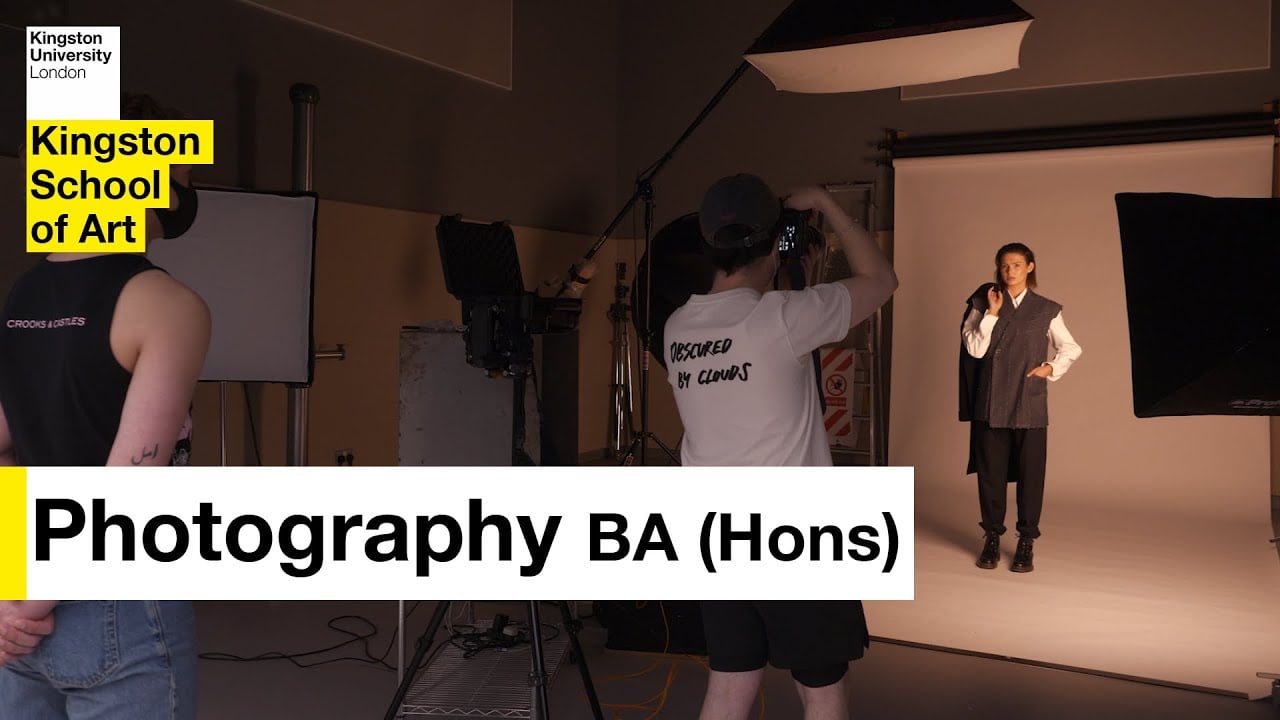
Discover photography at Kingston School of Art
Hear from our staff and students as they share what it's like to study photography at Kingston. Find out about the facilities, creative opportunities and skills you can develop throughout your studies.
International students: direct application
Are you an international student? Have you decided Kingston is the place for you? If so, you can apply for this course directly, rather than having to go through UCAS.

What career opportunities does this course offer?
Our graduates have progressed to roles in editorial, studio photography, fashion, documentary, picture editing, styling, archival and web management and roles within the film industry. Examples of roles include:
- editorial, fashion, advertising photographer
- photojournalist
- artist
- curator
- photographic assistant / technician
- software trainer
- studio and gallery assistant
- stylist
- picture editor
- web designer
- art director
- art buyer
Future Skills
Our Future Skills programme is embedded within all our undergraduate courses and throughout the whole Kingston experience. These skills will help you to become a future-proof graduate by equipping you with the skills most valued by employers, such as problem-solving, digital competency and adaptability.
As you progress through your degree, you'll learn to navigate, explore and apply these graduate skills. You’ll also understand how to demonstrate and articulate to employers how these future skills give you the edge.

Teaching and assessment
Scheduled learning and teaching on this course includes timetabled activities including lectures, seminars and small group tutorials.
It may also include critiques, project work, studio practice and performance, digital labs, workshops, and placements.
Gallery of student work

Shizza Majeed
Babaji's Britain series
Shizza Majeed
Babaji's Britain series
Shizza Majeed
Babaji's Britain series

Thomas Evans
Hen Wlad Fy Nhadau series
Thomas Evans
Hen Wlad Fy Nhadau series

Sudheha Amerasinghe
Gathered Heights series
Sudheha Amerasinghe
Gathered Heights series

Sudheha Amerasinghe
Gathered Heights series
Fees and funding
Additional course costs
Some courses may require additional costs beyond tuition fees. When planning your studies, you’ll want to consider tuition fees, living costs, and any extra costs that might relate to your area of study.
Your tuition fees include costs for teaching, assessment and university facilities. So your access to libraries, shared IT resources and various student support services are all covered. Accommodation and general living expenses are not covered by these fees.
Where applicable, additional expenses for your course may include:
Scholarships and bursaries
For students interested in studying this course at Kingston, there are several opportunities to seek funding support.


Course changes and regulations
The information on this page reflects the currently intended course structure and module details. To improve your student experience and the quality of your degree, we may review and change the material information of this course. Find out more about course changes
Programme Specifications for the course are published ahead of each academic year.
Regulations governing this course can be found on our website.


Key information
The scrolling banner below displays some key factual data about this course (including different course combinations or delivery modes of this course where relevant).

