

Business Economics BSc (Hons)
- Business, management and marketing
- Economics
- Undergraduate
Begin your exciting journey with Business Economics BSc at Kingston University. Here you will learn a variety of financial, organisational, market issues and environmental topics which affect businesses on a global scale.

Prepare for the financial district with our Bloomberg Trading Room
Take your first steps towards a career in business economics with our Business Economics BSc (Hons) degree course.
Join a diverse, inclusive and friendly department which introduces you to a variety of ways to study Economics. If you’re not sure which area of economics you want to pursue, our flexible structure means you can transfer between our three Economics courses at the end of your first year.
No matter what you decide, we will teach you a wide range of skills, theories and methods to prepare you for employment and empower you to shape the economies of tomorrow.
Economics at Kingston University
Economics at Kingston starts with an interest in the real world. Hear how our students are fine-tuning their decision making and resource allocation skills as part of their course.

Why choose this course
This course has a unique pluralistic approach. You'll discover a wide variety of economic thought and theories, and therefore learn to understand and address problems from a range of perspectives. You'll study why businesses, people and governments make decisions and the consequences of these decisions.
This course focuses on the real-life application of economics. You'll explore how businesses operate in the economy, and can choose to study the financial aspects of business and specialist aspects of economics.
You'll use industry-standard IT facilities and develop many further skills highly valued by employers. These include analytical, numerical, data analysis and problem-solving skills, and the use of specialist statistical software. In addition, you will have free access to the Financial Times and Economist. We are also one of only a few UK universities to have a state-of-the-art Bloomberg Trading Room for you to use.
Prepare for global impact
Kingston School of Law, Social and Behavioural Sciences offers courses in economics, law, psychology and criminology. Our degrees are underpinned by a vibrant research culture and delivered by a blend of practitioners and academics who are dedicated to equipping you with the employability skills to thrive in your career.

Course content
This course builds your knowledge of core topics and different schools of thought in economics. Our Business Economics BSc (Hons) concentrates on how economics can be applied to business. You will focus on economic analysis of business activities and understand how businesses operate in the economy. You can also choose to study the financial aspects of business and specialist aspects of economics.
Foundation Year in Social Sciences
If you would like to study this degree at Kingston University but are not yet ready to join the first year of a BSc (Hons) course, you may want to consider studying this course with a foundation year.
Year 1
Year 1 provides a historical background to modern economics, whilst exploring a range of economic principles and perspectives. You will also begin to study the mathematical and statistical foundations essential to the study of economics.
Core modules
Year 2
Year 2 further develops your knowledge of microeconomics (individual or company decisions) and macroeconomics (national decisions). You'll consider mainstream and alternative approaches to economic modelling.
Core modules
Optional year
You have the option to take an additional year to study abroad or to undertake a year-long work placement overseas (or even a mix of both.)
Professional placement year
This course has a professional placement year option which takes place between Year 2 and your Final Year. During this professional placement year you will take a placement within a relevant setting, ensuring you gain essential experience to add to your CV and help you secure a graduate job.
Final year
In the final year, Economics of Organisations and Strategy explores strategic decision-making in companies, economic analysis of organisational structures and the development of business organisations. In Working as an Economist you will focus on a topic in business economics, and develop your research, writing and communication skills. You will also study International Trade and Finance, and Development Economics, while developing your graduate attributes and preparing for your future career
Core modules
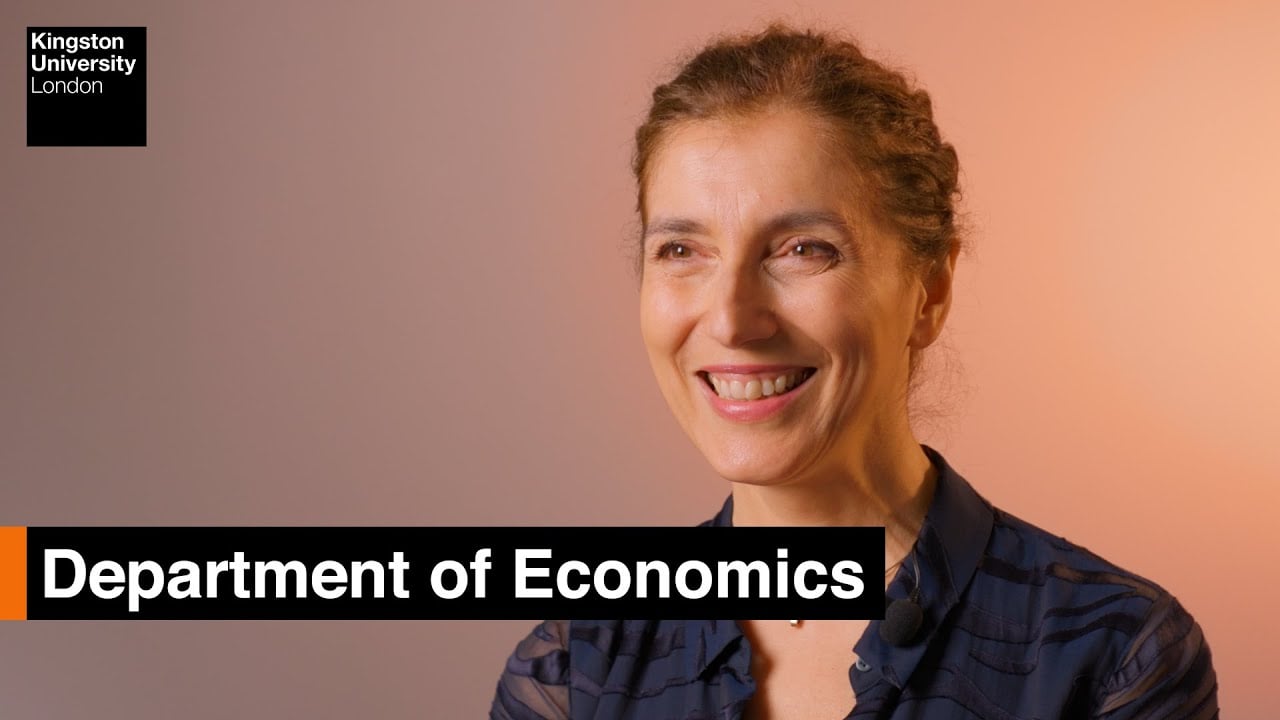
Discover the Department of Economics
Hear from our academics as they share what it’s like to study economics at Kingston University and the opportunities and skills you can develop throughout your degree.
International students: direct application
Are you an international student? Have you decided Kingston is the place for you? If so, you can apply for this course directly, rather than having to go through UCAS.

What career opportunities does this course offer?
Graduates from our Business Economics BSc (Hons) course work as economists, analysts and consultants for both private and public sector businesses and organisations. Employers include the Bank of England, the Home Office, Deloitte, Goldman Sachs and Citigroup. Graduates often pursue careers in the City of London and the civil service.
Many graduates progress to job roles such as Area Manager, Consultant, Marketeer and Sales Consultant. Employers include Arcadia Group, Backstop, Edexcel, London Eye, Talarius and United Biscuits. Alternatively, they go on to postgraduate study.

Future Skills
Our Future Skills programme is embedded within all our undergraduate courses and throughout the whole Kingston experience. These skills will help you to become a future-proof graduate by equipping you with the skills most valued by employers, such as problem-solving, digital competency and adaptability.
As you progress through your degree, you'll learn to navigate, explore and apply these graduate skills. You’ll also understand how to demonstrate and articulate to employers how these future skills give you the edge.

Teaching and assessment
Scheduled learning and teaching on this course includes timetabled activities including lectures, seminars and small group tutorials.

Fees and funding
Additional course costs
Some courses may require additional costs beyond tuition fees. When planning your studies, you’ll want to consider tuition fees, living costs, and any extra costs that might relate to your area of study.
Your tuition fees include costs for teaching, assessment and university facilities. So your access to libraries, shared IT resources and various student support services are all covered. Accommodation and general living expenses are not covered by these fees.
Where applicable, additional expenses for your course may include:
Scholarships and bursaries
For students interested in studying this course at Kingston, there are several opportunities to seek funding support.


Course changes and regulations
The information on this page reflects the currently intended course structure and module details. To improve your student experience and the quality of your degree, we may review and change the material information of this course. Find out more about course changes
Programme Specifications for the course are published ahead of each academic year.
Regulations governing this course can be found on our website.
What our students and graduates say
I did a placement year in the civil service. I was a student economist at the Department for International Trade. I was based in the Chief Economist's office where I assisted the Chief Economist in a range of tasks, including producing macroeconomics briefings and working on strategic trade papers.
I plan on becoming an economist in the future, which is a very theoretical and analytical career. I think my course will help me develop these necessary skills to become a competent economist.
What are the facilities like?
When you join Kingston University, you will have access to a wide range of facilities and resources designed to support your studies. Use the virtual tour below to explore some of the facilities and learning environments that students within this subject area may experience during their studies.




Key information
The scrolling banner below displays some key factual data about this course (including different course combinations or delivery modes of this course where relevant).


