Construction Project Management BSc (Hons)
- Engineering: civil, construction and surveying
- Undergraduate
Prepare for your future career in construction with the Construction Project Management BSc (Hons) course from Kingston University. We are ranked Top 10 in the UK for Construction, Surveying and Planning (The Guardian University Guide 2026). This course is accredited by the Chartered Institute of Building (CIOB), which results in full membership of the Institute for graduates.

Understand the construction project lifecycle from beginning to end
You will graduate ready for employment.
At our Penrhyn Road campus, you will have access to a modern environment with the latest equipment, including:
- extensive materials and facilities for concrete, masonry, steel and timber structures
- geotechnical and hydraulics testing facilities
- surveying equipment, such as satellite global-positioning systems
Dedicated computer-aided design facilities include:
- a range of CAD/CAM packages, such as Ideas, SolidWorks, AutoCAD and REVIT
- finite element analysis
- computational fluid dynamics
- virtual instrumentation
I have already been offered a graduate scheme before I have even graduated thanks to the skills and knowledge that Kingston has helped me learn.
Facilities


Why choose this course
Construction project managers play a crucial role in the construction project lifecycle. They ensure projects are completed on time, to budget, to a specified quality and meet the client's needs.
As the construction industry continues to grow, the demand for construction project managers is increasing. If you are interested in becoming a construction project manager and ensuring the construction process goes smoothly from start to finish, this course is the ideal platform to kickstart your career.
This course is designed to equip graduates with the knowledge, skills and professional behaviours that are expected from a construction project manager. In addition, you will learn how to mitigate the impacts of climate change on construction and human society.
This course combines construction management theory with planning, managing people, law and finance. To enable you to gain hands-on experience, you will study real-world case studies and take part in on-site practical activities.
In addition, you’ll have the opportunity to prepare for your future career with a year's paid work placement, or gain valuable experience by studying abroad.
Top 10 in the UK for Construction, Surveying and Planning, The Guardian University Guide 2026.
Professional accreditation
This course is accredited by the Chartered Institute of Building (CIOB), leading to full membership of the Institute.

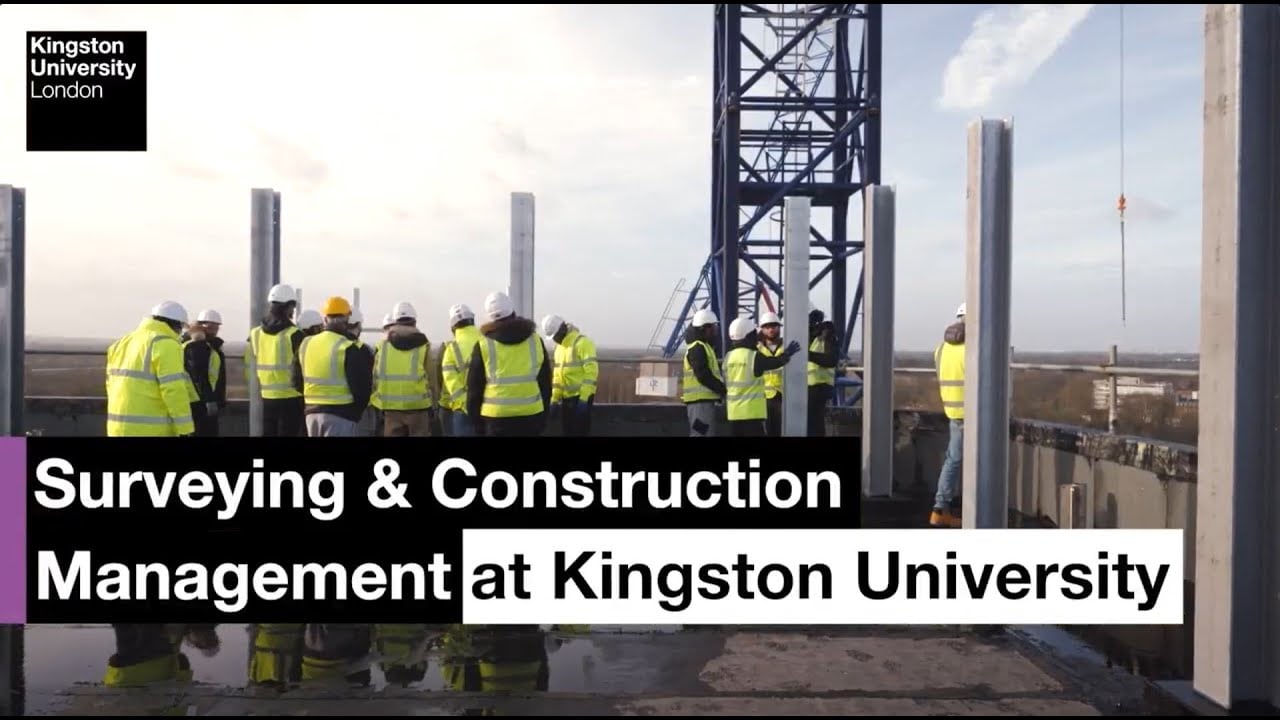
Surveying and construction management at Kingston University
Hear from current students and graduates as they share their experiences of studying surveying and construction management at Kingston University.
Course content
Please note that this is an indicative list of modules and is not intended as a definitive list. Those listed here may also be a mixture of core and optional modules.
Year 1
Year 1 introduces Navigate for Professional Engineers. This is Future Skills module that helps students make the transition to higher education, develop strong foundations of self-awareness and self-motivation, and generate a sense of belonging to their course and Kingston University. Year 1 also introduces sustainability, climate literacy, the United Nations Sustainable Development Goals (UNSDGs), construction management practice, professional practice, construction technology and techniques, and construction law and its regulatory.
Core modules
Year 2
Year 2 includes Exploring Engineering Project Management – a Future Skills module which scaffolds Navigate from Year 1 and is skills-rich. It includes the development of team-working, interpersonal and interdisciplinary skills, critical self-reflection, communication and presentation skills, and the ability to organise, strategise and prioritise. You will also learn about digitisation in construction (i.e. using REVIT and BIM related software), construction technology including its environmental services, and business and legal principles including contract administration, planning, scheduling and cost planning.
Core modules
Year 3/4
Final year students will be guided to interact with professional and learning communities beyond the University and reflect on these interactions through Applied Business Management (a Future Skills module). Here, students will demonstrate the ability to apply their developing professional skills competencies in their chosen area and prepare themselves for employment and entrepreneurship.
The final year involves the in-depth study and application of contractual procedures including health and safety and environmental law, site practice and management, Construction Information Management System as part of digitisation in construction, feasibility of project and managing collaborative workflows in a BIM environment. You will carry out an individual project focused on research into a specialised subject.
Core modules
Foundation Year in Built Environment
Our Foundation Year in Built Environment is ideal if you would like to join one of our civil engineering, construction or surveying honours degrees but need a preparatory period of study.
It provides an alternative entry route if you do not meet our standard entry requirements but have the ability to succeed at degree-level study.

International students: direct application
Are you an international student? Have you decided Kingston is the place for you? If so, you can apply for this course directly, rather than having to go through UCAS.

We were told about the type of teaching and the field trips and I was particularly impressed at the way the course was not taught purely from the classroom.
What career opportunities does this course offer?
You'll graduate with technical and communication skills that are in demand in many sectors. As a result, graduates from this course go on to job roles, including:
- construction manager
- construction project manager
- assistant site manager
- estimator
- site manager/civil engineer.
Graduate employers include:
- Allan Builders
- Alan Builders Ltd
- RG Group
- Willmott Dixon
- PVG Group
- Cape Construction
- Costain
Future Skills
Our Future Skills programme is embedded within all our undergraduate courses and throughout the whole Kingston experience. These skills will help you to become a future-proof graduate by equipping you with the skills most valued by employers, such as problem-solving, digital competency and adaptability.
As you progress through your degree, you'll learn to navigate, explore and apply these graduate skills. You’ll also understand how to demonstrate and articulate to employers how these future skills give you the edge.

Teaching and assessment
Scheduled learning and teaching on this course includes timetabled activities including lectures, seminars and small group tutorials. It may also include placements, project work, workshops, workshops in computer labs, and laboratory workshops.
One of the best things about the course has been the diverse learning opportunities given to me from teachers with different backgrounds and experiences, along with the continuous development of myself while at Kingston University. If there are any problems, all the staff are very helpful and understanding of any circumstances that may arise during your time at Kingston.
Fees and funding
Additional course costs
Some courses may require additional costs beyond tuition fees. When planning your studies, you’ll want to consider tuition fees, living costs, and any extra costs that might relate to your area of study.
Your tuition fees include costs for teaching, assessment and university facilities. So your access to libraries, shared IT resources and various student support services are all covered. Accommodation and general living expenses are not covered by these fees.
Where applicable, additional expenses for your course may include:
Scholarships and bursaries
For students interested in studying this course at Kingston, there are several opportunities to seek funding support.


Course changes and regulations
The information on this page reflects the currently intended course structure and module details. To improve your student experience and the quality of your degree, we may review and change the material information of this course. Find out more about course changes
Programme Specifications for the course are published ahead of each academic year.
Regulations governing this course can be found on our website.
What our students and graduates say
I chose Kingston University as it has one of the best construction management courses out there, with helpful teachers and mentors to help with every step of the course. I was also recommended Kingston University by a former student because of the teaching staff along with its great location.
I initially looked at Kingston as I was looking at potentially commuting and therefore needed somewhere that was not too far away. I looked around a number of universities but was immediately impressed with Kingston due to its facilities and labs. I felt very comfortable within the building and amongst the students and lecturers.
Placement case study
Who: Ollie Notley
Placement company: Fluor
Why did you decide to do an industrial placement as part of your degree?
I always wanted to undertake a placement year to provide me with relevant experience to greatly enhance my chances of gaining graduate employment and improve my understanding of the industry. An industrial placement on your CV can really make you stand out from the crowd when applying for graduate roles or can even provide the opportunity to gain employment with the company offering the experience, like myself and many of my peers. For me, it was a no-brainer.
What was the process for getting a placement and what support did you get from the University?
I applied to my placement following a presentation from Fluor at the University and having an informal interview with their staff. I was later selected as one of the final 12 of 132 applicants to attend an assessment day. I was required to take part in two group tasks with other applicants and then present for 20 minutes to senior management on why I felt I would be suitable for the role.
The Placement Team supported me greatly throughout the process; this included arranging mock interviews and providing constructive criticism for my presentation after allowing me to practise it with them. Their vast experience proved extremely helpful and I owe them a great deal for their continued support.
What does your placement role involve?
My placement involved providing a variety of support to energy and chemical construction projects at many different phases. I spent half of my year in the Farnborough office working on design and planning and the other half on site for the construction of a biomass conversion at Drax Power Station, the largest power station in the UK.
How is your typical day – any specific projects were you involved with?
My typical day involved preparing plans and attending meetings for engineering, procurement and construction, to define the construction requirements for the project to ultimately help achieve project objectives, in which I played an important and active role.
What key elements of your job will involve what you had learned from your course?
The Construction Management BSc (Hons) course provided me with a strong general understanding of applicable design and building processes and technologies, in addition to a good understanding of materials used in the industry.
From your experience working at your placement employer is there anything that you will utilise when you go back to your study (if this is applicable)?
I have been able to gain a much-improved knowledge of the industry and how it works, which will supplement my studies well. I was able to develop an in-depth understanding of innovations used in the industry that I can carry forward into writing my dissertation, having gained first-hand experience while on placement.
How do you feel that your placement has benefited your course?
I will be able to apply my new first-hand industry experience to improve my overall degree classification and apply real life experiences to enhance my work. Knowing I have a job waiting for me will also relieve the stress of searching for a job while in my final year, allowing me to fully focus on my studies.
Are there any other benefits of doing a placement?
You get professional life experience where you learn the etiquette of working life. It's a good year off from university deadlines, coursework and exams, and the best opportunity to explore yourself academically and professionally. It enables you to think of your future with a broader perspective. It boosts your confidence level. You also make good professional contacts, which are very important. And if you perform well whilst on your placement and make the most out of it, you have a good chance to secure a place in the company too.
What job will you be seeking when you graduate?
I have signed a contract of employment for when I complete my degree and will begin work with Fluor in June 2015. As I have spent a year with the company, I have been offered a higher salary than that of a non-placement student.
What are the facilities like?
When you join Kingston University, you will have access to a wide range of facilities and resources designed to support your studies. Use the virtual tour below to explore some of the facilities and learning environments that students within this subject area may experience during their studies.







Key information
The scrolling banner below displays some key factual data about this course (including different course combinations or delivery modes of this course where relevant).