Law LLB (Hons)
Subject and course type
- Law, criminal justice and criminology
- Undergraduate
Kickstart your career in law with the Law LLB (Hons) course from Kingston University. Law at Kingston University is ranked No.1 in London for five out of seven NSS 2025 themes – including Assessment and Feedback, Academic Support, Organisation and Management, Learning Resources and Student Voice.
You are reading:
Develop your legal knowledge and the skills needed for modern employment
You will have a wealth of opportunities outside the classroom to further your learning and gain hands-on experience in your chosen field.
Our LLB Law degree gives you a solid foundation in law while letting you put your skills into practice from day one. Covering the seven foundations of legal knowledge required by the Bar Standard Board (BSB), the course ensures you meet the core academic requirements for entry onto the Bar Training Course.
You can lead mock trials, cross-examine forensic experts and witnesses, and gain practical experience in Kingston’s Legal Advice Centre, providing pro bono support.
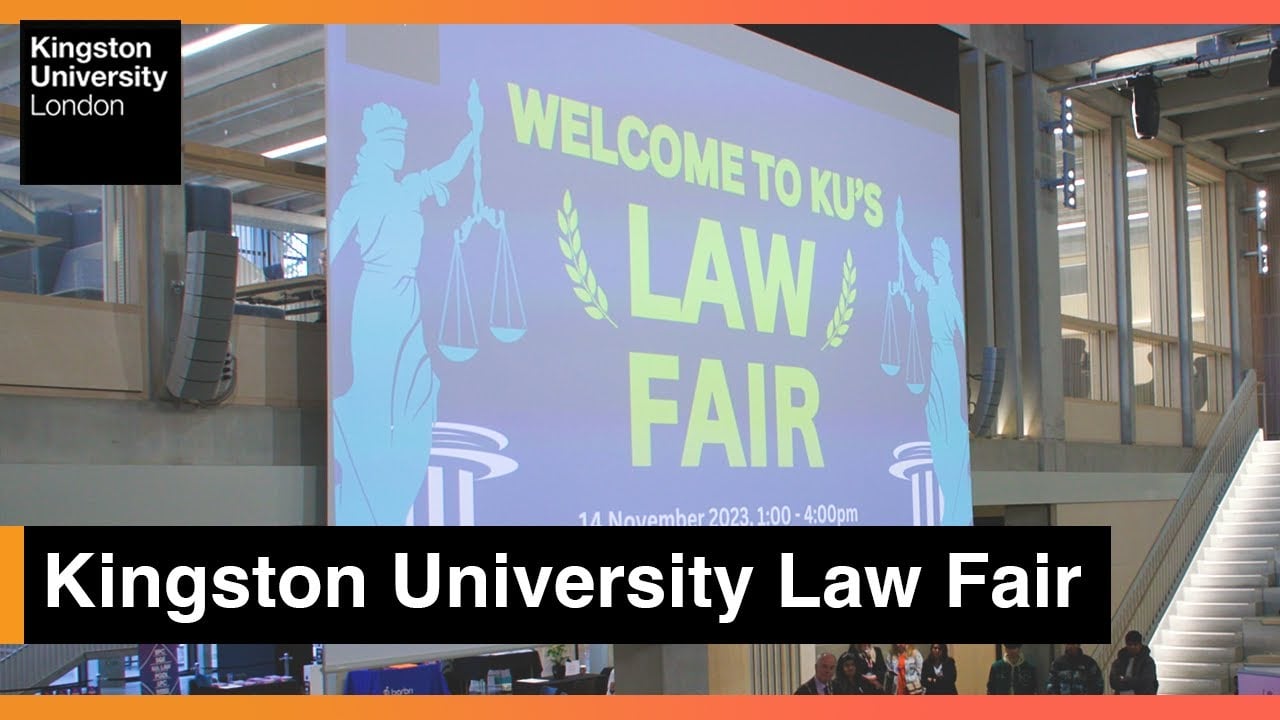
Unique opportunities include the Death Penalty Clinic (supported by Amicus) and court visits, law competitions, and the Law Fair, all designed to build skills, confidence, and employability in real-world legal practice.
Law at Kingston University
Hear from staff and students as they talk about what it's like to study undergraduate law at Kingston University.

The campus is great and the teaching staff are excellent – they really take an interest in your development, even after you leave.
Why choose this course
We recognise that in the competitive legal world, graduates need to be more rounded than ever. Our LLB delivers all the benefits of a conventional law degree, and a lot more. You'll gain an understanding of the English legal system and graduate with the legal knowledge, skills and experience valued by employers.
Over the course of this degree, you may lead mock trials and cross-examine forensic experts and witnesses in court. You might also work in our Legal Advice Centre, giving legal advice in domestic and consumer disputes, or participate in one of our international mooting or client interviewing competitions.
We invite academic experts and guest speakers from industry and our alumni to share their experiences. This often leads to internships for students with prestigious organisations, such as SecurityWomen and the Minority Rights Group International.
You'll graduate with legal knowledge, applied skills and work experience that is highly valued by employers. Even if you're not considering a career in the legal profession, a law degree develops critical thinking, logical analysis, the power of argument, and effective oral and written communication skills.
We are ranked No.1 in London for five out of seven NSS 2025 themes - including Assessment and Feedback, Academic Support, Organisation and Management, Learning Resources and Student Voice.
The Complete University Guide 2027 ranks us No.1 in London and No.4 in the UK for Student Satisfaction.
Prepare for global impact
Kingston School of Law, Social and Behavioural Sciences offers courses in economics, law, psychology and criminology. Our degrees are underpinned by a vibrant research culture and delivered by a blend of practitioners and academics who are dedicated to equipping you with the employability skills to thrive in your career.
Course content
Please note: Optional modules only run if there is enough demand. If we have an insufficient number of students interested in an optional module, that module will not be offered for this course.
Foundation year - Social Sciences
If you would like to study this degree at Kingston University but are not yet ready to join the first year of an LLB (Hons) course, you may want to consider studying this course with a foundation year.
Year 1
Year 1 introduces the English Legal System, Skills and Ethics, including how to access and use legal materials. Constitutional and Administrative Law covers the UK's constitution and relationships between individuals and state. Law of Tort considers civil wrongs such as negligence, nuisance and occupier's liability. Law of Contract explores binding agreements and breaches.
Core modules
30 credits
This module develops your understanding of the English Legal System (ELS) – courts, procedure and sources of law – in order to make sense of your legal studies.
You will be equipped with a legal methods toolkit, covering skills for research, analysis and writing relevant to your studies and in legal practice.
This module also has a strong emphasis on developing your personal and professional skills. We will help you to build your professional identity and global citizenship, enhancing your understanding of ethical issues, values, design thinking and commercial awareness. You will be guided by your Personal Tutor to plan your own personal and professional development journey and identify your core graduate attributes.
30 credits
The law of contract is the law of legally-enforceable agreements and is at the heart of English common law. It is one of the seven foundations of legal knowledge and invariably forms part of any degree with an overt legal content. It describes the rules which govern commercial activity, allowing businesses and consumers to maintain stable, consistent relationships over time and over distance. The law of contract covers everything from a complex multi-party agreement to construct a stadium, the employment of the cleaners and the star players, as well as the purchase of a hot dog from a stall outside.
30 credits
The module introduces you to the constitutional and administrative law of the United Kingdom through a study of the core constitutional principles present within the UK legal system and the control of executive action by the courts. The module provides an essential introduction to the study of law since the validity of any particular law is a function of a constitutional rule which establishes manner, form and necessary pedigree for what is to qualify as a valid particular or occasional law.
30 credits
Tort can be described as the area of civil law which provides a remedy for a party who has suffered the breach of a protected interest. The module focuses on the wide range of activity to which tort law applies and examines the remedies it provides for many different types of loss or harm. Tort is also one of the foundations of legal knowledge subjects required by the professional bodies as part of a qualifying law degree for those seeking entry to the legal profession.
Year 2
In Year 2 you will build on what you have learnt in Year 1. Your Land Law module will cover property ownership, use and rights. In the Criminal Law module you will study murder, theft and sexual crimes. EU Law considers the single market (informed by recent politics).
Core modules
30 credits
Land law studies the nature of land, the history of the current legislative structure and third party interests in, on and over private land in England and Wales. It introduces the concepts behind ownership and use of private land, considering also how the law operates in the context of freehold and leasehold title, rights of way and squatters' rights.
30 credits
This module studies the general principles of criminal liability, definitions of what constitutes particular crimes and offences, and how that law affects particular circumstances. This involves not only a critical examination of the law, but also, using hypothetical factual situations, an understanding its detailed application.
30 credits
The European Union's (EU) development has had a significant impact in Europe and globally. Although the UK has left the EU, its law is still relevant not only because it remains part of the applicable law of the UK, but also to understand how the UK now interacts with the EU.
You will develop detailed knowledge and in-depth understanding of the core areas of EU law, and the relationship between the EU and its member states and the respective role of the Court of Justice of the European Union and national courts in applying EU law.
This module also has a strong focus on developing your employability skills. You will take part in personal development activities designed to strengthen your professional identity and global citizenship, while expanding your knowledge of legal practice in different professional contexts.
Optional modules (choose one)
30 credits
How does law shape our globalised world? This module explores international law and comparative legal systems through real case studies, guest lectures, and research-led teaching.
The first part introduces public international law, examining sovereignty, statehood, the use of force, self-determination, territorial disputes, state responsibility for wrongdoing, international organisations, and environmental protection. Learning is case-based and interactive, supported by multimedia resources and workshops that also form part of the assessment. Guest speakers, practitioners and world-renowned scholars, bring real-world insight into pressing legal debates.
The second part turns to comparative law, focusing on France, Germany, and the United States. By exploring their constitutions, court structures, and legal histories, students discover how different traditions address common challenges.
Mapped to Kingston’s Future Skills framework, the module helps students build critical thinking, problem-solving, collaboration and digital fluency. They will be equipped to evaluate the legal dimensions of international and domestic issues as they appear in the news and are shaped by landmark case-law.
30 credits
This module has a focus on the sale and supply of goods, considering the legal framework within which such transactions occur. It also considers the law relating to consumer credit and the protections provided to the consumer by the law. It takes a critical approach to these matters and enables you to research particular areas, which forms a part of the assessment for the module.
Optional year
You will also have the opportunity to spend a year abroad on work placement or studying at one of our partner institutions in North America, Europe, Australia or Asia.
Professional placement year
This course has a professional placement option which takes place between Year 2 and your Final Year. During this professional placement year you will take a placement within a relevant setting, ensuring you gain essential experience to add to your CV and help you secure a graduate job.
Final year
In the Final Year, you will study Equity and Trusts, which considers wills, charitable trusts, and trustees. You will also complete a career-focused Future Skills module, which will help you develop your legal reasoning and other key employability skills.
For the rest of your study you will be able to shape your degree around what interests you the most.
Core modules
30 credits
This module examines the idea of conscience in English law. It looks at how, historically, equity developed from the authority of the King in order to ameliorate the problems caused by an increasingly inflexible common law, at a time when Parliament met infrequently. The concept of the trust, where ownership is divided between legal and beneficial owners, is examined including the conscience-inspired constructive trust, and the use of the trust in many contexts, including charity law. The administration of trusts is also considered.
15 credits
This module gives you a dedicated opportunity to develop your Future Skills Graduate Attributes.
At the start of the module, you will be supported to self-assess your current skills profile. You will determine which attributes and skills you need to develop to support your career ambitions. In this process, you will be supported by a dedicated career coach, helping you explore a range of options that includes self-employment/freelancing, starting your own business, higher level study, and other professional graduate-level opportunities. Throughout the module, you will be given opportunities to engage with external mentors, to support reflection and to develop a professional network.
You will undertake a tailored series of activities and projects, aligned to your goals, from a menu of development options. This could include short courses, enrichment activities and experiential learning options such as micro-placements. You will also be able to reflect on activities outside the University that develop your graduate attributes, such as work or volunteering.
Capstone modules (choose one)
30 credits
The dispute resolution module makes extensive use of role-play in order to develop a deeper understanding of the dynamics that underlie conflicts, and of the process of dispute resolution. Comparisons are made with litigation and with other adversarial and quasi-judicial mechanisms to place mediation and negotiation in context. Themes are identified and discussed, often using role-plays, and the social and psychological aspects considered. The module also covers theories of conflict and conflict management, and the general landscape of dispute resolution.
30 credits
Jurisprudence causes you to take an analytical step back to address issues that may have been presupposed, or simply left unspoken, during your degree. Jurisprudence builds upon the black-letter subjects you have studied and places them in a theoretical and social context: it is a meta-analysis of law, which pulls together themes from all of the areas you will have studied until now.
30 credits
The Law Reform Project enables you to apply your intellectual skills and knowledge to identifying a legal or policy problem and developing a clear reform agenda. You will also enhance your employment-related skills, including project management, innovative and strategic visioning, effective report writing, and cost/benefit analysis of your ideas. You'll learn how to address the risks and challenges involved in driving change, while gaining a broader understanding of the role of law in society and how legal solutions can be formulated to tackle real-world issues.
Where appropriate, you’re encouraged to engage with local community groups, pressure groups, practitioners, your placement employer or the Law School’s Legal Advice Centre as you shape your proposal and identify a viable path for reform.
Optional modules (choose one 30-credit module and one 15-credit module)
30 credits
This module examines the most common juristic person, the company (limited by shares or guarantee and both public and private limited companies). The cornerstones of the module include critical evaluation of the role of the company as a separate legal juristic person; directors and their duties; shareholders and their rights and legal remedies; employees and their position under the Companies Act 2006. Close examination is undertaken of the policy and reform process leading up to the enactment of the Companies Act 2006. Primary sources (statute and case law) and secondary sources (academic comment, reform discussion) are used at length during the module. This module is relevant for anyone interested in working in the commercial world.
30 credits
This module tackles some of the most urgent questions of justice in the modern world. The international criminal law component examines how law seeks to end impunity for the gravest crimes. From Nuremberg to today’s International Criminal Court, students explore how those responsible for genocide, crimes against humanity, war crimes and aggression can be brought before justice.
The human rights component takes a problem-based approach to contemporary challenges. We look at pressing issues such as how artificial intelligence shapes our rights and freedoms, alongside more traditional concerns like the prohibition of torture. Special attention is given to the protection of specific groups, including women, migrants, and minorities, and to rights linked to health and socio-economic status.
Students gain practical insight into how individuals and groups can seek redress through international mechanisms, whether at the United Nations or within regional systems in Europe, Africa and the Americas, while developing critical, analytical, and communication skills required to expand their employability horizons.
30 credits
This module explores the role of law in responding to and shaping technological innovation. It also covers the legal protection offered by intellectual property laws and considers particular types of such property (e.g. copyright and patents).
The module is designed to give you the competitive edge in evolving legal and non-legal fields that embrace technological development. Particular focus is given to standards and regulations of artificial intelligence, cyberspace and cybercrime, e-commerce, employment, environment, healthcare, intellectual property rights, and outer space. These areas are of particular importance in the current global market. The module implements an international and interdisciplinary approach, covering different jurisdictions, technologies, and industries.
15 credits
This module will be of interest to students who wish to study how the law regulates family life and how effective it is in doing so. The module covers the formation and termination of marriage and civil partnership; how occupation and ownership of the family home is regulated, and how effective these remedies are in cases of domestic violence; the law's approach to finance and property division on divorce, as well as maintenance for children, comparing this approach with the regulation of cohabitation.
The module then considers legal parentage and parenthood; parental responsibility, and the regulation of disputes between parents about their children.
Finally, local authority provision for vulnerable children and those who are experiencing harm in their families is considered, and adoption as a solution for children who cannot live with their birth families will be covered.
This module aims to consider the law in context of social policy which encourages desired types of family behaviour.
15 credits
International trade would be of interest to students wishing to be employed in the commercial field in both the UK and overseas. This module covers the international legal and institutional framework for regulating international trade. The module helps you to understand different aspects of international law, and to be able to apply them to business and management problems arising in a global economy. The module examines the legal, economic, political and institutional underpinnings of the world trade regime, and the core principles and legal rules governing international trade in goods, and services. A key focus is the World Trade Organization (WTO), which began to work in 1995 as a general umbrella organisation coordinating laws affecting trade, but which has a much wider impact on the regulation of international business activities. The module also examines the various contracts that are essential components of international trade transactions, such as international sales contracts, the contract of carriage and the insurance contract. In addition, legal issues arising from international trade dispute settlement will be explored.
Discover the Department of Law
Hear from our academics and find out more about the Department of Law.
International students: direct application
Are you an international student? Have you decided Kingston is the place for you? If so, you can apply for this course directly, rather than having to go through UCAS.

What career opportunities does this course offer?
Many graduates from this course go on to become solicitors or barristers or work as legal professionals within international businesses and organisations. Some graduates progress to study at postgraduate level.
Our Law graduates have secured the following jobs:
- Barrister
- Associate
- Junior analyst
- Legal assistant
- Paralegal
- Account development executive
- Insolvency practitioner
- Financial consultant
- Court clerk
Graduates from the Department of Law have secured jobs in the following companies:
- KPMG
- PricewaterhouseCoopers
- Lyons Davidson Solicitors
- Fredrickson International
- BM Advisory (formerly Atherton Bailey Chartered Accountants)
- Hudson Advisors
- Gill Solicitors
- Stuart & Co Solicitors (formally Stuart Karatas Solicitors)
For students who wish to qualify as a solicitor, the Solicitors Regulation Authority (SRA) changed its qualification requirements from September 2021. Students are now required to follow a new 'SQE' route. It means you will need to:
- Sit and pass the Solicitors Qualifying Examination, a centralised assessment in two parts: in general terms, SQE1 on legal knowledge and SQE2 on legal skills. To be eligible to sit SQE1, you must have a degree. To be eligible to sit SQE2, you must first have passed SQE1.
- Obtain two years of Qualifying Work Experience, which can be a training contract but can also be placements while at university or experience working in a law clinic.
- Meet the SRA's character and suitability requirements.
Our LLB Law, LLB Law and Criminal Justice, and LLB International Law courses will enable students to follow either route and will prepare students for much of SQE1. We can also support you to get work experience through our placement programme and our Legal Advice Centre. At Kingston, we support our students in understanding the options available to them.
The SQE represents a major change to legal education. So, if you have any questions or concerns, please do not hesitate to contact us. At Kingston, we are fully aware of the SRA's requirements and we aim to help all our students achieve their career ambitions, whether as a solicitor or barrister, or in the many other exciting and rewarding careers our law graduates go onto.
You will take part in an Assessment Centre Experience, providing the opportunity to experience the pathway to employment with tailored feedback:
- develop your understanding of the jobs market, including current trends and opportunities, different recruitment processes and how to identify relevant roles
- receive personalised feedback reports to help you to improve and progress
- access additional webinars on top tips, employer expectations and best practice
Future Skills
Our Future Skills programme is embedded within all our undergraduate courses and throughout the whole Kingston experience. These skills will help you to become a future-proof graduate by equipping you with the skills most valued by employers, such as problem-solving, digital competency and adaptability.
As you progress through your degree, you'll learn to navigate, explore and apply these graduate skills. You’ll also understand how to demonstrate and articulate to employers how these future skills give you the edge.

There were lots of things I liked about the Law LLB (Hons) at Kingston – especially the practical skills elements such as advice and negotiation. I also enjoyed the extra-curricular activities on offer, such as mooting, which enhance your CV and provide you with the opportunity to meet key players in the legal field.
Teaching and assessment
Scheduled learning and teaching on this course includes timetabled activities including lectures, seminars and small group tutorials.
Outside the scheduled learning and teaching hours, you will learn independently through self-study which will involve reading articles and books, working on projects, undertaking research, preparing for and completing your work for assessments. Some independent study work may need to be completed on-campus, as you may need to access campus-based facilities such as studios and labs.
Our academic support team here at Kingston University provides help in a range of areas.
When you arrive, we'll introduce you to your personal tutor. This is the member of academic staff who will provide academic guidance, support you throughout your time at Kingston and show you how to make the best use of all the help and resources that we offer at Kingston University.
A course is made up of modules, and each module is worth a number of credits. You must pass a given number of credits in order to achieve the award you registered on, for example 360 credits for a typical undergraduate course or 180 credits for a typical postgraduate course. The number of credits you need for your award is detailed in the programme specification which you can access from the link at the bottom of this page.
One credit equates to 10 hours of study. Therefore 120 credits across a year (typical for an undergraduate course) would equate to 1,200 notional hours. These hours are split into scheduled and guided. On this course, the percentage of that time that will be scheduled learning and teaching activities is shown below for each year of study. The remainder is made up of guided independent study.
- Year 1: 30% scheduled learning and teaching
- Year 2: 23% scheduled learning and teaching
- Year 3: 20% scheduled learning and teaching
The exact balance between scheduled learning and teaching and guided independent study will be informed by the modules you take.
Your course will primarily be delivered in person. It may include delivery of some activities online, either in real time or recorded.
Types of assessment
- Year 1: Coursework 63%; exams 27%; practical 10%
- Year 2: Coursework 30%; exams 57%; practical 13%
- Year 3: Coursework 70%; exams 30%
Please note: the above breakdowns are a guide calculated on core modules only. If your course includes optional modules, this breakdown may change to reflect the modules chosen.
We aim to provide feedback to you on your assessments within 20 working days.
Your individualised timetable is normally available to students within 48 hours of enrolment. Whilst we make every effort to ensure timetables are as student friendly as possible, scheduled learning and teaching can take place on any day of the week between 9am and 6pm. For undergraduate students, Wednesday afternoons are normally reserved for sports and cultural activities, but there may be occasions when this is not possible. Timetables for part-time students will depend on the modules selected.
Fees and funding
| Fee category | Annual Fee |
|---|---|
| Home (UK students) | |
| £10,050* | |
| Foundation Year | £5,760 |
| International | |
| Year 1 (2027/28): | £To be confirmed |
| Year 2 (2028/29): | £To be confirmed |
| Year 3 (2029/30): | £To be confirmed |
| Year 4 (2030/31): | £To be confirmed |
The tuition fee you pay depends on whether you are assessed as a 'Home' (UK), 'Islands' or 'International' student.
Please visit the Fees and Funding page for more information.
For courses with Professional Placement, the fee for the placement year can be viewed on the undergraduate fees table. The placement fee published is for the relevant academic year stated in the table. This fee is subject to annual increases but will not increase by more than the fee caps as prescribed by the Office for Students or such other replacing body.
*For full-time programmes lasting more than one academic year, a tuition fee is payable for each academic year of the course.
Your annual tuition fee covers your first attempt at all modules required for that academic year. Any re-study or repeat of modules will incur additional charges, calculated according to the number of credits taken.
Home students (UK): Tuition fees are subject to inflation-linked increases in line with government policy. Updated fees will be confirmed in line with the maximum fee cap set by the Government or the Office for Students (OfS) for each academic year. This means your fee may increase for each academic year of study, but only up to the maximum amount permitted for that year.
Eligible UK students can apply to the Government for a tuition loan, which is paid direct to the University. This has a low interest-rate which is charged from the time the first part of the loan is paid to the University until you have repaid it.
International students: Full-time taught international student fees are subject to an annual increase, which is published in advance for the full duration of your programme.
| Fee category | Annual Fee |
|---|---|
| Home (UK students) | £9,790* |
| International | |
| Year 1 (2026/27): | £19,200 |
| Year 2 (2027/28): | £19,900 |
| Year 3 (2028/29): | £20,700 |
The tuition fee you pay depends on whether you are assessed as a 'Home' (UK), 'Islands' or 'International' student.
Please visit the Fees and Funding page for more information.
For courses with Professional Placement, the fee for the placement year can be viewed on the undergraduate fees table. The placement fee published is for the relevant academic year stated in the table. This fee is subject to annual increases but will not increase by more than the fee caps as prescribed by the Office for Students or such other replacing body.
*For full-time programmes lasting more than one academic year, a tuition fee is payable for each academic year of the course.
Your annual tuition fee covers your first attempt at all modules required for that academic year. Any re-study or repeat of modules will incur additional charges, calculated according to the number of credits taken.
Home students (UK): Tuition fees are subject to inflation-linked increases in line with government policy. Updated fees will be confirmed in line with the maximum fee cap set by the Government or the Office for Students (OfS) for each academic year. This means your fee may increase for each academic year of study, but only up to the maximum amount permitted for that year.
Eligible UK students can apply to the Government for a tuition loan, which is paid direct to the University. This has a low interest-rate which is charged from the time the first part of the loan is paid to the University until you have repaid it.
International students: Full-time taught international student fees are subject to an annual increase, which is published in advance for the full duration of your programme.
| Fee category | Annual Fee |
|---|---|
| Home (UK students) | £9,535* |
| International | |
| Year 1 (2025/26): | £18,500 |
| Year 2 (2026/27): | £19,200 |
| Year 3 (2027/28): | £19,900 |
The tuition fee you pay depends on whether you are assessed as a 'Home' (UK), 'Islands' or 'International' student. In 2025/26 the fees for this course are above.
Please visit the Fees and Funding page for more information.
For courses with Professional Placement, the fee for the placement year can be viewed on the undergraduate fees table. The placement fee published is for the relevant academic year stated in the table. This fee is subject to annual increases but will not increase by more than the fee caps as prescribed by the Office for Students or such other replacing body.
*For full-time programmes lasting more than one academic year, a tuition fee is payable for each academic year of the course. Your annual tuition fees cover your first attempt at all of the modules necessary to complete that academic year. A re-study of any modules will incur additional charges calculated by the number of credits. Home tuition fees may be subject to annual increases but will not increase by more than the fee caps as prescribed by the Office for Students or such other replacing body. Full time taught International fees are subject to an annual increase and are published in advance for the full duration of the programme.
Eligible UK students can apply to the Government for a tuition loan, which is paid direct to the University. This has a low interest-rate which is charged from the time the first part of the loan is paid to the University until you have repaid it.
Additional course costs
Some courses may require additional costs beyond tuition fees. When planning your studies, you’ll want to consider tuition fees, living costs, and any extra costs that might relate to your area of study.
Your tuition fees include costs for teaching, assessment and university facilities. So your access to libraries, shared IT resources and various student support services are all covered. Accommodation and general living expenses are not covered by these fees.
Where applicable, additional expenses for your course may include:
Our libraries have an extensive collection of books and journals, as well as open-access computers and laptops available to rent. However, you may want to buy your own computer or personal copies of key textbooks. Textbooks may range from £50 to £250 per year. And a personal computer can range from £100 to £3,000 depending on your course requirements.
While most coursework is submitted online, some modules may require printed copies. You may want to allocate up to £100 per year for hard-copies of your coursework. It’s worth noting that 3D printing is never compulsory. So if you choose to use our 3D printers, you’ll need to pay for the material. This ranges from 3p per gram to 40p per gram.
Kingston University will pay for all compulsory field trips. Fees for optional trips can range from £30 to £350 per trip.
Your tuition fees don’t cover travel costs. To save on travel costs, you can use our intersite bus service. This route links the campuses and halls of residence with local train stations - Surbiton, Kingston upon Thames and Norbiton.
If you choose to do a placement year, travel costs will vary depending on your location. These costs could be up to £2,000.
Some courses may require professional memberships.
Students who choose to participate in optional competitions may incur additional costs. The participation fee for the International Space Law Moot has, in the past, been paid by the University. However, the cost of travel, accommodation and subsistence is typically funded by the student. All participation costs for the International Criminal Court Moot have, in the past, been paid by the University and Alumni contributions.
Scholarships and bursaries
For students interested in studying this course at Kingston, there are several opportunities to seek funding support.

Isola Bursary
Kingston alumnus, Peter Isola, set up the Isola Bursary to help those from under-resourced backgrounds pursue a career in Law. Priority for the Isola Bursary is given to those from households with an income of £25,000 or less however, meeting the criteria does not guarantee a bursary, as there is a limited number available.
Eligible students will be identified automatically and you do not need to apply for the bursary. However, please ensure that you do apply for your student finance support as you must have a household income assessment fully completed by the relevant organisation (with all evidence verified) in order to be considered for the Isola Bursary.
Law competitions
Course changes and regulations
The information on this page reflects the currently intended course structure and module details. To improve your student experience and the quality of your degree, we may review and change the material information of this course. Find out more about course changes
Programme Specifications for the course are published ahead of each academic year.
Regulations governing this course can be found on our website.
What our students and graduates say
After graduating I was awarded the Sweet and Maxwell Law Prize for best final-year student and the Jean Monnet Prize for the top student in European Union Law. These achievements, coupled with a strong academic record, resulted in me receiving offers from the University of Oxford and the University of Cambridge for postgraduate study.
Key information
The scrolling banner below displays some key factual data about this course (including different course combinations or delivery modes of this course where relevant).