Creative and Cultural Industries: Events and Experiences Design BA (Hons)
Subject and course type
- Creative industries
- Interaction and experience design
- Undergraduate
Develop practical and analytical skills in everything from curation, conception and resourcing to marketing and budgeting – all with a focus on exhibitions and events.
Kingston University’s Events and Experiences Design BA (Hons) will give you the skills you need to design imaginative, inclusive, and sustainable experiences that bring people together and foster shared perspectives.
You are reading:
Create unforgettable experiences, nurture shared experiences
Want to create moments that bring people together and spark inspiration?
Studying Creative Industries: Events and Experience Design prepares you for careers in exhibitions, festivals, and cultural events. Our graduates have worked with leading organisations including the Barbican and the V&A Museum.
You will explore design thinking, branding, storytelling, and project strategy, with opportunities to create both commercial and non-commercial projects. Sustainability and inclusivity are central, helping you design experiences that are both meaningful and responsible.
Working with students and industry partners, you will learn to design, manage, and deliver events that inspire audiences and nurture community connections.
When you graduate, you will have the creative, organisational, and strategic skills to succeed in the fast-moving world of events and experience design.
Check out our Instagram page to see what our students have been creating.
Creative industries at Kingston School of Art
Discover the wide range of opportunities that make up creative industries at Kingston School of Art. See the cutting-edge technology our students use to explore their interests as they work on live briefs and projects.

Why choose this course
- Do you want to create moments that bring people together, spark imagination, and connect ideas with audiences?
- Do you imagine how spaces, performances, or events can create those moments for people?
- Do you think about how music, lighting, visuals, or storytelling shape the way we experience the world?
- Do you want to design gatherings that bring people together, whether it is a festival, exhibition, or community project?
- Do you want to explore how technology, sustainability, and inclusivity can transform live experiences?
- Do you consider the emotions and connections people take away from events long after they end?
If so, you are already thinking like an experience designer in the creative industries.
Events and Experience Design combines creativity, organisation and imagination to shape cultural moments, brand activations, and community experiences. On this degree, you will learn to design and deliver projects that inspire audiences and leave a lasting impact.
Events and Experience Design explores how experiences can be crafted to engage audiences in meaningful ways. You will learn to design and manage events, exhibitions, and activations that blend creativity with strategy. Projects will introduce you to risk assessment, customer insight, storytelling, and experiential branding. You will have opportunities to collaborate with industry partners and community organisations.
As a student in Kingston School of Art, you will be part of a dynamic creative community where interdisciplinary collaboration and critical thinking are central to learning. You will benefit from our Thinking Through Making ethos, which places experimentation and hands-on practice at the heart of your studies. World-class facilities, including immersive technology spaces, 3D workshops, and film, photography, and printmaking studios, will support you in prototyping, testing, and delivering your ideas.
The Art School Experience
As part of Kingston School of Art, students benefit from joining a creative community where we encourage collaborative working and critical practice.
Our workshops and labs are open to all disciplines, enabling students and staff to work together, share ideas and explore multi-disciplinary making.

Course content
You will learn the principles of curation and visitor experience. You will gain project management knowledge and experience to deliver effective exhibitions and events for an organisation or client. Through a combination of in-house and live briefs you will discover your creative self and your future role in industry.
Year 1
Year 1 is common to all our creative and cultural industries courses. You will explore visual communication techniques, use of design software, storytelling and design thinking. You will learn individually and as part of a team of creative partners and professionals. You will examine the management and strategy of creative enterprises, and the history and development of art and design practice.
Core modules
30 credits
This module builds the skills and understanding needed to create and deliver effective visual and verbal communications. Students will be introduced to theories on perception and communication and will apply them to the analysis of persuasive visuals used in visual communications. Students are simultaneously introduced to a fundamental set of conceptual and practical tools.
Practical project tasks will give students the opportunity to develop or enhance their industry standard software skills, supported by our technicians. Through the creation of visual concepts, video narratives, content creation for social and experimentation with emerging platforms, students will explain the possible visual identities of an event, campaign, or product. Students will learn to examine and redefine problems through close observation and investigate the use of empathy with users. User experience, interface design and prototyping are used to enhance the quality of communication and the explanation and sharing of ideas.
A basic understanding of image creation, editing and outputting via industry standard software students, supported by technicians in the Digital Media Workstation. Emphasis is not placed on the technical execution of visual outcomes (layout, designs, social media content, posters) but on the relevance to the brief, effectiveness and originality. Students will be encouraged to select appropriate media to support their visual stories so they could use a range of 2D/3D work (graphic, video, photo, illustration) or VR (Virtual Reality), AR (Augmented Reality), XR (Mixed Reality) and other immersive and emerging technologies depending on the skill and interests of the student.
30 credits
This module will introduce you to Future Skills through engagement with Navigate. It will enable you to begin to develop your professional identity and global citizenship, by promoting your understanding of ethical issues and values, design thinking, and commercial awareness. These concepts and associated activities will support you to plan your own personal and professional development, as a means of developing your creative practice. This will be supported through active engagement with Navigate, and through personal development planning (supported by Personal Tutors), which will enable you to reflect upon your Future Skills graduate attributes. It will also enable you to reflect on and begin to evidence your understanding of the skills you are developing holistically; through all the work you are creating as part of your course.
You will learn to write in professional contexts (writing to industry figures via email or LinkedIn messaging), creating your own profile on networking sites. The module will focus on writing in number of professional contexts and you will practise using a range of techniques and strategies to produce professional documents.
Through the creation of a Podcast you will explore industry sectors and roles and issues around Equality, Diversity and Inclusion and begin engaging with industry figures and bodies, learn how to interview, record and create engaging audio stories and begin to define your own place in the Creative Industries.
30 credits
This module enables students to create a critical, historical, ethical and theoretical framework within which to investigate and understand practices of creativity in relation to art, design and culture.
The module explores the connections between creativity and social and cultural change by focusing on a variety of case studies both historical and contemporary. It will place emphasis on the ways in which significant moments in cultural history, and the creative products and solutions that emerge from them, have been shaped by the input of multiple stakeholders who inhabit a variety of positions from artists and designers to muses, theoreticians, patrons and engineers. The module will examine ethical issues that emerge around cultural and creative practices and theory.
With a close focus on analysis of key case studies, a series of lectures, seminars, workshops, and tutorials will support students' own emerging research interests and encourage the development of their historical knowledge, critical thinking and research skills.
The module thus helps students to make sense of the ethical concerns emerging in their own disciplines and to take a critical and analytical view of their own ideas, motivations and interests and how these views can translate into commercial project work.
The module will actively engage with visual and physical material. Seminars will also enable students to discuss key readings, and connect themes to their particular interests. Where possible, study visits, guest speakers, hacks, and screenings will be scheduled throughout the module.
As students progress they will be able to translate their concepts into outputs across video, music, social media content and reacting to theoretical content as and how their creative interests take them.
30 credits
This module explores different types of writing (academic, commercial, creative) and how the meaning and form is changed depending on the chosen audience. The mechanics of writing (drafting, editing) are paired with briefs that explore your ability to write reflectively about your creative work, to write commercially (copywriting, editorial), to bring writing into your creative practice (stories, poetry) and how to use prompts and conversational text to inform Artificially Intelligent creative tools. You will explore the ethics surrounding the use of these technologies and issues around copyright and plagiarism that arise from the use of these technologies.
This module is designed to familiarise students with a range of rhetorical strategies, aesthetic techniques, redrafting and editing skills, while also providing the opportunity to practise writing and editing in a number of commercial, creative and academic forms. You will be introduced to key techniques for writing effectively and will develop your ability to identify strengths and weaknesses in writing by reading and responding creatively to texts in each form.
This module focuses on writing techniques that will be explored through workshops and lectures. The impact that language choices make on the effectiveness of writing will lead on to the discussion of audience, social context, identity and voice.
Year 2
Years 2 examine Curation, Exhibition and Events in depth. You will learn the practices of display, collecting and exhibiting, and how meaning and message are created through exhibitions. You will learn branding, marketing and how to develop events for defined audiences. You will study conceptualisation and visualisation, visual narratives and storyboarding, artwork commission and project management.
You can choose to apply for a summer internship at the end of Year 2 to gain valuable experience and increase your employability.
Core modules
30 credits
This module introduces students to critical, practical and technical frameworks for exhibition and event management. Students are introduced to the practices of display, collecting and exhibiting, and encouraged to consider how meaning and message are created through exhibitions. A series of workshops will introduce key vocational tools including branding, social, marketing, and audience development. Students will devise their own projects, and in the process be introduced to conceptualisation and visualisation, the creation of visual narratives and storyboarding, and the commission and evaluation of work. Project management skills will be applied to individual projects, enabling students to manage budgets and schedules. They will also be tasked with producing a small digital and physical exhibition, learning the technical and conceptual skills required to achieve this.
30 credits
This module is intended to establish the importance of the customer or end user during the production of your creative work. This is not necessarily a given as when work includes aesthetic, craft or technical codes, values and stakeholders there can be powerful alternative interests and requirements. Creative producers need to balance, determine possible areas of trade-off and occasionally deny or defend against commercial or cultural considerations. This module therefore problematises the cultural consumer, investigates their needs and behaviours, and analyses and discovers how (interactive) communication can be established with them, including consideration of ethical practices within the sector. A multi-channel perspective will be adopted with particular emphasis on digital consumer decision journeys and the creation of social media brand advocates.
30.00 credits
This module introduces you to the principles and practices of project management. You will have had some limited experience of working in projects during the Design Thinking (HA4303) module and will be able to use this as recognition of the need and benefits to developing skills in this aspect of creative professional practice. Much work in the Creative Industries is organised in projects and many creatives work as freelancers or in small agencies operating in a project based manner. Project management involves the identification and organisation of resources, aligning them to milestones and objectives so that at the completion of the project the outcome is valued by the client and the project team generates a return on their effort. While it is the case that creative projects share similar characteristics to those intended to be run by methodologies such as Prince2, they are also different. The module explores this difference and aims at providing an approach and encouraging attitudes to their organisation that will enable creative projects to be better managed.
30 credits
This module provides you with an opportunity to apply your developing understanding of creative problem solving to real-world examples of problem conceptualisation, research and solution design. It will draw on the skills and problem solving techniques developed in the Visual Narrative and Design Thinking (HA4301) modules and the Creative Project Management (HA5305) module. Its main objective is to create a situation requiring professional level of interaction and the application of creative and design skills to the creation of a solution. This will prepare you for when you need to create and sell ideas into companies either for an agency or as a freelancer. Cases will be selected according to their relevance to each degree. Two scenarios are expected. One, the case will involve aspects of each degree and can be tackled by all students. Two, separate cases will be found to match each degree. Each organisation will bring a live or ‘as live', project for you to work on and produce a solution. The ‘liveness' of the project refers to the fact that it is a current issue that the organisation is currently experiencing and that you are working on a problem that therefore could contribute to, or change, how the organisation responds.
Optional year
You have the option to take an additional year to study abroad.
Year 3
Years 3 examine Curation, Exhibition and Events in depth. You will study cultural entrepreneurship and explore ways of building a sustainable independent career. You will further your knowledge and skills in the curation and execution of events.
The major project in your final year will be a visual project, business or marketing plan, or consultancy project for a company.
You will research and identify a current curatorial challenge and provide visual communication solutions that are tailored for the chosen audience. You will be challenged and guided by your supervisors to achieve your potential.
Core modules
30 credits
This module extends the critical and practical engagement with contemporary events design explored in Level 5, culminating in a physical and digital exhibition designed and fully realised by the students, located in a space outside of Kingston School of Art, using the knowledge and practical skills acquired.
Students will continue to develop a range of vocational skills – including pitching a brief, working with a client, developing a narrative, storyboarding, creating content for social and other platforms, event branding, exhibition design, audience development, market research, public programming, benchmarking and project management. A strong emphasis will be placed on working collaboratively: students will work in teams to realise the exhibition.
30 credits
This module explores what attitudes, skills and activities equip the entrepreneur in the Creative and Cultural Industries with the resources and decision-making skills to survive and thrive. It takes the term culturepreneur - originally one of derision, and problematises the distinctive features of enterprising people and teams that attempt to craft desirable value propositions for their users or customers while at the same time ensuring they capture sufficient revenue and build and deploy necessary reputational capital.
The module is not intended to be a business planning module as though there maybe cases where enterprises are conceptualised and pitched it is also the case that entrepreneurship is a broader concept concerning the creation and execution of creative projects that involve enterprising or new formulations of value. In these cases ideas still need to be conceptualised, prototyped, resources identified and won.
30 credits
This is the programme's capstone module, a double-weighted individual piece of work that provides an opportunity for you to consolidate and apply previous knowledge gained and skills acquired during your degree. It will be an opportunity to develop and express your creative self, demonstrated through the production of a major enquiry into and response to an issue experienced by people and organisations operating in the creative industries. The work will be theoretically informed and practically orientated and be relevant to the field of your degree; either Art Direction, Curation Exhibition and Events or Design Marketing.
15 credits
This module gives you a dedicated opportunity to develop your Future Skills Graduate Attributes.
At the start of the module, you will be supported to self-assess your current skills profile. You will determine which attributes and skills you need to develop to support your career ambitions. In this process, you will be supported by a dedicated career coach, helping you explore a range of options that includes self-employment/freelancing, starting your own business, higher level study, and other professional graduate-level opportunities. Throughout the module, you will be given opportunities to engage with external mentors, to support reflection and to develop a professional network.
You will undertake a tailored series of activities and projects, aligned to your goals, from a menu of development options. This could include short courses, enrichment activities and experiential learning options such as micro-placements. You will also be able to reflect on activities outside the University that develop your graduate attributes, such as work or volunteering.
15 credits
This module provides final-year students with the opportunity to develop a professional portfolio tailored to their career ambitions in the creative industries as the final step in Future Skills development known as Apply. The module is designed to support students in curating, refining, and presenting their work in a way that effectively communicates their skills, creativity, and professional identity.
Through workshops, industry insights, and guided reflection, students will explore best practices in portfolio development across the specialisms of Art Direction, Design Marketing, and Events & Experience Design. The module emphasises the development of Kingston University's Future Skills graduate attributes, including creative problem solving, digital competency, being enterprising, having a questioning mindset, adaptability, empathy, collaboration, resilience, and self-awareness.
A key component of this module is a cycle of industry standard mock interviews, where students will present their portfolios and receive constructive feedback on their work, communication skills, and professional presence. This process will prepare students for real-world job applications and client interactions, ensuring they can confidently articulate their creative vision and expertise.
The module culminates in a portfolio submission and a mock interview assessment, complemented by a critical reflection on the development process and strategic planning for their next career steps.
International students: direct application
Are you an international student? Have you decided Kingston is the place for you? If so, you can apply for this course directly, rather than having to go through UCAS.
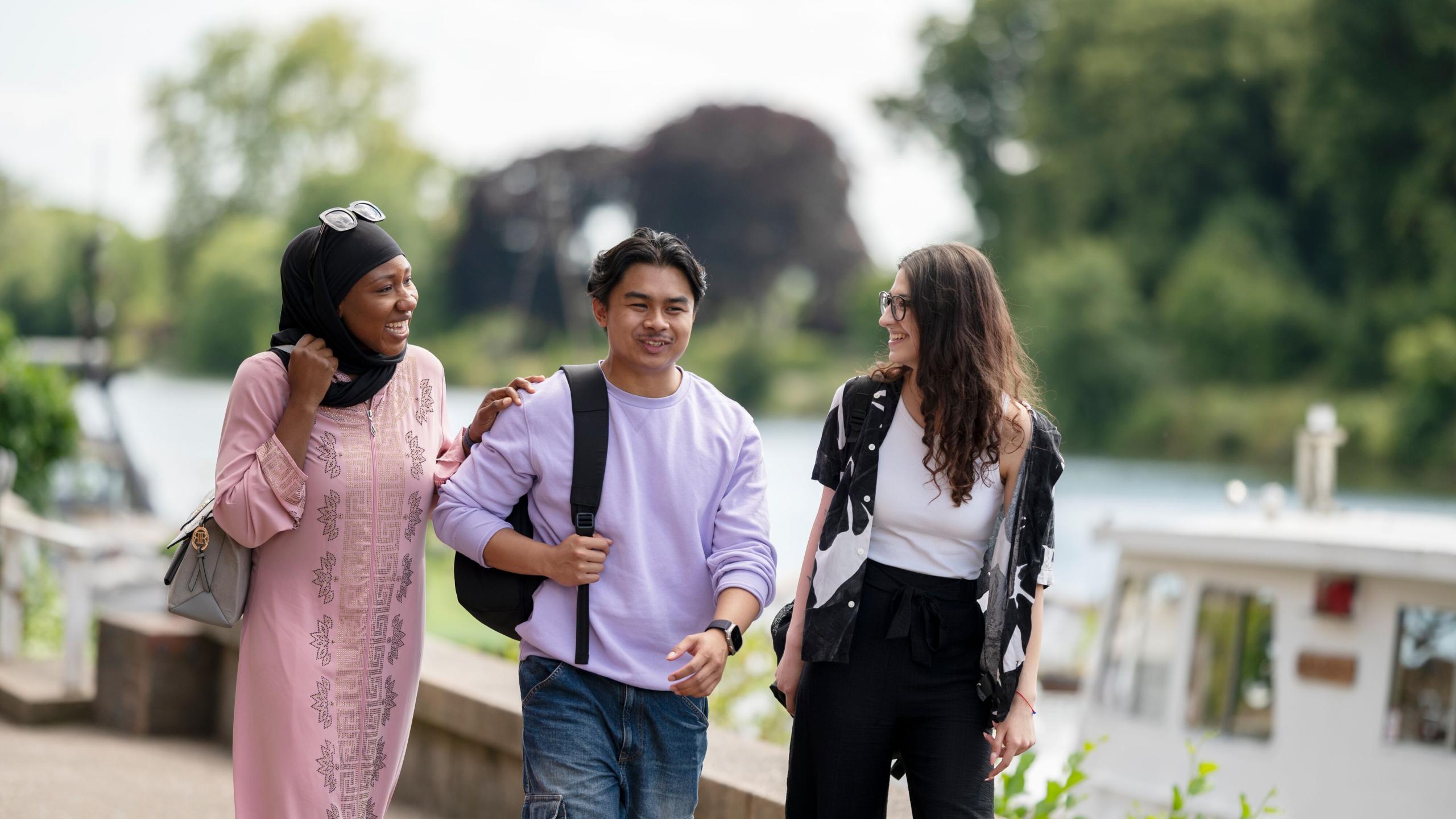
What career opportunities does this course offer?
You’ll complete this course fully equipped for a creative sector career in exhibitions and events. The programme will also give you the opportunity to showcase your work to fashion, art, media, broadcasting and publishing organisations.
Graduates from Kingston School of Art have gone on to work in organisations such as the Barbican, Foundling Museum, Hauser & Wirth, National Archives, Open-City, the London Transport Museum and the V&A Museum. Others have established their own consultancies and events companies, or even pursued careers in academia and research.
Future Skills
Our Future Skills programme is embedded within all our undergraduate courses and throughout the whole Kingston experience. These skills will help you to become a future-proof graduate by equipping you with the skills most valued by employers, such as problem-solving, digital competency and adaptability.
As you progress through your degree, you'll learn to navigate, explore and apply these graduate skills. You’ll also understand how to demonstrate and articulate to employers how these future skills give you the edge.

Teaching and assessment
Scheduled learning and teaching on this course includes timetabled activities including lectures, seminars and small group tutorials. It may also include critiques, project work, studio practice and performance, digital labs, workshops, and placements.
Outside the scheduled learning and teaching hours, you will learn independently through self-study which will involve reading articles and books, working on projects, undertaking research, preparing for and completing your work for assessments. Some independent study work may need to be completed on-campus, as you may need to access campus-based facilities such as studios and labs.
Our academic support team here at Kingston University provides help in a range of areas.
When you arrive, we'll introduce you to your personal tutor. This is the member of academic staff who will provide academic guidance, be a support throughout your time at Kingston and show you how to make the best use of all the help and resources that we offer at Kingston University.
A course is made up of modules, and each module is worth a number of credits. You must pass a given number of credits in order to achieve the award you registered on, for example 360 credits for a typical undergraduate course or 180 credits for a typical postgraduate course. The number of credits you need for your award is detailed in the programme specification which you can access from the link at the bottom of this page.
One credit equates to 10 hours of study. Therefore 120 credits across a year (typical for an undergraduate course) would equate to 1,200 notional hours. These hours are split into scheduled and guided. On this course, the percentage of that time that will be scheduled learning and teaching activities is shown below for each year of study. The remainder is made up of guided independent study.
- Year 1: 22% scheduled learning and teaching
- Year 2: 23% scheduled learning and teaching
- Year 3: 18% scheduled learning and teaching
The exact balance between scheduled learning and teaching and guided independent study will be informed by the modules you take.
Your course will primarily be delivered in person. It may include delivery of some activities online, either in real time or recorded.
Types of assessment
- Year 1: Coursework 100%
- Year 2: Coursework 80%; practical 20%
- Year 3: Coursework 80%; practical 20%
Please note: the above breakdowns are a guide calculated on core modules only. If your course includes optional modules, this breakdown may change to reflect the modules chosen.
We aim to provide feedback on assessments within 20 working days.
Your individualised timetable is normally available to students within 48 hours of enrolment. Whilst we make every effort to ensure timetables are as student-friendly as possible, scheduled learning and teaching can take place on any day of the week between 9am and 6pm. For undergraduate students, Wednesday afternoons are normally reserved for sports and cultural activities, but there may be occasions when this is not possible. Timetables for part-time students will depend on the modules selected.
Fees and funding
| Fee category | Annual Fee |
|---|---|
| Home (UK students) | £10,050* |
| International | |
| Year 1 (2027/28): | £To be confirmed |
| Year 2 (2028/29): | £To be confirmed |
| Year 3 (2029/30): | £To be confirmed |
The tuition fee you pay depends on whether you are assessed as a 'Home' (UK), 'Islands' or 'International' student.
For courses with Professional Placement, the fee for the placement year can be viewed in our Fees and Funding section. The placement fee published is for the relevant academic year stated in the table. This fee is subject to annual increases but will not increase by more than the fee caps as prescribed by the Office for Students or such other replacing body.
*For full-time programmes lasting more than one academic year, a tuition fee is payable for each academic year of the course.
Your annual tuition fee covers your first attempt at all modules required for that academic year. Any re-study or repeat of modules will incur additional charges, calculated according to the number of credits taken.
Home students (UK): Tuition fees are subject to inflation-linked increases in line with government policy. Updated fees will be confirmed in line with the maximum fee cap set by the Government or the Office for Students (OfS) for each academic year. This means your fee may increase for each academic year of study, but only up to the maximum amount permitted for that year.
Eligible UK students can apply to the Government for a tuition loan, which is paid direct to the University. This has a low interest-rate which is charged from the time the first part of the loan is paid to the University until you have repaid it.
International students: Full-time taught international student fees are subject to an annual increase, which is published in advance for the full duration of your programme.
| Fee category | Annual Fee |
|---|---|
| Home (UK students) | £9,790* |
| International | |
| Year 1 (2026/27): | £19,200 |
| Year 2 (2027/28): | £19,900 |
| Year 3 (2028/29): | £20,700 |
The tuition fee you pay depends on whether you are assessed as a 'Home' (UK), 'Islands' or 'International' student.
For courses with Professional Placement, the fee for the placement year can be viewed in our Fees and Funding section. The placement fee published is for the relevant academic year stated in the table. This fee is subject to annual increases but will not increase by more than the fee caps as prescribed by the Office for Students or such other replacing body.
*For full-time programmes lasting more than one academic year, a tuition fee is payable for each academic year of the course.
Your annual tuition fee covers your first attempt at all modules required for that academic year. Any re-study or repeat of modules will incur additional charges, calculated according to the number of credits taken.
Home students (UK): Tuition fees are subject to inflation-linked increases in line with government policy. Updated fees will be confirmed in line with the maximum fee cap set by the Government or the Office for Students (OfS) for each academic year. This means your fee may increase for each academic year of study, but only up to the maximum amount permitted for that year.
Eligible UK students can apply to the Government for a tuition loan, which is paid direct to the University. This has a low interest-rate which is charged from the time the first part of the loan is paid to the University until you have repaid it.
International students: Full-time taught international student fees are subject to an annual increase, which is published in advance for the full duration of your programme.
| Fee category | Annual Fee |
|---|---|
| Home (UK students) | £9,535* |
| International | |
| Year 1 (2025/26): | £18,500 |
| Year 2 (2026/27): | £19,200 |
| Year 3 (2027/28): | £19,900 |
The tuition fee you pay depends on whether you are assessed as a 'Home' (UK), 'Islands' or 'International' student. In 2025/26 the fees for this course are above.
For courses with Professional Placement, the fee for the placement year can be viewed in our Fees and Funding section. The placement fee published is for the relevant academic year stated in the table. This fee is subject to annual increases but will not increase by more than the fee caps as prescribed by the Office for Students or such other replacing body.
* For full-time programmes of a duration of more than one academic year, the published fee is an annual fee, payable each year, for the duration of the programme. Your annual tuition fees cover your first attempt at all of the modules necessary to complete that academic year. A re-study of any modules will incur additional charges calculated by the number of credits. Home tuition fees may be subject to annual increases but will not increase by more than the fee caps as prescribed by the Office for Students or such other replacing body. Full-time taught International fees are subject to an annual increase and are published in advance for the full duration of the programme.
Eligible UK students can apply to the Government for a tuition loan, which is paid direct to the University. This has a low interest-rate which is charged from the time the first part of the loan is paid to the University until you have repaid it.
Additional course costs
Some courses may require additional costs beyond tuition fees. When planning your studies, you’ll want to consider tuition fees, living costs, and any extra costs that might relate to your area of study.
Your tuition fees include costs for teaching, assessment and university facilities. So your access to libraries, shared IT resources and various student support services are all covered. Accommodation and general living expenses are not covered by these fees.
Where applicable, additional expenses for your course may include:
Our libraries have an extensive collection of books and journals, as well as open-access computers and laptops available to rent. However, you may want to buy your own computer or personal copies of key textbooks. Textbooks may range from £50 to £250 per year. And a personal computer can range from £100 to £3,000 depending on your course requirements.
While most coursework is submitted online, some modules may require printed copies. You may want to allocate up to £100 per year for hard-copies of your coursework. It’s worth noting that 3D printing is never compulsory. So if you choose to use our 3D printers, you’ll need to pay for the material. This ranges from 3p per gram to 40p per gram.
Kingston University will pay for all compulsory field trips. Fees for optional trips can range from £25 for local trips to various costs for international trips.
Your tuition fees don’t cover travel costs. To save on travel costs, you can use our intersite bus service. This route links the campuses and halls of residence with the local train stations, Surbiton, Kingston upon Thames, and Norbiton.
If you take part in external shows and exhibitions, you’ll need to cover your travel costs. These will vary according to the location.
Scholarships and bursaries
For students interested in studying this course at Kingston, there are several opportunities to seek funding support.

Course changes and regulations
The information on this page reflects the currently intended course structure and module details. To improve your student experience and the quality of your degree, we may review and change the material information of this course. Find out more about course changes
Programme Specifications for the course are published ahead of each academic year.
Regulations governing this course can be found on our website.