Psychology with Criminology BSc (Hons)
Subject and course type
- Law, criminal justice and criminology
- Psychology
- Undergraduate
Take your first steps to becoming a chartered psychologist with the Psychology with Criminology BSc (Hons) course from Kingston, accredited by the British Psychological Society (BPS). This means that graduates, with a minimum of a 2:2 from this course, are eligible to gain Graduate Basis for Chartered Membership (GBC) from the BPS.
You are reading:
Learn how studying the human mind and behaviour can help us understand crime
You will have a wealth of opportunities outside the classroom to further your learning and gain hands-on experience in your chosen field.
Our Psychology with Criminology BSc (Hons) course combines two complementary subjects, examining why crimes arise and how they affect individuals and society. As part of the course, you'll make use of our purpose-built laboratories with high-specification equipment (EEG, eye-tracking, a driving simulator, an observation lab for interviews and behavioural recordings and specialised cognitive and physiological testing).
After you graduate, you could take further training in forensic psychology, or pivot to another field of psychology that you want to work in. For example, clinical, counselling or educational psychology.
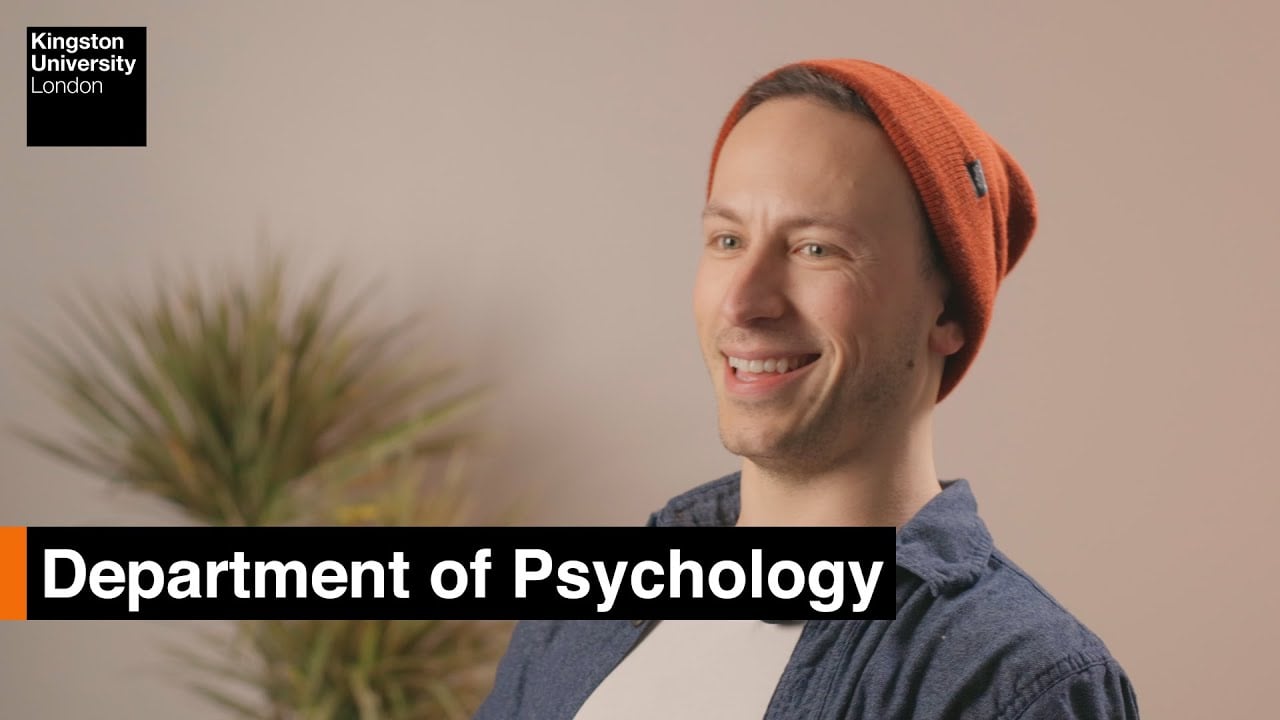
Psychology at Kingston University
Learn more about studying undergraduate psychology at Kingston University and hear from our students and staff.
The high level of the programme team's responsiveness to the student voice is commendable. A proactive approach is adopted to continually evaluate, develop and enhance the programmes based on student input.
Why choose this course
With Psychology with Criminology BSc (Hons), you'll tackle some of society's most pressing issues and discover how the fields of psychology and criminology can contribute to our understanding of these challenges. Most importantly, this course sets you on the path to find solutions to these issues and gives you knowledge and skills that you can apply in a variety of occupational roles.
During your studies, you'll explore key theories and ideas of psychological science and criminology. You'll gain a deeper insight into the human mind and behaviour and study how we respond to crime, criminal behaviour and victimisation. You'll find out why individuals offend, how their crimes affect society and how the criminal justice system operates.
Throughout the degree, you'll develop skills valued by employers, such as:
- teamwork
- communication
- time and task management skills
- statistical analysis of data
- problem-solving
- the ability to critically evaluate evidence.
Accreditation
This course is accredited by the British Psychological Society (BPS), which means that you could go on to become a Chartered Psychologist if that is your chosen career path. This is an ongoing accreditation.
Graduates, with a minimum of a 2:2 from this course, are eligible to gain Graduate Basis for Chartered Membership (GBC) from the BPS. This is a necessary first step towards becoming a Chartered Psychologist. You would then take further training in a specific field of psychology that you want to work in. This could then lead to a career as a Chartered Psychologist in your chosen field, for example forensic psychology.
Prepare for global impact
Kingston School of Law, Social and Behavioural Sciences offers courses in economics, law, psychology and criminology. Our degrees are underpinned by a vibrant research culture and delivered by a blend of practitioners and academics who are dedicated to equipping you with the employability skills to thrive in your career.
Course content
Please note: Optional modules only run if there is enough demand. If we have an insufficient number of students interested in an optional module, that module will not be offered for this course.
Foundation year - Social Sciences
If you would like to study this degree at Kingston University but are not yet ready to join the first year of a BSc (Hons) course, you may want to consider studying this course with a foundation year.
Year 1
In your first year you will acquire a broad foundation of knowledge around key theories and ideas of psychological science and criminology. You will begin to critically analyse historic perspectives and contemporary issues. You will be introduced to key strategies which are used in psychological research.
Core modules
30 credits
This module introduces you to the fascinating theories and ideas of psychological science across core research areas.
It provides a broad foundation of knowledge, encompassing both these core areas and many specialised sub-areas, including biological psychology, learning, sensory and perceptual processes, memory, thought and knowledge, language, social psychology, developmental psychology, neuropsychology, individual differences, and clinical psychology.
30 credits
This module will equip you with the essential skills for studying psychology, including reflective thinking, critical evaluation and effective collaboration.
We will look beyond traditional Eurocentric frameworks to explore diverse ways of constructing and sharing knowledge, gaining insight into indigenous and Eastern psychological traditions.
The module will examine key conceptual and historical paradigms, as well as major philosophical debates that have shaped psychology as a science. You will also study the impact of colonialism on psychological research and theory, providing a broader understanding of the field.
30.00 credits
This module is a core requirement for students taking psychology in level 4. The module will introduce you to key strategies which are used in psychological research, including designing an experiment, hypothesis testing, and statistical analysis. The main features of the module will involve the acquisition of practical skills in psychological research, learning how to apply and carry out statistical tests using SPSS, and how to report research findings.
Throughout the module you will learn how to design a research project, analyse data and report a psychological experiment.
30 credits
This module will introduce students to a range of theoretical perspectives and debates that inform criminology, and which underpin their learning throughout the criminology programme. Theories will be evaluated in relation to academic scholarship, empirical evidence, popularity and application in crime policy and practice, and in relation to their geographical, social, cultural, historical locations.
Students will learn about a changing and dynamic field of study, which has encompassed both positivistic and social analyses of crime and criminalisation. They will learn to evaluate criminological theory in relation to a range of intellectual movements. They will be encouraged to understand criminological theory in relation to shifts across allied subjects like sociology, gender studies, critical race studies, social policy, politics and psychology.
Year 2
In the second year, you will learn about policing and punishment. You will examine the relationship between brain function and our understanding of cognition and behaviour. You will explore current theory and practice that focuses on the person in psychology, whilst developing experimental research designs and delving further into inferential statistics.
Core modules
30 credits
In this module, you will gain a critical insight into key issues and controversies in the delivery of justice by the principal institutions of the criminal justice system: the police, prison, and probation services. You will explore the historical context in which these institutions developed and examine the main challenges they face in the 21st century.
Debates around policing will be situated within wider discussions of procedural and spatial justice, decolonisation, globalisation, and the role of the police in a diverse society. You will also engage with the prison and offender management services through a critical exploration of both theoretical perspectives and practical realities.
You will consider the logic of punishment and examine the range of penalties available – from fines and community sentences to restorative justice – while reflecting on how justice is conceptualised and delivered (or not delivered) in contemporary society. Particular attention will be paid to the changing place of the victim in criminal justice processes.
Through real-world learning opportunities and authentic assessments, developed in partnership with external organisations, you will connect criminological theory to practice and gain a deeper understanding of how justice is enacted in practice.
30.00 credits
This module builds on the introduction to research methods and inferential statistics offered in PS4001 Research Methods 1. It will cover more advanced research designs — involving multiple independent variables — and more advanced inferential statistics such as analysis of variance, regression analysis and factor analysis. It will also introduce students to qualitative research methods and data analysis. Students will learn to develop and implement multifactorial experimental designs through practical research exercises and a project. Students' scientific writing skills will be further developed on the basis of a series of lab reports.
30 credits
The module covers a broad range of key theories and empirical research in social and developmental psychology. You will study current theory and practice in psychology across range of topics that focuses on the person in psychology. We will explore the importance of culture, ethics, the scientific approach and the notion of measurement.
30 credits
This module covers major topics within the field of cognitive psychology and examines the relationship between brain function and our understanding of cognition and behaviour. You will be introduced to key theoretical explanations proposed to account for human cognition, alongside some real-life applications of cognitive psychology. You will study the structure and function of the nervous system before examining the contribution of specialised brain structures to cognitive functions such as perception, attention, language, memory and decision making, and behaviours such as motivation, eating, emotion and sleep. You will also learn about the effect of hormones, drugs and neurological dysfunction on cognition and behaviour.
Optional year
You have the option to take an additional year to study abroad or to undertake a year-long work placement overseas (or even a mix of both).
Professional placement year
This course has a professional placement option which takes place between Year 2 and your Final Year. During this professional placement year you will take a placement within a relevant setting, ensuring you gain essential experience to add to your CV and help you secure a graduate job.
Final year
In your final year, you will study a set of core modules, including a Psychology Research Project, which allows you to independently research a chosen topic. You will also explore personality and individual differences and examine global crime and justice. Alongside the core modules, you will choose one optional module, enabling you to tailor your studies to your own interests and aspirations.
Core modules
30.00 credits
This module provides the opportunity to study and employ different methodologies in psychology by evaluating the strengths and limitations of different research designs. Students will execute an empirical research project on a topic agreed in consultation with a Psychology staff supervisor. Supervisory sessions with an academic supervisor will guide students to conduct a literature review, formulate a research question, design a research study, and consider research ethics relating to their study, culminating in data collection and writing up of a research report which satisfies APA guidelines.
15 credits
This module examines contemporary perspectives on personality and individual differences, including theories of personality and intelligence, and the measurement of individual differences You will explore the concepts of equality, diversity, and inclusion, and discuss how psychologists can actively promote practices which embrace and value diversity and inclusion. You will review the practice of assessing individual differences in clinical, educational, and organisational contexts, considering ethical issues and the promotion of equality, diversity, and inclusion in these contexts.
30 credits
In this module, you'll explore key debates around crime, harm, and control within a global context. You’ll be encouraged to think critically about the dominance of the Global North in criminological discourse and engage with the call to decolonise criminology.
Through a comparative lens, you'll examine how crime and justice are defined, experienced, and addressed across different nations and regions. You'll explore both the convergences and divergences that emerge globally, developing an understanding of how local and global dimensions of crime are interconnected.
You'll interrogate the concept of global crime and explore its transnational nature by studying a wide range of substantive topics. These may include drug and human trafficking, terrorism and the 'war on terror', violence against women and girls, organised crime, environmental harm, genocide, and crimes against humanity.
15 credits
This module gives you a dedicated opportunity to develop your Future Skills Graduate Attributes.
At the start of the module, you will be supported to self-assess your current skills profile. You will determine which attributes and skills you need to develop to support your career ambitions. In this process, you will be supported by a dedicated career coach, helping you explore a range of options that includes self-employment/freelancing, starting your own business, higher level study, and other professional graduate-level opportunities. Throughout the module, you will be given opportunities to engage with external mentors, to support reflection and to develop a professional network.
You will undertake a tailored series of activities and projects, aligned to your goals, from a menu of development options. This could include short courses, enrichment activities and experiential learning options such as micro-placements. You will also be able to reflect on activities outside the University that develop your graduate attributes, such as work or volunteering.
Optional modules (choose one)
30.00 credits
This module will give a broad overview of the intersection between psychology and the criminal justice system. Forensic psychology is concerned with the psychological aspects of the legal process including police investigation and court procedures. Students will learn to apply psychological theory to criminal investigation, understand the psychological problems and developmental processes associated with criminal behaviour and victimisation. There will be an introduction to the assessment and treatment of those who have committed offences. The module will also give an insight into the training and career pathways for forensic psychologists.
30.00 credits
The module will engage students with the main themes of contemporary health psychology and positive psychology with a particular focus on theory, research, intervention, and application. The students will gain an understanding of the importance of psychological processes in the experience of health and illness, and explore the role of behaviour and emotion in current trends of mortality and morbidity. In addition, students will gain an understanding of the role of positive emotions, optimism, spirituality, flourishing relationships, and community engagement in promoting health, well-being, and happiness. They will also become aware of the crucial roles health psychology and positive psychology have to play in the development and evaluation of physical and psychological health promotion interventions.
30 credits
This module provides students with the opportunity to address workplace issues that can benefit from input by psychologists. Students will gain an appreciation of the challenges of applying psychological research and knowledge in workplace settings. Students will complete 40 hours of work experience, and apply psychological research findings and knowledge to their chosen context, under the supervision of a workplace supervisor. Students are required to reflect on their experiences in the workplace and examine how knowledge gained from their course can be used in their setting.
Discover the Department of Psychology
Hear from our academics as they talk about what it's like to study in the department.
International students: direct application
Are you an international student? Have you decided Kingston is the place for you? If so, you can apply for this course directly, rather than having to go through UCAS.

What career opportunities does this course offer?
After graduation, you'll be ideally-placed to pursue careers in crime prevention, criminal and youth justice, community development, local government, security, social research and the police.
However, our students obtain employment in a wide variety of settings. These range from:
- health and social occupations - such as care assistants and assistant psychologists
- commercial, professional and managerial jobs - such as events and media organiser, sales executive and recruitment.
- graduates have also entered clinical courses, teacher training, counselling courses and other postgraduate training.
Many of our graduates have continued their educational journey at Kingston University by joining one of our flagship MSc courses. These include MSc Clinical Applications of Psychology and the BPS-accredited MSc Forensic Psychology.
You will take part in an Assessment Centre Experience, providing the opportunity to experience the pathway to employment with tailored feedback:
- develop your understanding of the jobs market, including current trends and opportunities, different recruitment processes and how to identify relevant roles
- receive personalised feedback reports to help you to improve and progress
- access additional webinars on top tips, employer expectations and best practice
Future Skills
Our Future Skills programme is embedded within all our undergraduate courses and throughout the whole Kingston experience. These skills will help you to become a future-proof graduate by equipping you with the skills most valued by employers, such as problem-solving, digital competency and adaptability.
As you progress through your degree, you'll learn to navigate, explore and apply these graduate skills. You’ll also understand how to demonstrate and articulate to employers how these future skills give you the edge.

Teaching and assessment
Scheduled learning and teaching on this course includes timetabled activities including lectures, seminars and small group tutorials.
Outside the scheduled learning and teaching hours, you will learn independently through self-study which will involve reading articles and books, working on projects, undertaking research, preparing for and completing your work for assessments. Some independent study work may need to be completed on-campus, as you may need to access campus-based facilities such as studios and labs.
Our academic support team here at Kingston University provides help in a range of areas.
When you arrive, we'll introduce you to your personal tutor. This is the member of academic staff who will provide academic guidance, support you throughout your time at Kingston and show you how to make the best use of all the help and resources that we offer at Kingston University.
A course is made up of modules, and each module is worth a number of credits. You must pass a given number of credits in order to achieve the award you registered on, for example 360 credits for a typical undergraduate course or 180 credits for a typical postgraduate course. The number of credits you need for your award is detailed in the programme specification which you can access from the link at the bottom of this page.
One credit equates to 10 hours of study. Therefore 120 credits across a year (typical for an undergraduate course) would equate to 1,200 notional hours. These hours are split into scheduled and guided. On this course, the percentage of that time that will be scheduled learning and teaching activities is shown below for each year of study. The remainder is made up of guided independent study.
- Year 1: 23% scheduled learning and teaching
- Year 2: 23% scheduled learning and teaching
- Year 3: 27% scheduled learning and teaching
The exact balance between scheduled learning and teaching and guided independent study will be informed by the modules you take.
Your course will primarily be delivered in person. It may include delivery of some activities online, either in real time or recorded.
Types of assessment
- Year 1: Coursework 65%; practical 0%; exams 35%
- Year 2: Coursework 52%; practical 18%; exams 30%
- Year 3: Coursework 100%; practical 0%; exams 0%
Please note: the above breakdowns are a guide calculated on core modules only. If your course includes optional modules, this breakdown may change to reflect the modules chosen.
We aim to provide feedback to you on your assessments within 20 working days.
Your individualised timetable is normally available to students within 48 hours of enrolment. Whilst we make every effort to ensure timetables are as student friendly as possible, scheduled learning and teaching can take place on any day of the week between 9am and 6pm. For undergraduate students, Wednesday afternoons are normally reserved for sports and cultural activities, but there may be occasions when this is not possible. Timetables for part-time students will depend on the modules selected.
Fees and funding
| Fee category | Annual Fee |
|---|---|
| Home (UK students) | |
| £10,050* | |
| Foundation Year: | £10,050 |
| International | |
| Year 1 (2027/28): | £To be confirmed |
| Year 2 (2028/29): | £To be confirmed |
| Year 3 (2029/30): | £To be confirmed |
| Year 4 (2030/31): | £To be confirmed |
The tuition fee you pay depends on whether you are assessed as a 'Home' (UK), 'Islands' or 'International' student.
Please visit the Fees and Funding page for more information.
For courses with Professional Placement, the fee for the placement year can be viewed on the undergraduate fees table. The placement fee published is for the relevant academic year stated in the table. This fee is subject to annual increases but will not increase by more than the fee caps as prescribed by the Office for Students or such other replacing body.
*For full-time programmes lasting more than one academic year, a tuition fee is payable for each academic year of the course.
Your annual tuition fee covers your first attempt at all modules required for that academic year. Any re-study or repeat of modules will incur additional charges, calculated according to the number of credits taken.
Home students (UK): Tuition fees are subject to inflation-linked increases in line with government policy. Updated fees will be confirmed in line with the maximum fee cap set by the Government or the Office for Students (OfS) for each academic year. This means your fee may increase for each academic year of study, but only up to the maximum amount permitted for that year.
Eligible UK students can apply to the Government for a tuition loan, which is paid direct to the University. This has a low interest-rate which is charged from the time the first part of the loan is paid to the University until you have repaid it.
International students: Full-time taught international student fees are subject to an annual increase, which is published in advance for the full duration of your programme.
| Fee category | Annual Fee |
|---|---|
| Home (UK students) | |
| £9,790* | |
| Foundation Year: | £9,790 |
| International | |
| Year 1 (2026/27): | £19,200 |
| Year 2 (2027/28): | £19,900 |
| Year 3 (2028/29): | £20,700 |
| Year 4 (2029/30): | £21,500 |
The tuition fee you pay depends on whether you are assessed as a 'Home' (UK), 'Islands' or 'International' student.
Please visit the Fees and Funding page for more information.
For courses with Professional Placement, the fee for the placement year can be viewed on the undergraduate fees table. The placement fee published is for the relevant academic year stated in the table. This fee is subject to annual increases but will not increase by more than the fee caps as prescribed by the Office for Students or such other replacing body.
*For full-time programmes lasting more than one academic year, a tuition fee is payable for each academic year of the course.
Your annual tuition fee covers your first attempt at all modules required for that academic year. Any re-study or repeat of modules will incur additional charges, calculated according to the number of credits taken.
Home students (UK): Tuition fees are subject to inflation-linked increases in line with government policy. Updated fees will be confirmed in line with the maximum fee cap set by the Government or the Office for Students (OfS) for each academic year. This means your fee may increase for each academic year of study, but only up to the maximum amount permitted for that year.
Eligible UK students can apply to the Government for a tuition loan, which is paid direct to the University. This has a low interest-rate which is charged from the time the first part of the loan is paid to the University until you have repaid it.
International students: Full-time taught international student fees are subject to an annual increase, which is published in advance for the full duration of your programme.
| Fee category | Annual Fee |
|---|---|
| Home (UK students) | |
| £9,535* | |
| Foundation Year: | £9,535 |
| International | |
| Year 1 (2025/26): | £18,500 |
| Year 2 (2026/27): | £19,200 |
| Year 3 (2027/28): | £19,900 |
| Year 4 (2028/29): | £20,700 |
The tuition fee you pay depends on whether you are assessed as a 'Home' (UK), 'Islands' or 'International' student. In 2025/26 the fees for this course are above.
Please visit the Fees and Funding page for more information.
For courses with Professional Placement, the fee for the placement year can be viewed on the undergraduate fees table. The placement fee published is for the relevant academic year stated in the table. This fee is subject to annual increases but will not increase by more than the fee caps as prescribed by the Office for Students or such other replacing body.
* For full-time programmes of a duration of more than one academic year, the published fee is an annual fee, payable each year, for the duration of the programme. Your annual tuition fees cover your first attempt at all of the modules necessary to complete that academic year. A re-study of any modules will incur additional charges calculated by the number of credits. Home tuition fees may be subject to annual increases but will not increase by more than the fee caps as prescribed by the Office for Students or such other replacing body. Full-time taught International fees are subject to an annual increase and are published in advance for the full duration of the programme.
Eligible UK students can apply to the Government for a tuition loan, which is paid direct to the University. This has a low interest-rate which is charged from the time the first part of the loan is paid to the University until you have repaid it.
Additional course costs
Some courses may require additional costs beyond tuition fees. When planning your studies, you’ll want to consider tuition fees, living costs, and any extra costs that might relate to your area of study.
Your tuition fees include costs for teaching, assessment and university facilities. So your access to libraries, shared IT resources and various student support services are all covered. Accommodation and general living expenses are not covered by these fees.
Where applicable, additional expenses for your course may include:
Our libraries have an extensive collection of books and journals, as well as open-access computers and laptops available to rent. However, you may want to buy your own computer or personal copies of key textbooks. Textbooks may range from £50 to £250 per year. And a personal computer can range from £100 to £3,000 depending on your course requirements.
While most coursework is submitted online, some modules may require printed copies. You may want to allocate up to £100 per year for hard-copies of your coursework. It’s worth noting that 3D printing is never compulsory. So if you choose to use our 3D printers, you’ll need to pay for the material. This ranges from 3p per gram to 40p per gram.
Kingston University will pay for all compulsory field trips. Fees for optional trips can range from £30 to £350 per trip.
Your tuition fees don’t cover travel costs. To save on travel costs, you can use our intersite bus service. This route links the campuses and halls of residence with local train stations - Surbiton, Kingston upon Thames, and Norbiton.
Courses involving placements or direct work with vulnerable groups may require a DBS check or other security checks.
If you choose to do a placement year, travel costs will vary depending on your location. These costs could be up to £2,000.
Some courses may require professional memberships.
Scholarships and bursaries
For students interested in studying this course at Kingston, there are several opportunities to seek funding support.

Course changes and regulations
The information on this page reflects the currently intended course structure and module details. To improve your student experience and the quality of your degree, we may review and change the material information of this course. Find out more about course changes
Programme Specifications for the course are published ahead of each academic year.
Regulations governing this course can be found on our website.
Key information
The scrolling banner below displays some key factual data about this course (including different course combinations or delivery modes of this course where relevant).