Aerospace Engineering MEng/BEng (Hons)
- Engineering: aerospace, aviation and aircraft
- Undergraduate
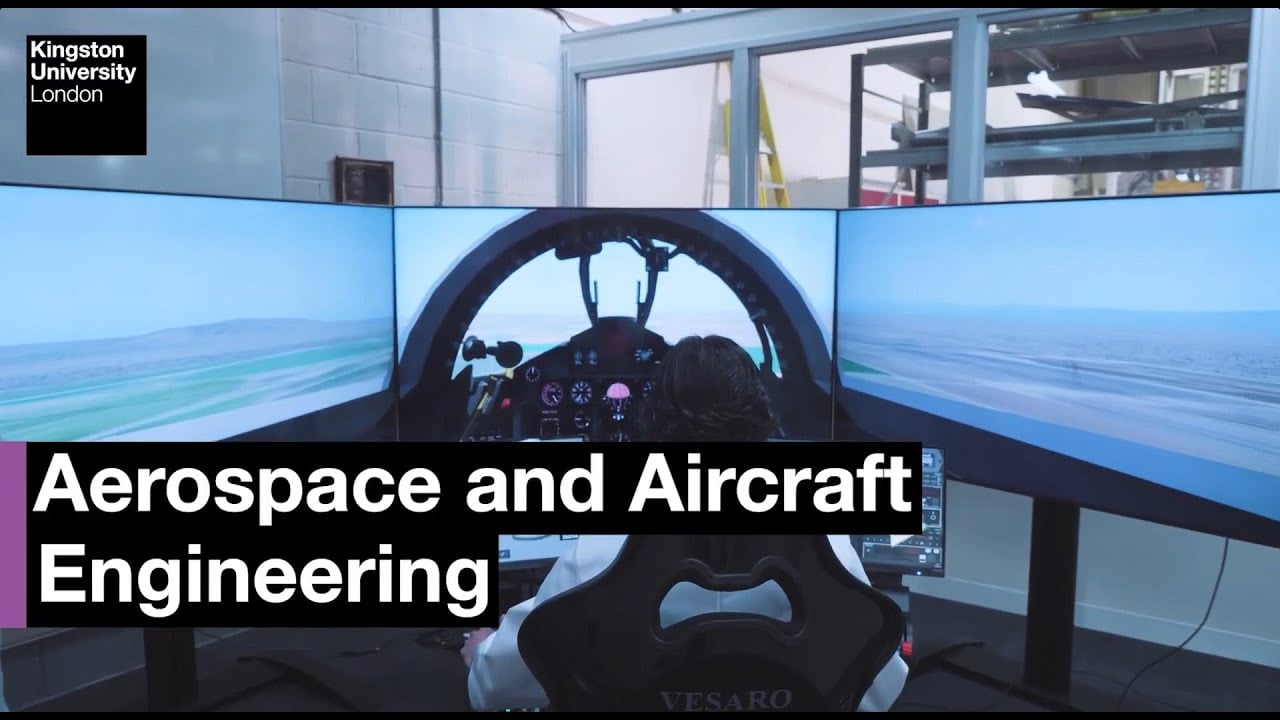
The Aerospace Engineering MEng/BEng (Hons) degree and Aerospace Engineering MEng/BEng (Hons) degree with Space Technology pathway from Kingston University are accredited by the Royal Aeronautical Society (RAeS), leading to chartered engineer (CEng) status. We are the only UK university with industry-standard flight simulators that include Airbus A320 Flight Simulator, Helicopter Simulator and Six-Degree of Freedom Motion Simulator.

Gain the skills and knowledge you need for an out-of-this-world career
Launch your career developing aircraft and spacecraft.
At our Roehampton Vale campus, you will have access to a modern environment with the latest technology, including:
- a fully-equipped rocket propulsion test lab for testing and firing of live rockets for data acquisition. You can fire rocket engines you have designed and constructed
- a fully-equipped manufacturing workshop where you can manufacture your rocket engine designs using the extensive range of equipment – including CNC machines
- 3D rapid prototype printer which enables you to print your computer-designed models for testing and evaluation
- industry-standard test and experimental equipment for metrology, robotics, fatigue and quality control
- state-of-the-art computing facilities for computer aided design (CAD) and other specialist software
- a mission control room equipped with high-performance PCs with tri-screen setup, for planning and operating space missions
- a flight simulator, where you can programme a mathematical model of your design into the simulator and then monitor the results
- large-scale wind tunnels that enable testing in winds of up to 90 miles per hour
- laser doppler anemometry system, which allows us to make very accurate velocity measurements in the wind tunnel.
You’ll learn both the theory and practical skills you need to succeed in your future career and put your knowledge to the test in a flight test course, onboard a flying laboratory aircraft. You’ll be employment-ready at graduation.
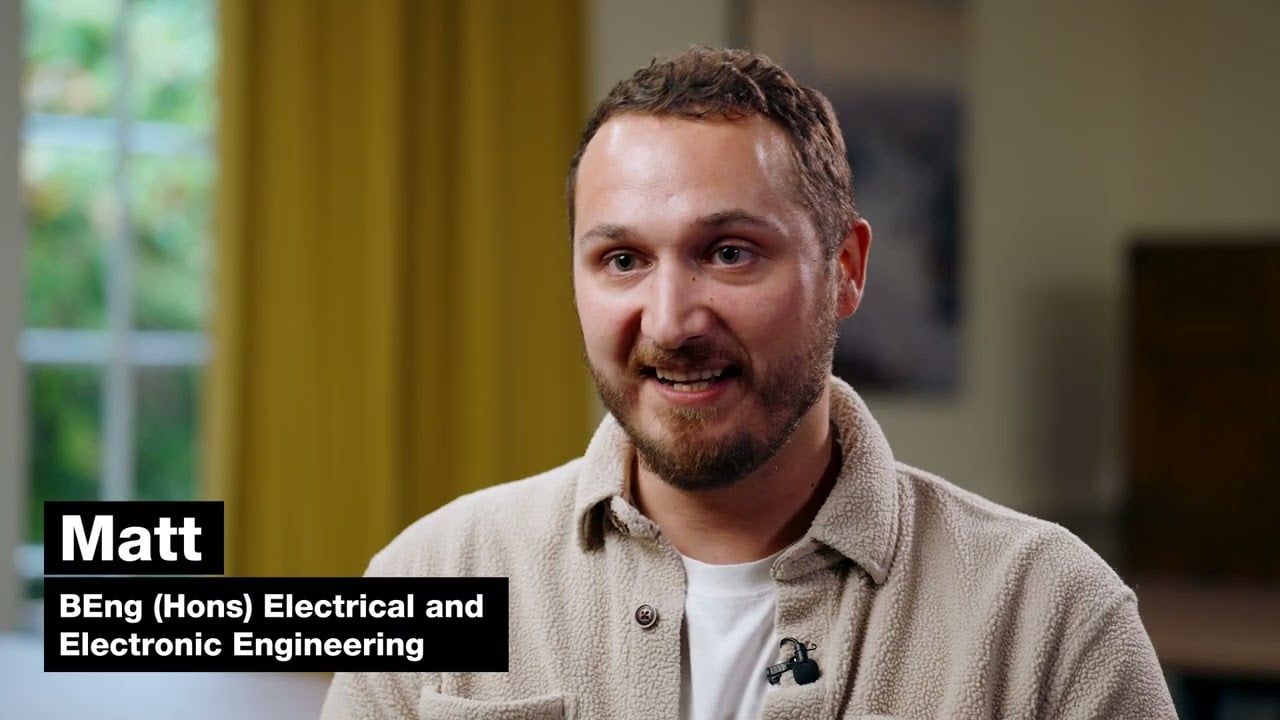
Engineering at Kingston University
Follow along as our students talk through the skills they're developing to design their future careers.
Why choose this course
If you dream of developing and engineering the aircraft and spacecraft that connects earth with space, our Aerospace Engineering MEng/BEng (Hons) degree could be the right launchpad.
This course has an innovative curriculum, excellent links with industry and cutting-edge facilities. As a result, Kingston is the perfect place to study aerodynamics, propulsion, structures, dynamics and materials.
Throughout the course, you'll put theory into practice by applying what you learn to aerospace design problems. You’ll also participate in a group design project to give you a chance to experience the development process in a work-like environment.
You can choose whether to take the BEng or MEng version of this course. The MEng has an extra year of study and can provide a faster route to chartered engineer (CEng) status. However, both courses provide the option to pursue an industrial placement, which can boost your employability even further. In addition, you can take our specialised Space Technology pathway, if you know that’s the area you want to work in after graduation.
Whatever you choose, employability is a key element of this programme. As a result, you'll enhance your skills throughout the course through industrial visits, placements, and extra-curricular activities. Students are also encouraged to take part in our Formula Student Competition, which involves designing and making a race car.
If you are studying in Sri Lanka, find out more on our page for country-specific information.
Accreditation
The Aerospace Engineering MEng course is accredited by the Royal Aeronautical Society and satisfies, in full, the academic requirements for Chartered Engineer (CEng) and Incorporated Engineer (IEng) registration.
The Aerospace Engineering BEng(Hons) course is accredited by the Royal Aeronautical Society and satisfies, in part, the academic requirements for Chartered Engineer (CEng) registration and in full, Incorporated Engineer (IEng) registration.
This course is undergoing routine renewal in 2024/25 academic year.


Course content
You can choose to take an optional professional placement year between Years 2 and 3 (BEng (Hons) and Year 3 (MEng only). MEng students have to study and earn 120 credits in Year 3 while taking their industrial placement using work-based learning by carrying out an industrial individual project as well as applied business and management analysis. They also need to study an aerospace engineering science module using a blended or distance-learning model (subject to RAeS accreditation).
The Space Technology pathway is the same as the standard programme for the first two years, but students are expected to work on a space-related project in the Engineering Project Management module at Level 5. In the final year, students must take Space Vehicle Design and work on a space-related individual project and group project.
Extended degree with a foundation year
If you would like to study one of our engineering degrees at Kingston University but are not yet ready for Year 1 of an undergraduate course, a foundation year is ideal. Please see the engineering foundation year course page for details.
Year 1
Year 1 provides an introduction to aerospace engineering under Professional Practice, and will underpin the skills and knowledge required for further specialised study. You will study a mix of analytical subjects, such as mathematics, structures, dynamics, electronics, thermodynamics and engineering applications, alongside an introduction to the profession of engineering.
Core modules
Aerospace Engineering BEng/MEng only: core module
Aerospace Engineering (Space Technology) BEng/MEng only: core module
Year 2
Year 2 will introduce you to specialised topics in aerospace engineering such as aerodynamics, propulsion, structures, dynamics and materials. It includes further study of mathematics, electronics, control and computing. A design-orientated module (Aerospace Engineering Design and Project Management) will apply the principles taught in the other modules to problems of aerospace design.
Core modules
Aerospace Engineering BEng/MEng only: core module
Aerospace Engineering (Space Technology) BEng/MEng only: core module
Year 3
In Year 3, you will deepen your knowledge of specialised aerospace engineering subjects and will broaden your expertise in other areas of engineering. BEng students undertake a major group design project and an individual research project along with business and management as well as further and more in depth studies of aerodynamics, propulsion, structure, materials and dynamics including applied computational techniques widely used in industry. MEng students have the opportunity of integrating industrial placement with further studies using a combination of work-based learning as well as blended and distance learning (subject to accreditation by RAeS).
Core modules
Aerospace Engineering BEng/MEng only: core module
Aerospace Engineering (Space Technology) BEng/MEng only: core module
Year 4
Year 4 of the MEng course includes a multidisciplinary group design project that helps to integrate and apply your academic knowledge, develop your teamworking and communication skills, and increase your understanding of real-world engineering issues.
Core modules
Aerospace Engineering MEng only: core module
Aerospace Engineering (Space Technology) MEng only: core module
My favourite module was design, because you get to build models, which is interesting. If you go and knock on their office doors and ask for help, the staff are always there and they don't turn anyone away. They are really helpful in that sense. Doing an industrial placement gives you that head start when you are searching for jobs.
Inside the Department of Aerospace and Aircraft Engineering
Hear from our students and academics as they share their experiences and talk about the facilities and opportunities available throughout your studies.
International students: direct application
Are you an international student? Have you decided Kingston is the place for you? If so, you can apply for this course directly, rather than having to go through UCAS.

What career opportunities does this course offer?
Graduates from this course have gone on to jobs with Boeing, BAE Systems, Qinetiq, Airbus, Lockheed Martin, AWE, Rolls-Royce, Thales, General Electric and British Airways. Many graduates go on to study at masters and doctoral level.
Types of graduate jobs include:
- Production engineer
- Repair engineer
- Applications engineer
- Contract loader
- Civil servant
- Telemetry and loads analysis engineer
- Bid manager
Our Aerospace Engineering BEng (Hons) course is accredited by the Royal Aeronautical Society for 2018 entry. It satisfies, in part, the academic requirements for Chartered Engineer (CEng) registration and, in full, Incorporated Engineer (IEng) registration.
Our Aerospace Engineering MEng course is accredited by the Royal Aeronautical Society for 2018 entry. It satisfies, in full, the academic requirements for Chartered Engineer (CEng) and Incorporated Engineer (IEng) registration.
Find out more about the full criteria and validity for Chartered Engineer (CEng) status and Incorporated Engineer (IEng) status.
This degree has been accredited by the Royal Aeronautical Society under licence from the UK regulator, the Engineering Council. Accreditation is a mark of assurance that the degree meets the standards set by the Engineering Council in the UK Standard for Professional Engineering Competence (UK-SPEC).
An accredited degree will provide you with some or all of the underpinning knowledge, understanding and skills for eventual registration as an Incorporated (IEng) or Chartered Engineer (CEng). Some employers recruit preferentially from accredited degrees, and an accredited degree is likely to be recognised by other countries that are signatories to international accords.
Please check the Engineering Council website for more information.
Future Skills
Our Future Skills programme is embedded within all our undergraduate courses and throughout the whole Kingston experience. These skills will help you to become a future-proof graduate by equipping you with the skills most valued by employers, such as problem-solving, digital competency and adaptability.
As you progress through your degree, you'll learn to navigate, explore and apply these graduate skills. You’ll also understand how to demonstrate and articulate to employers how these future skills give you the edge.

Teaching and assessment
Scheduled learning and teaching on this course includes timetabled activities including lectures, seminars and small group tutorials.
It may also include placements, project work, workshops, workshops in computer labs, and laboratory workshops.
Fees and funding
Scholarships and bursaries
For students interested in studying this course at Kingston, there are several opportunities to seek funding support.

Additional course costs
Some courses may require additional costs beyond tuition fees. When planning your studies, you’ll want to consider tuition fees, living costs, and any extra costs that might relate to your area of study.
Your tuition fees include costs for teaching, assessment and university facilities. So your access to libraries, shared IT resources and various student support services are all covered. Accommodation and general living expenses are not covered by these fees.
Where applicable, additional expenses for your course may include:
Course changes and regulations
The information on this page reflects the currently intended course structure and module details. To improve your student experience and the quality of your degree, we may review and change the material information of this course. Find out more about course changes
Specifications for this course are published ahead of each academic year.
Regulations governing this course can be found on our website.
What our students and graduates say
The placement year gave me an insight into industry and made me want to become an engineer even more. The University has such excellent connections that many students get very good placements. My time management skills have improved by working in a real life environment. I feel it has made me a much better student.
I'm just going into my final year of the MEng. I chose the option to do a professional placement year and did a placement at Airbus.
Kingston University stood out for me because of its state-of-the-art facilities. They have a hands-on approach coupled with the theory that engineers must learn to be successful.
With flexible machine labs and experienced technicians, I was able to spend all the time I needed working on my dissertation. My project was to design, develop and build a micro jet engine using design by analysis techniques. This meant I had to produce a preliminary design using turbine cycle analysis and from there produce a detailed CAD (computer aided design) model. Air flow simulations were then performed using the CFD (computational fluid dynamics) package, ANSYS CFX. The airflow characteristics were observed and from the results each main component was redesigned and optimised before manufacture to ensure the engine would work. The idea of using design by analysis came from my placement year at Airbus, where I worked within the simulation and modelling team for landing gear systems. Testing of the engine is planned for early next month.
What are the facilities like?
When you join Kingston University, you will have access to a wide range of facilities and resources designed to support your studies. Use the virtual tour below to explore some of the facilities and learning environments that students within this subject area may experience during their studies.











Key information
The scrolling banner below displays some key factual data about this course (including different course combinations or delivery modes of this course where relevant).